How to boil your egg perfectly every time

How to boil your egg perfectly every time – according to simulation

Search ‘how to boil an egg’ on Google, and you get over three billion results, some telling you to put the egg in cold water after boiling to preserve the runny yolk. Intrigued, we decided to investigate the science behind this advice.

Rather than heading straight to our lab for experimentation, we used computer simulation to calculate and model the movement of heat and temperature through the egg and surrounding fluid. Simulation lets us predict data at times that would be impractical or expensive in actual experiments.

Modeling the heat flow in a boiling egg could be a surprisingly tricky problem. An egg consists of a solid shell holding the white and yolk, initially in a liquid state but solidifying as the cooking continues. Being natural products, the exact properties and sizes of eggs vary.

To simplify the problem, we found technical publications that describe the average dimensions and thermal properties of the shell, white, and yolk for a typical egg. We decided to define these properties at a temperature of 60°C, which is around the point the yolk starts to solidify. Using computer-aided-design software, we created the geometry of the egg, and defined a body of fluid to surround it. This fluid body represents the boiling water in a saucepan during the first cooking stage. Afterward, the fluid body can be used to mimic cool-down in air or a bowl of 10°C cold water. We decided that the eggs would start the process from room temperature in all cases.

We ran the simulation using powerful software, Ansys Fluent. The software was initially developed for understanding problems such as the flow of air over planes or heat in a chemical plant, but it can be applied to domestic problems such as the humble boiled egg. To allow the simulation to run quickly on an ordinary computer, we took advantage of the fact an egg shape is a body-of-revolution and looks the same however it’s rotated around its axis. This lets us model it as an axisymmetric body that the computer considers two-dimensional. This reduces the number of calculations and gives us the answer quicker and more cheaply than simulating the real-life, three-dimensional shape.

As an example of the simulation results, Figure 1 shows the temperature distribution on a slice along the egg’s axis after cooking in boiling water for six minutes. The material towards the outside has heated up close to the temperature of the water. However, the central region corresponding to the yolk is still around 50°C, corresponding to a runny egg.

Figure 1: Temperature distribution on a slice across the egg after six minutes of immersion in boiling water.

Figure 2 shows a side-by-side comparison of subsequently cooling the egg in air or 10°C water for five minutes (five minutes being our estimate of the time it takes to finish eating our first dippy egg and move on to the second). When cooled in air, the central region of the egg continues to increase to 70°C, removing the prospect of a runny egg, even though the outer region and shell have decreased in temperature. In contrast, after cooling in water, the central region stays unchanged at 50°C while the shell has decreased close to 10°C. Leaving your perfect dippy egg in air risks ruining the runny yolk – but cooling it in water may save it.

Egg-article-in-line-image-fig-2-A
Egg-article-in-line-image-fig-2-B

Figure 2: Temperature distribution on a slice through the egg following cooking
and five minutes of cooling in (a) air and (b) water.

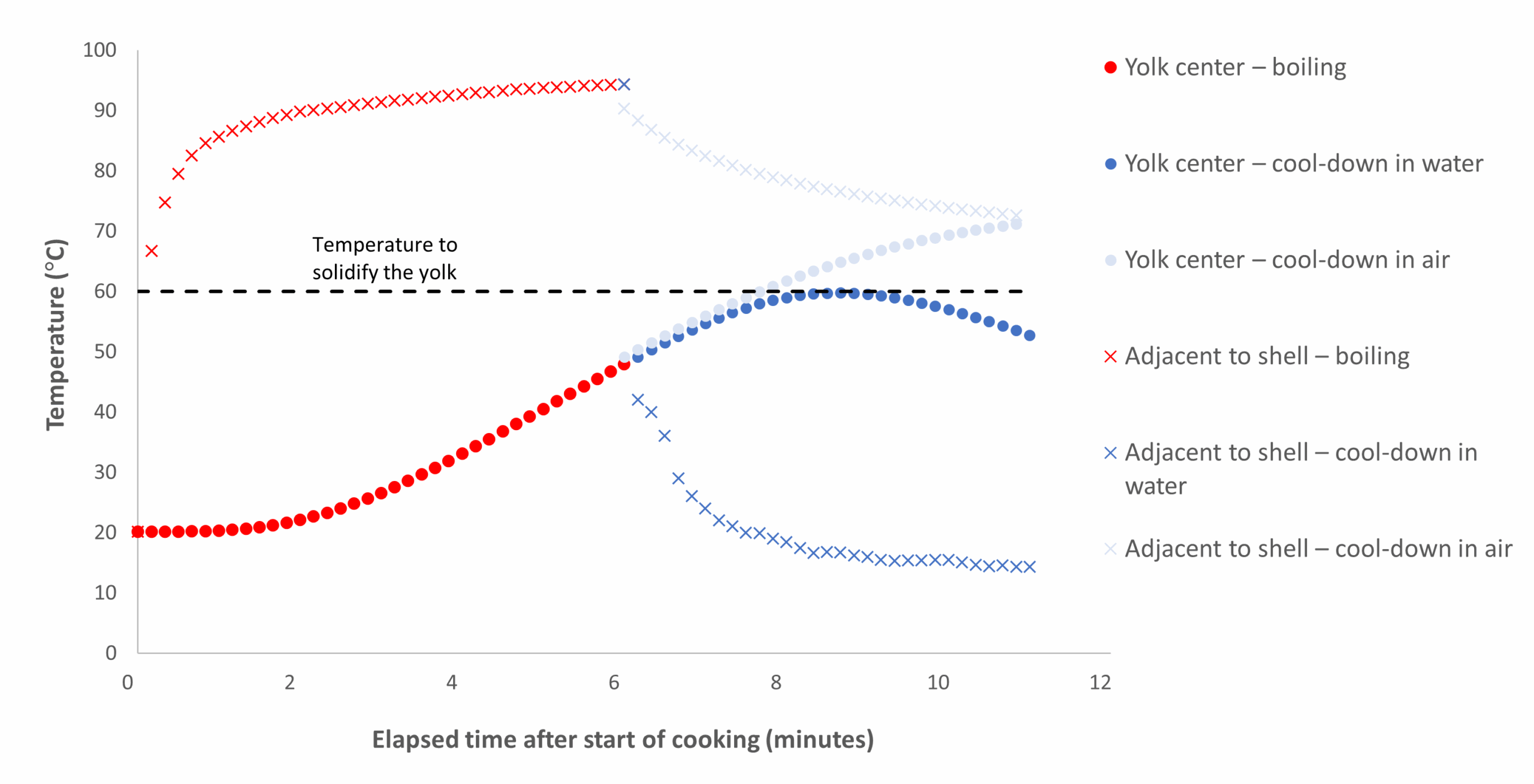
As well as modeling the overall temperature in the egg, we extracted the data for two specific points – at the center and the edge of the egg – and plotted them on a graph (Figure 3) to see how they differed. The data showed that the yolk’s temperature lags that at the shell. This is because the thermal diffusivity of the white and yolk are relatively low. Thermal diffusivity is a measure of how quickly heat can move through a material. So, it takes a while for the yolk to heat up, but once it does, it keeps cooking, absorbing heat from the rest of the egg material. It’s slow to respond to changes in the surrounding water (or air). The temperature just inside the shell responds much more quickly to changes, though, since the path the heat needs to travel from the surrounding fluid is considerably shorter, and the thermal diffusivity of the shell markedly higher.

How to boil your egg perfectly every time|||||||
Figure 3: Temperature profiles with time at the center point of the yolk (circles) and adjacent to the shell (crosses)

With the aid of some considered simplifications, we think this simulation analysis has proven the cookery expert right: cooling eggs down in cold water really does preserve the runny yolk. However, whenever you analyze a problem for the first time, it’s important to compare results against an experimental benchmark, so you can confirm the realism of the assumptions and simplifications in a computer simulation. We took three eggs and boiled each for six minutes in a lab beaker. One was opened straight away, and the other two after cooling in cold water or in air for five minutes. As predicted by our computer simulation, the yolks ranged from runny to fully cooked. And the best thing about this experiment? Everyone got an egg cooked precisely to their liking at the end.

Contact us to find out more about our capabilities and how we use science to understand and improve everyday products.


||||||||||||||||
Find the authors
on LinkedIn:

Reducing the carbon footprint and plastic waste of LFTs: Evidence-based opportunities

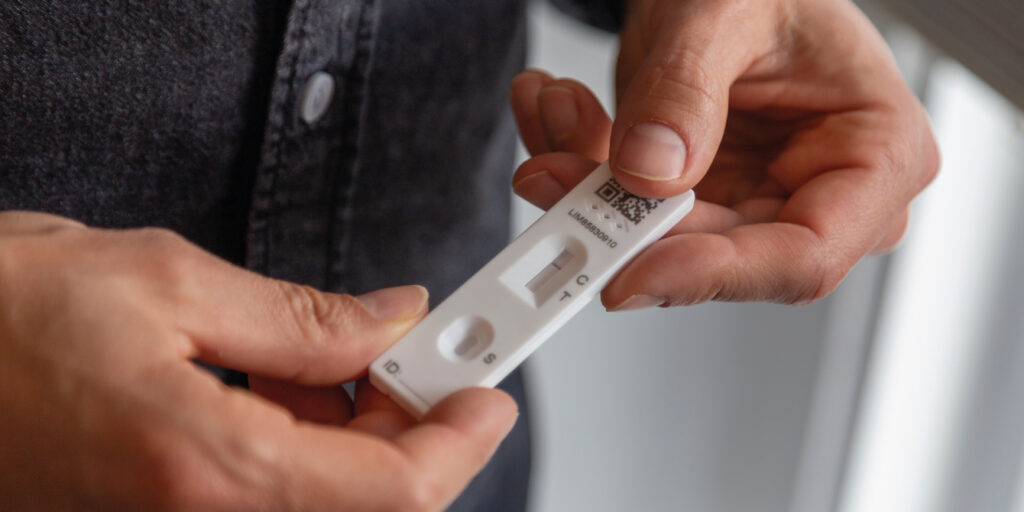
Billions of lateral flow tests have been used worldwide during the COVID-19 pandemic – over two billion have been provided in the UK alone. Debate has raged on social media about why the tests need to use so much single-use plastic and how they could be made more ‘sustainable’. The test strip caseworks is a particular source of dismay – why so much plastic to house such a tiny test strip?

With the UK government ending the free distribution of lateral flow tests for the general public – citing a transition from emergency response to longer-term management of the pandemic – now is the ideal time to look more closely at the sustainability of these lateral flow tests, and to seek the data to demystify some of the emotional assumptions being made.

Familiarity with lateral flow testing has certainly increased, as has confidence in their clinical performance. It’s expected that lateral flow devices will be more present in our daily lives post-pandemic – not just for COVID-19 and pregnancy testing but to diagnose diseases such as seasonal influenza and sexually transmitted infections – all from the comfort of the home.

We’ve carried out a high-level assessment to quantify the approximate environmental impact of lateral flow tests and identify evidence-based suggestions for improving their environmental sustainability.

Why do COVID-19 lateral flow tests contain lots of single-use plastic in the first place?

The emergence of COVID-19 was a global emergency, and vast quantities of lateral flow tests were needed urgently. Once developers could produce the right immunoassay chemistry to detect the virus (SARS-CoV-2), it required implementation in a low-cost, low-risk device, that has a mature supply chain – with proven, readily available materials that wouldn’t compromise analytical or clinical performance.

This meant using existing plastic casework designs to retain and protect the nitrocellulose test strip. Plastic is robust, low cost, lightweight, easy to transport, and easily printed for QR codes and LOT numbers. Critically, it’s a consistent material proven for the highest volume manufacturing and won’t interfere with the immunoassay chemistry.

From a performance, cost, and manufacturing perspective, redesigning the product with new materials would have been high risk. Material changes may also have needed significant R&D costs, new capital equipment as well as additional cost and effort needed to demonstrate equivalence and achieve regulatory approval – risking the ability to provide sufficient numbers of high-quality tests, at speed during the pandemic.

Our results: The sustainability of lateral flow tests

But how serious an environmental impact do these tests have? To find out, we broke down a test into its constituent components and weighed them to calculate the approximate environmental impact, using standard emissions factors to calculate the carbon footprint of a single test.

web_body_lateral-flow-test-kit-1

We focused on carbon footprint (the carbon dioxide and other greenhouse gases emitted during manufacture, transport, and disposal of the tests) and plastic waste (waste that would persist indefinitely if released into the environment) – the two issues that have attracted the most attention around lateral flow tests. A more comprehensive study should consider a broader range of environmental impacts, for example, the use of scarce resources and emission of other pollutants to avoid unintended consequences of any product changes.

Our results reveal:

  • The components needed to conduct the test account for around half of the carbon footprint and around two-thirds of the plastic waste. Packaging makes up most of the rest – as is often the case, a surprisingly high proportion of the total environmental impact
  • The test strip caseworks, which attracts the most comment online, is responsible for around 30% of the carbon footprint and 40% of the plastic waste. While it’s the most significant single contributor to the environmental impacts we evaluated, the large number of other small parts is also significant. Focusing on the caseworks therefore might not be the best strategy for improving the sustainability of the tests overall.
web_body_lateral-flow-test-analysis-1a-2
web_body_lateral-flow-test-analysis-1b-3

Lateral flow tests a minor piece of UK healthcare’s environmental impact

To put these numbers into context, we can compare the environmental impact of the two billion COVID-19 lateral flow tests distributed in the UK with the UK healthcare system’s overall environmental impact. We estimate the UK’s lateral flow tests have a carbon footprint equivalent to around 0.5% of the total NHS carbon footprint. This isn’t a trivial amount, but it’s also not the largest single contributor to the impact of the UK health system.

It’s also worth considering the positive environmental impact of a user-administered test on the health system. Conducting a test at home can eliminate the need for an individual to visit a test site, GP’s surgery, or hospital (assuming the clinical performance of the lateral flow test is adequate). Based on estimates from the Sustainable Healthcare Coalition, one lateral flow test has around 5% of the carbon footprint of a single GP appointment and produces a similarly low percentage of non-degradable (plastic) waste.

And that’s before we consider travel. We estimate one lateral flow test has the same carbon footprint as driving 350 metres in an average UK car. So, if you’re driving yourself to a test site or GP surgery some distance away, at-home lateral flow tests compare even more favorably.

If a lateral flow test prevents an individual from transmitting COVID-19 to a vulnerable person, there’s a public health benefit – as well as an environmental benefit – to keeping people out of the hospital. We can all see the discarded waste from home tests, but the less visible impact from energy- and material-intensive medical interventions is often significantly higher.

These approximate figures demonstrate why building an evidence base is vital during product development targeting sustainability objectives – because the results can be unexpected and non-intuitive.

Quick ways to optimize today’s lateral flow tests

Just because waste from lateral flow tests might not be the most urgent sustainability issue for UK healthcare, that doesn’t mean we can’t and shouldn’t do something about it.

We used the ‘avoid/shift/improve’ model to find potential quick wins for lateral flow tests. These reduce the carbon footprint of each test by nearly a third and the plastic waste by almost a quarter – without impacting the fundamentals of how the test works.

They include:

  • Eliminate waste bags. There’s a case for quickly isolating contaminated waste (even given COVID-19 also spreads from infected individuals through the air), but the bags account for around 5% of the carbon footprint of the test. It’s not clear how widely used they are in a domestic setting – there may be a risk-based justification for not including them in the test kit.
  • Package all the test strips in a single foil pouch. Using a single re-sealable pouch to protect the tests from ambient humidity (rather than individually packing each test in a pouch with desiccant) is common in packs of lateral flow tests designed for use by healthcare professionals. However, once opened, the stability lifetime of the remaining tests is affected.
  • Reduce the size of paper instructions. These are important for the effectiveness of the tests and are a regulatory requirement, but account for 5% of the carbon footprint of a test – could they be reduced in size?
  • Eliminate the cardboard sleeve. This packaging isn’t essential to the safe and effective functioning of the test, and it seems likely that the functions it does provide could be achieved with less material.
  • Prefill the extraction tubes with buffer solution. This is already done in some test kits, although manufacturers need to be conscious of moisture loss and the effect on shelf life. However, the separate plastic vial used in the test kit we studied accounts for around 5% of the carbon footprint and plastic waste.
  • Increase the size of the pack from seven to ten tests. This would mean less package waste per individual test. Including ten tests in one pack instead of seven reduces the carbon footprint by around 5% (depending on how many other optimizations are done at the same time). Perhaps a pack of seven tests was originally designed to cover a week of daily testing – but is that how tests are being used in practice?
web_body_lateral-flow-test-analysis-2

Redesign of the test strip caseworks

Looking to the longer-term gets us into product redesign – creating a new generation of the product with sustainability in mind. Doing this can take significant investment since, for medical devices, it’s likely to require new regulatory approval, which is a lengthy and costly process.

A popular idea circulating for lateral flow tests is to minimize the plastic test strip caseworks (without compromising the essential functions of providing a stable platform, and protecting the nitrocellulose test strip). It might be possible to halve the caseworks mass and reduce the overall carbon footprint and plastic waste by 15-20%. This would require significant investment in R&D, production tooling, and regulatory approval hoops to jump through – but could be worthwhile if future demand for tests stays high.

Longer-term options

If we consider that the world may require billions more lateral flow tests over the coming decade, a more comprehensive redesign becomes commercially viable. This could involve stripping the design back to the fundamental requirements for a lateral flow test – flowing a sample through the test strip in a way that is controlled and free from contamination. Current designs take advantage of established components to collect, buffer, and dose the sample – but, at this production volume, it may be worthwhile designing a system from the ground up that is optimized for cost, usability, performance, and sustainability.

Sustainability as a brand differentiator

It’s clear there’s scope to optimize lateral flow tests to reduce their environmental impact – and a systematic analysis reveals options beyond those that might jump out to someone when they use the tests. But it’s essential to put the impact of lateral flow tests in the context of the wider healthcare system, to focus resources where they can have the most environmental impact – and to recognize that, sometimes, the plastic waste people can see helps to avoid more serious, but less visible consequences.

On the other hand, while visible plastic waste from lateral flow tests may not be the most pressing environmental issue facing the healthcare industry, it highlights the growing influence consumer opinion is likely to have as diagnosis and treatment shift from hospitals to homes. And as lateral flow tests become (in the UK, at least) a product people buy with their own money, choosing from a range of options, there may be a competitive advantage for businesses that take note and optimize their products for sustainability.

Featuring analysis conducted by Katie Williams, Mechanical Engineer

References
  • Prime Minister sets out plan for living with COVID [Internet]. GOV.UK. 2022 [cited 1 April 2022]. Available from: https://www.gov.uk/government/news/prime-minister-sets-out-plan-for-living-with-covid
  • The Sustainable Healthcare Coalition. Care Pathways Calculator. [Internet]. Sustainable Healthcare Coalition. 2022 [cited 1 April 2022]. Available from: https://shcoalition.org/