LinkedIn

Breathing new life into clinical outcomes

The rise of connected devices and the variety of information they can generate is set to drive an increase in patient adherence to therapies. Our trials have shown that remote and hidden sensing of actual user behaviour can uncover unexpected and significant opportunities to improve the patient experience.

So how can connected technology help in the development stages of a new product, especially in a clinical environment? A recent study – Non-adherence: a direct influence on clinical trial duration and cost – by Moe Alsumidaie highlights the significant costs of non-adherence during pharmaceutical development. The study reported a 40% increase in patient enrolment to allow for non-adherence – adding an estimated $12m to the cost of a Phase 3 study.

We are also starting to see many medical device approvals in the connected space. MobileHealth reported 51 approvals in 2017 alone – the focus being on app-based patient management of disease, especially in the cardiac and diabetes sectors. There were only two respiratory-based systems reported – namely the connected spirometer GoSpiro and a new inhaler monitoring device for AstraZeneca’s Symbicort aerosol inhaler, dubbed the SmartTouch.

These solutions are enabling remarkable new capabilities for patients – and also for payers as we move towards outcomes-based healthcare. But are there steps that can be taken earlier in medical device development that can disrupt the whole process for the benefit of everyone?

What if we took a little bit of time to insert technology into products in either the clinical stage of drug development or early device design phases to understand how patients interact with the device and dosing regime? Two of the main methods to understand what has happened in a clinical investigation is to get patients to fill in a diary during their study and, on return, count the number of doses taken from the inhaler or capsule pack. Not quite 21st century.

Maybe, in the near future, clinical plans will include more advanced technology to enable a more accurate understanding of the efficacy of a new drug in development – was that poor resultant FEV1 clinical endpoint really due to the drug or was it because the patient simply forgot to prime the device and inhaled nothing but fresh air? Being able to unpick the actual usage data, so that these distinctions can be accurately made, could potentially help all stakeholders to better understand what the patient actually did and hence clarify where the subsequent opportunity to improve patient outcome actually lies – be it drug, device or training/education. In essence, it’s about using technology to guide design and development so that the appropriate solution is selected.

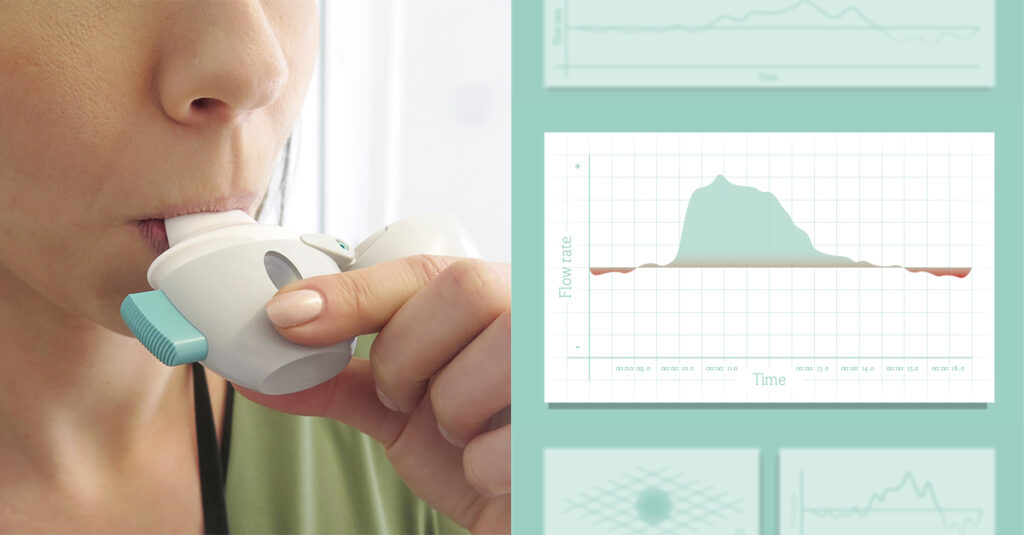
Here at CDP we wanted to go further and challenge ourselves to capture some very specific usage data for inhalation, whilst avoiding the Hawthorne effect and without changing the external form factor, thereby minimising any influence on user behaviour. It is common knowledge that all inhalers have associated use errors, so we took a commercially available one that has documented use errors and inserted miniature sensors that would enable both real-time indication and post-usage remote assessment of those use errors – namely priming action, orientation of use and inhalation/exhalation profile. We enabled the data to be time stamped and communicated to an appropriate output, in this case on-screen graphical readouts.

Behind this is the need to understand the volume of specific use data that gets logged and learn how to translate and classify the events represented as peaks and troughs on a graph. At CDP we have a wealth of experience of doing this across several sectors including sports and packaging systems.

If you’re looking for a breath of fresh air in your next respiratory drug delivery development, get in touch via hello@cambridge-design.co.uk or visit us at the RDD 2018 event in Arizona, 22-26 April on exhibit table 6.
CDP and ECCO - Step Forward

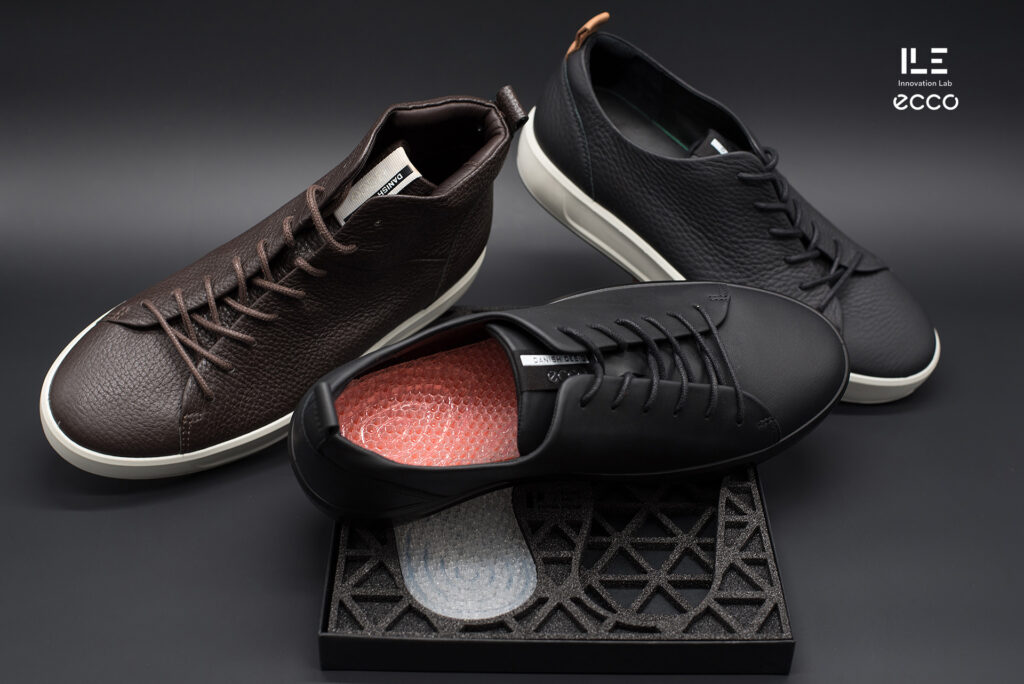
A unique step forward – wearable sensor breakthrough from CDP and ECCO heralds a new era of customisation

14 March 2018 – Technology and product design firm Cambridge Design Partnership (CDP) has worked with leading shoe brand ECCO on a breakthrough in data-driven customised footwear. It opens the door to a new generation of customised footwear for the mass market – heralding an evolution in engineered comfort. Consumers will get a full digital analysis of their foot structure and the way they move in just a few minutes – and shoes will be tailored to their specific requirements in just a few hours.

The QUANT-U (‘quantified you’) project will have an initial public release at W-21 Amsterdam –  ECCO’s concept shoe store – in April. A key element is the wearable sensor embedded in the soles of the test shoes. It collects a multitude of data using gyroscopes, pressure sensors and accelerometers – as well as the temperature and humidity inside each shoe – to create a unique digital footprint. This data is autonomously translated into geometries for in-store 3D printing of shoes based on each individual’s biomechanical and orthotic parameters.

“The biggest challenge was the fact that the sensors are very close to the ground, hidden inside shoes and covered by a human body – yet they need to send data from both shoes simultaneously to a connected device such as a mobile phone,” said Roberto Basile, a software engineer at CDP. “We needed to maintain reliable communication – using Bluetooth Low Energy – despite the human body acting as an obstacle to the wireless signals. The mechanical system inside the sensor had to be robust enough for people to walk on it, while the battery had to be small and last at least three days without being recharged.”

The first prototype of the wearable sensor was created by CDP and ECCO in less than four months. The inbuilt algorithm filters the raw biomechanical data from the sensor into functional information. This data creates the input parameters for a 3D-printed customised midsole for individual customers in approximately two hours. For the QUANT-U pilot, the customised midsole will be paired with ECCO’s iconic Flexure shoe.

“Throughout my experience in footwear design and engineering, the concept of perfect fit, perfect dynamics and ultimate performance has long been an obsession,” said Patrizio Carlucci, head of ILE (Innovation Lab ECCO). “With QUANT-U we are now combining future technologies in order to augment footwear functionality without interfering with its aesthetics.”

ENDS

Notes for editors

Cambridge Design Partnership is a technology and product design partner focused on helping clients grow their businesses. Some of the world’s largest companies trust CDP to develop their most important innovations. Located in both Cambridge (UK) and in Palo Alto, California (US), CDP specialises in the consumer products, healthcare, energy and industrial equipment markets. Its multidisciplinary staff have the expert knowledge to identify opportunities and tackle the challenges its clients face. For more information, visit: www.cambridge-design.co.uk

Founded by shoemaker Karl Toosbuy in Denmark in 1963, ECCO footwear has since grown into a global brand with factories and retailers across the world. ECCO manages the entire manufacturing process from start to finish – ECCO designers develop the collections, ECCO-owned tanneries produce the leather and ECCO-owned factories make the shoes sold across the world. ECCO, from the very beginning, has fused together premium raw materials with dynamic comfort platforms to produce an unparalleled wearing experience for its consumer. For more information, visit: www.ecco.com

ILE is ECCO’s independent cross-disciplinary design studio. ILE explores, creates and delivers projects embracing alternative production methods, advanced materials, new technologies and experiential solutions in footwear. Results of the work can be found via limited edition collections at the experimental shoe store W-21 Amsterdam.

For further information, contact:

Cambridge Design Partnership
Marketing Team
+44 (0)1223 264428
marketing@cambridge-design.co.uk

ECCO
Teo Pazanin
Research and Communication at ILE
+31 6 38 68 55 67
tepa@ecco.com

Jessica Paulus
Strategist and Communication at ILE
+49 1 51 68 12 04 81
jepa@ecco.com

General inquiries
info@Quant-u.com

MainImageResized

WORLD-CLASS INSPIRATION Launch of new Pyrex range of cookware designed by CDP and International Cookware

28 February 2018 – Technology and product design firm Cambridge Design Partnership (CDP) has joined forces with International Cookware to help shape a new generation of Pyrex dish designs that can take centre stage on the table. The new Inspiration ovenware range pushes the boundaries of material and manufacturing technology, with aesthetic influence drawn from traditional handcrafted finishes and bold geometric detailing.

It’s the second successful design collaboration between the two companies – following on from the launch of the centenary Pyrex ovenware range Optimum in 2015. Pyrex is renowned as a pioneer in premium glass cookware. But recent research highlighted that the very qualities which made the brand so dependable in the kitchen – functionality, practicality and resilience – were discouraging customers from presenting the cookware on the dining table.

The collaborative research uncovered crucial insight which offered a new perspective on the functional and aesthetic design. The new range also had to deliver consumer value and appeal across a variety of sizes, while adhering to challenging industrial borosilicate glass manufacturing requirements.

“The result is an addition to Pyrex’s market-leading range of products that can take centre stage on any dinner table,” said Ben Strutt, a partner at CDP. “Presentation of food is central to the dining experience and the ideologies of being a good host – and the Inspiration range delivers new levels of beauty and refinement without sacrificing legendary Pyrex performance and durability.

“From front-end consumer research through to industrial design and design for manufacturing, our comprehensive understanding of the whole process enabled us to propose credible design concepts which helped Pyrex push the boundaries of what is possible with the material. We are uniquely placed to tackle this kind of challenge as we can draw on expertise from different disciplines, as well as our experience of working within very specific client marketing and manufacturing requirements.”

The research for the new range highlighted an opportunity for an ‘occasional’ piece of cookware that combined practicality and style, would not look out of place with personal crockery set choices, and would support a range of food types and occasions. Ease of cleaning was critical, as was the depth of the cookware to prevent food overflowing in the oven.

“The design of the handles – often utilitarian in nature – required a fundamentally different approach to meet the aspirational project objectives,” said Ben. “The final design has integrated handles that blend into the sides of the dish, appearing as attractive features when not in use.” The new design is manufactured in tempered borosilicate glass, which can withstand temperature variations of up to 220°C – so the Inspiration range can go straight from the fridge to the oven.

“Working with CDP has helped us balance the complex list of demands and create an attractive new range of cookware that is equally at home on the table or in the oven,” said Xavier Frappier, senior product manager at Pyrex licensee International Cookware. “The new Inspiration range combines traditional values with cutting-edge manufacturing and design to give our customers the very best in elegant but practical cookware for any occasion.”


Notes for editors

Cambridge Design Partnership is a technology and product design partner focused on helping clients grow their businesses. Some of the world’s largest companies trust CDP to develop their most important innovations. Located in both Cambridge (UK) and in Palo Alto, California (US), CDP specialises in the consumer products, healthcare, energy and industrial equipment markets. Its multidisciplinary staff have the expert knowledge to identify opportunities and tackle the challenges its clients face. For more information, visit: www.cambridge-design.co.uk

Pyrex is a trademark of Corning Incorporated, used under licence by International Cookware. The iconic cookware brand has offered families new ideas to help prepare, cook and serve at the table since 1915. Combining tradition and innovation, the brand now includes a wide range of cookware, available in several materials, shapes, designs and colours. International Cookware has its own borosilicate glass manufacturing plant in Châteauroux, France, and employs more than 500 people. For more information, visit: www.pyrex.eu

For further information, contact the marketing team:
+44 (0)1223 264428
marketing@cambridge-design.co.uk

TOP DESIGN HONOUR

TOP DESIGN HONOUR – CDP wins a prestigious Good Design award for innovative product design

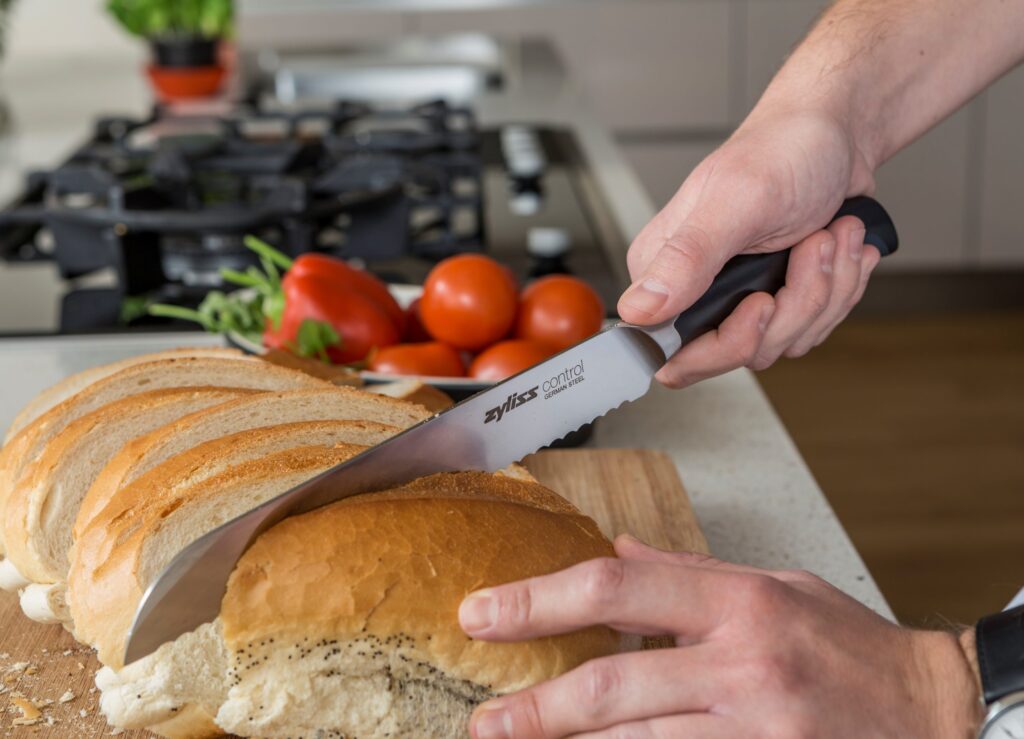
12 February 2018 – Technology and product design firm Cambridge Design Partnership (CDP) has been awarded one of the top honours in the design world. It has won a Good Design award for its work with DKB Household on the Zyliss Control knife range – a breakthrough in knife design that improves the user experience and reduces the spread of bacteria.

The prestigious Good Design awards aim to recognise the most innovative and cutting-edge industrial, product and graphic designs produced around the world. They are run by The Chicago Athenaeum Museum of Architecture and Design, in co-operation with the European Centre for Architecture, Art, Design and Urban Studies. The organisers say the emphasis is on quality design of the highest form, function and aesthetics – a standard beyond ordinary consumer products and graphics.

“Since 1950, Good Design has become an internationally acknowledged benchmark and symbol of outstanding design that serves as a beacon for design-interested audiences in our global economies,” said Christian Narkiewicz-Laine, museum president at The Chicago Athenaeum.

Challenging convention, the Zyliss Control knives were designed to meet the needs of the consumer – not just the professional chef. They were the result of extensive consumer-focused research into how people actually use kitchen knives in their home, as well as their concerns and aspirations. The research was conducted by a multidisciplinary CDP team, using the powerful ‘jobs-to-be-done’ innovation perspective to provide a solid evidence base for inclusion of a range of functional knife and storage attributes.

The knives support many different grip styles comfortably and have a unique indentation on top of the blade to give more confidence and control for detailed preparation work. They are manufactured from high-grade German stainless steel and feature antibacterial agents in the handle which kill 99.9% of all germs. They are also dishwasher safe – and the range includes two sizes of wood storage blocks, both featuring antibacterial removable sheaths that are also dishwasher safe.

“This Good Design award is a fantastic endorsement of the unique skills of our world-class team,” said Andrew Wynne, senior design consultant at CDP. “We know our clients appreciate those skills – as three-quarters of our new clients last year came from recommendations. But it is an honour to also have this prestigious independent recognition of our design expertise. Our approach combines front-end consumer research with the very latest technology. In the case of the Zyliss Control knives, this enabled us to prioritise user needs in the product’s design – completely differentiating the Zyliss brand from others in the marketplace.”

Notes for editors
Cambridge Design Partnership is a technology and product design partner focused on helping clients grow their businesses. Some of the world’s largest companies trust CDP to develop their most important innovations. Located in both Cambridge (UK) and in Palo Alto, California (US), CDP specialises in the consumer products, healthcare, energy and industrial equipment markets. Its multidisciplinary staff have the expert knowledge to identify opportunities and tackle the challenges its clients face. For more information, visit: www.cambridge-design.co.uk

For further information, contact the marketing team:
+44 (0)1223 264428
marketing@cambridge-design.co.uk

Patient-friendly packaging with intuitive design and an injection of fun, CDP takes a fresh look at pharma packaging

Technology and product design firm Cambridge Design Partnership (CDP) has unveiled a new approach to pharmaceutical packaging. An intuitive design coupled with an injection of fun has resulted in a single-use medicine pouch that is a world away from traditional pharmaceutical packaging.

The BeeBetter pouch is easy to use – the patient simply pushes on the childproof mouthpiece, which then pops up ready for use. The correct amount of medication is dispensed as the user squeezes the pack and sucks on the mouthpiece. And there’s a sweet surprise at the end – in the form of a spoonful of honey – to encourage the patient to finish the whole dose.

The concept has been designed to demonstrate how putting the patient at the centre of packaging design can transform the user’s experience. Once opened, the BeeBetter could be given to a child to hold and operate themselves – safe in the knowledge that they are getting the correct amount of medication. And the honey acts as an incentive for the child to finish the dose – once the top section of the foil pouch is empty, the user’s sucking action breaks the frangible seal inside separating the honey at the bottom from the rest of the contents.

“We wanted to challenge the misconception that children’s medicine needs to come out of a bottle and involve a measuring spoon or plastic syringe and an unpleasant experience for a child who is already not feeling great,” said Bastiaan de Leeuw, head of drug delivery business development at CDP. “So we decided to look at the problem from the child’s perspective and design packaging that is not only easy to use but also has a fun element.”

The innovative design of the BeeBetter could, for example, benefit elderly patients who struggle with traditional medicine bottles – and particularly those with memory problems, as it would make it easier to keep track of each dose. Even younger adults could find it useful – when travelling, for example, as it would be more convenient than carrying a whole bottle of cough medicine and risking it leaking. The packaging idea could also have a variety of non-medical applications – ranging from energy gels for cyclists to a replacement for the ketchup sachets that spill everywhere.

The CDP team will be demonstrating the BeeBetter concept – along with other innovations such as its diialog user insight service and Klarus drug delivery system – at the Pharmapack event, 7-8 February, at the Paris Expo, stand D55.

Notes for editors

Cambridge Design Partnership is a technology and product design partner focused on helping clients grow their businesses. Some of the world’s largest companies trust CDP to develop their most important innovations. Located in both Cambridge (UK) and in Palo Alto, California (US), CDP specialises in the consumer products, healthcare, energy and industrial equipment markets. Its multidisciplinary staff have the expert knowledge to identify opportunities and tackle the challenges its clients face. For more information, visit: www.cambridge-design.co.uk

For further information, contact the marketing team:
+44 (0)1223 264428
marketing@cambridge-design.co.uk

OLYMPUS DIGITAL CAMERA

THE WHOLE TRUTH Miniaturised technology from CDP uncovers the secrets of the perfect toothbrush

25 January 2018 – Innovation from technology and product design firm Cambridge Design Partnership (CDP) is set to transform mass-market toothbrush design. The ‘TruthBrush’ technology turns the humble manual toothbrush into a sophisticated monitoring device that can capture a variety of information about how people are actually brushing their teeth.

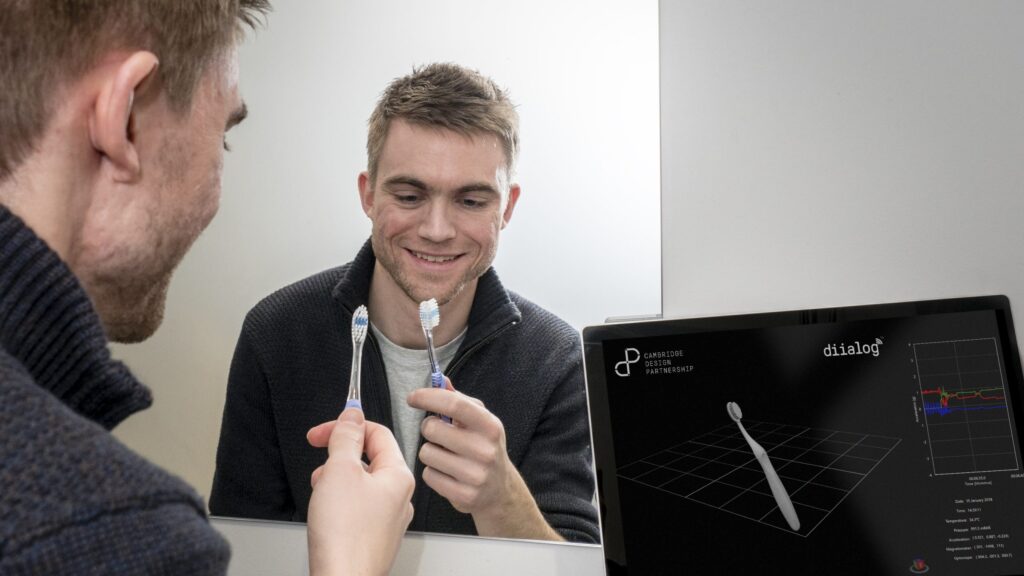
Using miniaturised sensor technology, coupled with sophisticated algorithms, the TruthBrush can reveal information ranging from how long someone spends brushing their teeth and at what times of day through to technique data, such as the ratio of time spent cleaning the top versus the bottom teeth.

This information is already becoming available in the electric toothbrush market – via smart apps connecting to the electronics already present in an electric brush. But developing an electric toothbrush is an expensive process, the information gathered is only partially relevant to manual toothbrush users – and the vast majority of consumers, particularly those in the developing world, still use manual toothbrushes.

What’s different about the TruthBrush is that it makes it possible for any toothbrush company to gather that same data at a fraction of the cost – and use the information to bring innovation to every bathroom at an affordable price. It could mean, for example, a better toothbrush handle for elderly people struggling with dexterity issues – or a brush that lights up and buzzes when a child has brushed their teeth for the required amount of time.

“This is primarily a service to help clients work out where innovation opportunities lie,” said George Bostock, oral care leader at CDP. “It’s a practical alternative to investing millions of pounds developing a fully connected brush with a whole host of features that consumers don’t actually need or want. A manual toothbrush in the right hands is as good as an expensive electric toothbrush. The challenge is getting people to clean their teeth properly with whatever device they use.”

The TruthBrush highlights how people are using even a basic manual toothbrush – and gives food for thought when it comes to improvements in design. It might be that a twisted handle shape – or a different neck design – could make it easier to clean the difficult-to-reach teeth at the back of the mouth, for example.

“The oral care environment is incredibly complex,” said George. “Even the most basic toothbrush usually has 500+ bristles, and everyone brushes their teeth slightly differently – so mathematically modelling how bristles move around the mouth is very difficult. Add to that the fact that the substance you are trying to remove – plaque – is a biosystem of different components, all clinging to your teeth, so it’s not just a simple question of how much force you need to use to remove it. This complexity makes it hard to validate test methods – whereas the TruthBrush can uncover vital information from behind the bathroom door, without affecting the consumer’s daily routine.”

The TruthBrush uses CDP’s unique user insight service diialog™, which translates a stream of data from miniature sensors into valuable information to help clients make more informed investment decisions. As diialog uses the latest in ultra-low-cost sensors, it means the size of user trials can far exceed those of established ethnographic methods.

The CDP team will be demonstrating the TruthBrush technology – along with other innovations such as the novel Klarus drug delivery system – at the MD&M West event, 6-8 February, at the Anaheim Convention Center in California, stand 1425.

Notes for editors

Cambridge Design Partnership is a technology and product design partner focused on helping clients grow their businesses. Some of the world’s largest companies trust CDP to develop their most important innovations. Located in both Cambridge (UK) and in Palo Alto, California (US), CDP specialises in the consumer products, healthcare, energy and industrial equipment markets. Its multidisciplinary staff have the expert knowledge to identify opportunities and tackle the challenges its clients face. For more information, visit: www.cambridge-design.co.uk

For further information, contact the marketing team:
+44 (0)1223 264428
marketing@cambridge-design.co.uk

What really happened in Vegas – Cambridge Design Partnership

What really happened in Vegas

Las Vegas is crazy – and the CES tech show is even crazier. I needed a long drive through Death Valley and Yosemite afterwards to work out what on earth I’d witnessed.

CES is full of ideas and new, shiny gadgets – but, just like Vegas, not all that glitters is gold. Here are some of the major themes that struck me walking the stands, and some of the little touches that maybe provide real innovation:

1. Measurement – we’re going to measure everything! The first overwhelming slap in the face is that the ‘Internet of Things’ (IoT) is really here. It was hard to find products that didn’t provide some kind of internet interaction or capture data for someone. Is all of it really useful? Does all of it really link to a user or system benefit? I couldn’t help thinking of The Circle – a futuristic book by Dave Eggers about the IoT, where convenience, supervision and feedback rule over common sense and broader human needs. Many of the ‘innovations’ at CES (mentioning no names) seemed to be traditional devices with a comms module to provide some simplistic single data route. Some of the more interesting devices have begun to incorporate multiple functions as a result of the connection – for example, the LG Hom-Bot vacuum cleaner that integrates cleaning with home security and home monitoring. But this is not exactly an obvious combination of functions – and I can’t help wondering whether there aren’t other, more relevant, tasks the vacuum cleaner would be better suited to.

Although I found many of the connected concepts a little over the top, I was very impressed with Qualcomm’s running shoe sole with a promised ‘life of sole’ battery performance – very exciting.

2. Smarter products – having used a sleep monitor last year, I Iearnt how badly I sleep sometimes. Well, at least that’s what the data told me. At CES there were endless sleep gadgets. There were rooms full of connected pillows, mattresses, headbands, headphones and monitors, all to improve sleep. But I can’t help feeling we are responding to the symptoms of a connected world with more connections and data. As an innovator, I’d like to explore a different approach to the very real issues of sleep and look at the root causes – stress, diet, exercise, daylight – to see if smarter tech really can help with these.

A refreshing development away from the typical so-called ‘smart’ technologies was a breakthrough in clothes washing. Xeros Technologies, a developer of polymer technologies, demonstrated three technologies which drastically improve sustainability – water-reducing beads, ‘in-drum’ technology and improved filtering to prevent microplastics entering the water cycle. This technology has been around for many years – the ‘innovation’ at CES was a move from the commercial to the consumer market. It’ll be interesting to see whether this will be the future of laundry in the home.

3. Maturing user interfaces – I love the phrase that products are magical when the technology gets out of the way. The explosion of voice recognition and the battle of Google Assistant vs Amazon Alexa was hard to miss. Below is a fraction of a display showing the proliferation of Google Assistant into hundreds of devices. Almost as many as the hundreds of white boilersuited minions they sent to the show.

But I was excited to see more ways we could interact beyond the touchscreen. Two examples of this were an incredibly robust demo from Osram on eye monitoring and face metric monitoring. I have seen this technology before but never from such a neat sensor which provided incredible robustness for eye direction monitoring and facial recognition. The potential to improve driver safety by monitoring microsleep could clearly save lives on the road, with no obvious user interaction needed. Imagine a yellow warning light on the dashboard that says the driver is falling asleep!

Another neat implementation of improved user interface – and technology getting out of the way – was a toothbrush using optical markers and a ‘magic mirror’ phone app to track these markers to help kids brush longer as they ‘kill the monsters’ on the screen by accessing and brushing different parts of their mouth.

4. System products – my final observation was the increasing number of products that were packed with multiple technologies to solve multiple issues. A simple example of this was a cycle helmet by Coros winning a Best of CES award. Its integrated lighting and bone conduction speakers help riders maintain road awareness whilst enjoying calls or music on their bike. To my mind, this is a useful application of technology – in contrast to the LG Home-Bot, where the combination of features seems somewhat forced.

The ‘innovations’ on display at CES were a really interesting demonstration of how technology – and our use of it – is advancing. However, the products that I believe will make the most impact in the next few years are not the ones with the greatest combination of technology. The winners will be the ones where the glitzy technology seems to disappear behind the crystal clear consumer need – whether that is saving time, saving water or saving lives.

The luxury of designing for one

The luxury of designing for one

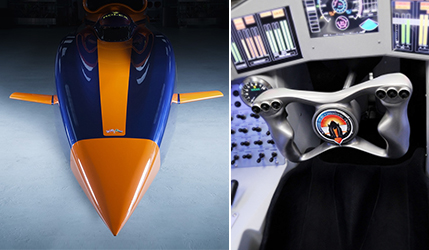
It weighs 7.5 tonnes and is powered by both a jet engine and a rocket, which together will produce over 135,000 bhp – more than six times the power of all the Formula 1 cars on a starting grid put together. It has temperatures inside the rocket that reach 3,000°C – twice as hot as the inside of a volcano. And it’s all designed to power the supersonic Bloodhound car to over 1,000 mph.

But when it’s screaming down the South African desert, the car will be controlled from just one component – our steering wheel – designed for just one brave driver, Andy Green (see video here).

The Bloodhound project has faced many extreme challenges and is an awesome engineering adventure. However, as we became more and more involved in the design of the steering wheel component, I couldn’t help but notice the contrast with the design challenges we normally work on that end up in mass production. So I thoroughly enjoyed the specificity of the Bloodhound brief – which led me to ponder on how manufacturing volumes influence our design approach. I think this can be summed up in three areas:

1. User needs – we normally design products to be used by millions of people in multiple markets. This means that, although they differ hugely in age, physical size, strength and cognitive ability, they must all receive a safe, consistent and excellent experience to meet their specific needs. To understand these diverse customer groups, we employ techniques like ethnographic research, human factors studies and statistical analysis. We then test design features, through prototyping, with representative user groups to validate our vision.

With the Bloodhound steering wheel, on the other hand, when a feature needed to be confirmed or adjusted, we simply had to print a model and ask Andy to hold it. Luckily for us, Andy has an extraordinary clarity when it comes to what he likes and dislikes – and this process quickly led to an optimised design, with adjustments to the button locations, the handle geometry and the clearance for his legs until everything was right! In terms of mechanical strength, we could proof test the actual wheel to make sure it met the technical specification. Although we calculated the strength using finite element analysis, it was verified by a tensiometer machine when we had the first sample wheel manufactured. We were later reassured to hear that the Bloodhound team couldn’t actually break it in what was intended to be a destructive test.

2. Manufacturing volume – when we create new products for our clients, we must consider how to mechanise manufacture to make millions of replicas at high quality and low cost. As engineers, we need to maintain the function of a new device despite the natural variation of materials and manufacturing processes, and the degradation of the product during its life. We use strategies like ‘failure modes and effect analysis’ and ‘tolerance analysis’ to help predict how the design will react to manufacturing variances – and how this might lead to failures or poor outcomes for the user. We identify critical design and manufacturing features – and check that they can be easily reproduced by the materials processes we are using to ensure a high production yield and high product reliability, all within acceptable costs, of course. Because we never see the product before it is shipped to the customer, we have to rely on statistical analysis to prove that every copy of our design will work as intended until it comes to the end of its service life.

The Bloodhound steering wheel, in contrast, was manufactured in a very low quantity (just a handful – the actual wheel and a few back-ups). This allowed a very slow (days/hours rather than seconds) and very high-performance manufacturing process to engineer a large margin of safety to make sure nothing would go wrong. So the wheel is 3D printed in titanium and costs around £15,000 to make – a manufacturing cost per part that would make our regular clients faint!

3. Environment – in product development, the environment of use can be hard to predict. During transportation, a product can be taken from extremes of cold to hot or wet to dry – consider a medical device trucked across a desert in the Middle East that then has to perform a critical diagnostic test. We engineer products for these extremes, which often leads to significant design challenges. The product can also sit in contact with nasty chemicals on a shelf for years before the customer receives it – which could slowly degrade many plastic components.

The difference with the Bloodhound project is that the environment is relatively well known. We know where in the world the steering wheel will be used – and that it will be used under the strict supervision of many project engineers. However, no car has ever travelled at the speeds expected – and when you extend that thinking beyond our component to the whole car’s aerodynamics, power and stability, then only the engineers intimately involved in the project really understand the scale of the challenge.

However, they are overcoming this challenge using the same principle that we use to create reliable mass-produced products. It’s based on careful specification of the challenge, breaking this down into systems and subsystems, and then designing each carefully to that specification. The design is systematically tested – first at component level, then system level and finally at car level. Then the Bloodhound team will run the car gradually faster and faster, all the time monitoring performance through a network of sensors and data loggers installed around the vehicle. If the calculations work out to be correct, this process will continue until the 1,000 mph target is exceeded.

So, in conclusion, do I really think that designing for the ‘one-off’ Bloodhound was a ‘luxury’ project? As a potentially iconic design for such a high-visibility engineering project, then it truly is an honour to be involved. Certainly, with the steering wheel, many of the complications involved in design for high-volume manufacture just went away.

But, at the end of the day, it was not detailed aspects of process or approach that I remember most. What I have really taken from the experience is the value of having a team with such a clear and inspiring vision of success for the project – to travel at 1,000 mph and inspire a generation of new engineers. This vision meant all the people we worked with were totally focused on finding ways to succeed. Perhaps this is because we can all visualise the 1,000 mph run in our mind’s eye – whereas a million different customers using a product, each in a slightly different way, in their daily lives is much more divergent.

So what I will take back from the Bloodhound experience to our ‘designing for the many’ projects is that when you can build a ‘clarity of vision’ across the team as to what success looks like, then this will pay dividends many times over in the outcome of the innovation.

Reflections on wearable technology

As wearable technology in all its (as yet unknown) forms becomes ubiquitous, it is interesting to reflect on practical changes this might bring to our lives – and whether it will represent a significant departure from the now decade-old smartphone generation. Having never used any wearable technology before, I was recently given a smartwatch to try out. After a week of constant use, I thought it might be interesting to look back on what I learnt and the impact of the device on my daily life.

The first thing I was surprised to note was that my smartphone ‘screen time’ was significantly reduced. This may seem counterintuitive but isn’t that surprising when you consider the frequency and variability of mobile notifications and the level of distractibility that seems to increase with screen size. As notifications come to your wrist, they can be prioritised almost instantaneously – a welcome change from the laborious pocket-extraction-swipe-to-unlock routine – with maybe only one in ten meriting an instant response. Smartphones are becoming increasingly notorious for their capacity to absorb our entire attention when in use, so any opportunity to reduce the frequency of screen checks is a welcome one – not to mention a chance to improve personal safety.

Secondly, it quickly became clear that regular use of a smartwatch results in a more seamless integration between our physical and virtual environments – making it (to a certain extent) a low-level form of augmented reality. This trend towards a more fluid interaction with technology is something we have seen grow in our client-based projects and is really driving the development of wearables. The way our customers are using technology is constantly changing, making it more important than ever to focus on human factors and ensure we are meeting the correct stakeholder needs.

The physical design of the watch means that it moves with you and responds to you – in stark contrast to the prescribed set of actions associated with other technology such as phones, computers or tablets. The user interface (UI) design of the watch also allows features such as fitness tracking, map guidance and instant messaging to become part of the wearer’s larger everyday experience, rather than detracting from it. Using the watch to provide walking directions, for example, allows you to take in the surrounding environment – improving both your safety and the quality of your journey to a large degree. This satisfies the craving for constant connectivity and simultaneously allows more effective engagement with the physical world – two factors that have arguably eroded one another in recent years.

Ensuring that our UIs allow for multiple possible use cases is a vital part of the product development we undertake for our clients. There are always trade-offs – for example, between navigational ease and product aesthetics – and getting the balance right can be challenging, particularly with the increasing number and variety of interconnected devices. I was pleased to see that the smartwatch has mostly avoided the fatal mistake of ‘too much too small’ in its UI design, and prevents flashy graphics overwhelming the product’s usefulness.

The final point I was glad to see was that the watch prevented my screen becoming clogged up with advertising – and I would suggest that wearables might be an important step in reclaiming the screen space we have lost to this corporate encroachment on our mobile devices. Along with many others over the past decade, I have watched with resignation as popular apps and websites have either been bought out by large corporations or forced to increase revenue through advertising. Even previously protected spaces, such as our social media feeds, have succumbed to the patently enormous potential for commercialisation and now offer us more tailored products and services for our consumption than ever before. Wearable technology, as it is currently developing, simply does not offer enough pixels for advertising companies to exploit effectively – although finding ways to effectively generate revenue on our wrists without inhibiting the user experience is surely an area ripe for innovation.

Overall, I was impressed by the changes wearable technology made to my life in just one week. But although I think this technology is worthy of the hype, I don’t think it has quite achieved the revolutionary status of the smartphone just yet. But then again, perhaps that’s a good thing.

What ‘job’ is your customer trying to get done?

It sounds like the simplest question in the world. The answer should come naturally to the most junior marketer or designer in product or service companies. And yet most likely the response will reference an existing product… drill a hole, nebulise a drug, mop the floor, play a cd…, rather than the customer’s need, or desired outcome…put up a shelf, cure my illness, keep my house clean, listen to music. This seemingly small oversight can have catastrophic consequences for a long-term innovation pipeline!

The paradox, identified by marketing guru Peter Drucker is that “The customer rarely buys what the company thinks it is selling…nobody pays for a product. What is paid for is satisfaction”.

The star line-up at FEI Boston this year included pioneering innovation academics, such as Clay Christensen, successful entrepreneurs such as Netflix co-founder and home entertainment disruptor, Marc Randolph, and many other creative leaders with stories to tell from every possible market; it was an inspirational three day event. Consistent themes centred on thinking about customers, and markets in new ways, applying lean start up principles for rapid trial, failure, and iteration, and utilising multiple sources of evidence to underpin innovation decisions. An audience of ‘evidence enthusiasts’ provided the perfect context to launch CDP’s new quantitative research service, diialog™.

In his keynote Clay told his now famous innovation story, how during an engagement for McDonalds, meeting with milkshake drinkers outside drive-through fast-food venues at 6:00am in the morning caused the research team to rethink the beverage market. It was not about the milkshake; it was about a sustaining snack that wasn’t too light or too heavy, could be consumed one handed while driving and due to the viscosity, would take some twenty minutes to consume. The milkshake was the solution to the ‘job’ of having a tantalising and sustaining companion during a boring early morning commute. The term ‘milkshake’ was the only common element with another entirely different afternoon ‘job’, a busy Mum trying to placate kids after school. This insight lead the team to define a specification for a successful smaller, less viscous new product!

With his characteristic dry humour, Clay also recounted an epiphany after a heated discussion with his wife, by applying the same principles to understanding what ‘jobs’ she had ‘hired him’ for (in their relationship), which in some instances varied significantly from those that he admitted his instinct had anticipated. Technically speaking it was a story of misaligned contextual expectations, but we were reassured, it had a happy ending!

Equally vivid was the challenging ‘job’ he threw out to the audience; ‘my son wants to furnish his empty new apartment next week’. Which brand will deliver on that aspirational outcome? Who in the audience could have escaped the ‘Ikea’ brand-mark popping into their heads to satisfy this ‘job-to-be done’?

Having applied the ‘jobs-to-be-done’ approach for more than five years to address client innovation challenges ranging from food and beverage, to lifestyle, to medical conditions, it was a privilege to lead the Chief Innovation Officer track, and hear one of my innovation heroes talk about his work and thinking.

Other highlights included Craig Dubitsky, the creative energy behind Hello Products, and co-founder of iconic lip-balm EOS, encouraging the audience to “fall in love with the problem, not the solution” and reminding us of a delightfully simple human principle so often overlooked in a world of multi-channel marketing jargon. His track record demonstrates this approach can be game-changing and highly lucrative, even in supposedly mature or commoditised categories.

Christopher Lochhead energetically dared companies to either ‘reimagine existing problems’, or ‘design new categories’, or face the consequences. The ‘energy shot’ drink was invented when category pioneer Manoj Bhargava had a breakthrough moment of clarity – that existing large volume liquid energy solutions wrongly assumed that a consumer was both tired and thirsty! By creating a new category of low volume ‘liquid energy’ solution, the multi-billion dollar 5-Hour Energy business was born.

Finally Marc Randolph’s story had reminiscences of industry giants such as Kodak, reminding us that even (or perhaps especially) the biggest businesses in the world cannot rest on their laurels and that the future is in front of us – we just need the courage and vision to see it. When he and a friend posted a DVD in a scruffy self-addressed envelope one afternoon, and received it back, undamaged, the next day, the world of in-home entertainment would change for ever and another goliath would shortly come crashing down. Like so many infamous stories of incumbents displaced by creative, rapidly moving start-ups who care little for corporate, brand, or historic baggage, Blockbuster missed the pivotal moment to buy into Netflix. That negative engagement in the Blockbuster boardroom motivated the Netflix team to pivot, iterate their business model, and take the calculated risks that would lead to their meteoric triumph.

These successful people, among many inspirational speakers at the conference were the first to admit there wasn’t a secret to their success, all could list far more failures than victories. Despite the common perception that innovation success is a lightning strike, the core message was that risk can be managed through culture, attitude and response to risk and failure. Failure is a critical part of innovation process and those who are successful, tend to be the ones who embrace it, learn and pivot the fastest.

With Clay’s wise words in my ear and my own experience of the effectiveness of the human centred approach to our innovation, I will continue to evangelise ‘jobs-to-be-done’ as a highly effective way of providing insight which can seed disruptive and transformational new solutions to everyday challenges.

CDP’s Front End Innovation team advocate a ‘Research for Innovation™’ approach which combines evidence from many sources, with a design and technology perspective, to look beyond today’s solutions and enable the creation of new product and service experiences. If you have an innovation challenge you’d like to chew over with our team, you can reach a real person at +44 (0)1223 264428!

diialog™ is a new research service from Cambridge Design Partnership. It uses a miniaturised sensor array embedded into small prototypes, products and packaging by our model-making team to underpin our Research-for-Innovation™ activities, validating consistencies and highlighting gaps between what consumers say they do, with what their real actions reveal.