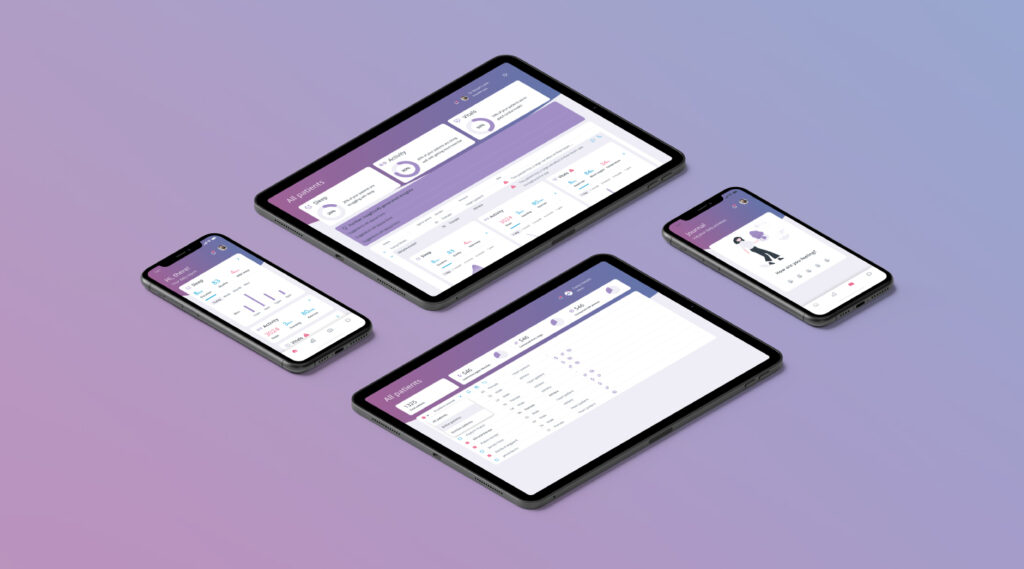
CDP recently led an investigation into how to advance innovation in digital health in the UK for the CPI, UKRI/Innovate UK and ABHI. Our aim was to find out how best to enable the UK to be the place of choice for enabling high-risk digital health innovation, improving patient outcomes.
Our work with 50 leading healthcare professionals and entrepreneurs revealed that the UK has an enviable record in early-stage innovation, a highly regarded healthcare system and a potential treasure trove of high-quality data.

REPORT
An Action Plan: Driving Growth of the UK Digital Health Industry
However, we also found several hurdles that trip up many innovations before their potential can be truly realized.
In this article, we describe our top five hurdles to success and signpost the resources available to help innovators overcome them.
1. Offering the wrong product at the wrong price
Let’s start with perhaps the most obvious: you need to get your offering right. This was one of the more frequent topics to emerge in our discussions. True, it tended to come from the industry and investors, rather than entrepreneurs themselves. But perhaps this is the point; those closest to the concept are so captivated by the opportunity to solve a problem that they are rarely the best judge of commercial success.
“The biggest problem is developing stuff we don’t need, at the wrong price point.”
Life Sciences Lead, multinational consultancy
“People have struggled with finding the right balance between fixing a problem not just for the sake of it because it’s going to add value, but also there is a market attached to it.”
Medical Director, AI dermatology revenue-earning startup
Getting the right product at the right price is not easy. Regardless of how it is funded, healthcare everywhere is a complex system of separate entities with conflicting priorities. One of the biggest challenges for digital health offerings in particular is that the person paying the bills is rarely the direct beneficiary. This is as true across the NHS in the UK as it is in insurance-led services in the US.
Digital interventions are regularly shown to make significant positive impacts on diagnosis, therapy, adherence and behavior change. To date, the FDA has approved, authorised or cleared 171 AI/ML-enabled medical devices. However, digital means adding overheads (electronics, batteries, software or new digital services) to an already overstretched budget that tends to bring value much further down the pathway.
To get the right product at the right price, you need to be crystal clear about the value you bring and who you bring it to so that you can ensure the price is right.
Helpful Resources
For the UK market, we found the following resources helpful in crossing this important hurdle:
- The NHS Innovation Service provides an innovation guide that explains how to build a value proposition
- The NICE Advice Service provides personalized advice on the value propositions for a fee
- The NHS Clinical Entrepreneur Programme (CEP), launched in 2016, provides training for NHS staff on the skills required to build a healthcare startup, all without them needing to leave the NHS
Indeed, this is such an important area that we at CDP are looking at how recent advances in Generative AI might make this easier to get right from the outset – not just for offering services within the UK, but how UK-based innovation can provide the right offering in the larger markets of the US and EU.
2. Neglecting the needs of key stakeholders
Digital products and services are still a novelty in healthcare. Even the regulation is taken from a device mindset – consider the terms SaMD (Software as a Medical Device) and now even AIaMD (Artificial Intelligence as a Medical Device). The digital-first mindset is to move fast, learn and repeat to get the best user insight and optimum benefit to market as fast as possible. This is not an easy marriage for healthcare, where verification and validation are critical steps to approval.
“If you are manufacturing a digital health product, you have three sets of policies to navigate right now [in the UK].”
CEO, digital health SME (referring to NHS DTAC, NICE and MHRA)
“The regs are written to cover all medical devices. They’re not very specific; it’s very high level and quite hard to interpret what we should actually be doing as an individual company.”
Medical Director, AI dermatology revenue-earning startup
This is not simply about the regulator; it is also about who will receive, who will administer and who will pay for your digital offering. On top of proving safety and efficacy, payers and adopters want to see evidence that your technology works under real-world conditions and produces sufficient benefit relative to current clinical practice to justify its cost. Not only do you need to convince your investor you have the right product at the right price point; you also need to convince them you have access to reimbursement.
This need has led us here at CDP to build a strategy and insight team that explicitly looks across the spectrum of stakeholders including the end-user, practitioner and payer.
Helpful Resources
The following resources are helpful when considering the regulatory and UK purchaser stakeholders:
- The NHS’ AI and Digital Regulations service offers a developer’s guide that leads you through the various regulatory and NHS requirements for digital technologies
- The NICE Evidence Standards Framework is designed to help ensure NHS stakeholders are adopting robust technologies that are likely to provide the expected performance, and are good value for money. The framework can be used by developers to understand their customer needs. NICE also offers an assessment of current/planned evidence via their META tool
- The NICE Early Value Assessment can also help indicate the value your product can bring, and allow you to get support to understand what further evidence needs to be generated.
- Similarly, NHS’ Digital Technology Assessment Criteria (DTAC) are designed to assess suppliers at the point of procurement, or as part of a due diligence process, ensuring digital technologies meet minimum baseline standards. The criteria can also be used by developers to understand what is expected for entry into the NHS and social care
- FDA’s list of approved, authorized or cleared AI/ML-enabled medical devices
3. Testing, verifying and validating
The regulatory pathway will force you to verify and validate. It will be rigorous. It will take more time than you or your investors want. So, you will need to test, test and test again as early as possible to build the evidence you need for investment. And, importantly, test both the medical efficacy of your offering and its likely commercial success.
“[It] can take longer than six months, ridiculously, to build a cohort of data.
Getting people to step away from frontline service in the NHS is a fundamental challenge of getting access to that data. Even if you offered to pay, they’d say” ‘I don’t care; it’s not the money I’m short of, it’s people’.”
President, medical imaging multinational
“We really struggle to work with SMEs because we’re not able to move at the pace that they require for their cash flow.”
Director of Innovation, NHS trust
As these sentiments show, however, gathering data takes time and patience. The NHS is indeed a treasure trove of data, but unlocking it is a real hurdle. Existing NHS data typically needs preparation – cleaning and anonymizing – before you can access it. And there simply may not be the staff available to do this, meaning you may need to build additional paths to gather test data.
The fidelity of the test can start low-fi, but will need to increase as you develop. CDP typically starts with insights research and human factors studies using UI sketches/descriptions of the product to explore the true user journey, before moving onto trials with real-life samples and wizard-of-Oz demonstrators. This builds a body of evidence that reinforces your expectation of efficacy with the all-important usability and the commercial viability of your offering, before embarking on the summative human factors, clinical and market trials.
Helpful Resources
The following resources can help you prepare your plans for testing, verification and validation:
- NIHR study support service provides guidance and advice
- The HDR UK Gateway portal helps researchers find existing data sets and connects them to relevant stakeholders
- Trusted Research Environments (TREs) are a new initiative to facilitate access to NHS data for R&D. Only a few TREs currently exist and there is no guarantee they will have the data you’re looking for. However, the teams involved are well placed to advise you on next steps. Even though this requires approval from HRA and notification to MHRA, consider if it might be better to just do your own trial to collect fresh data instead. This is where an experienced external innovation partner can be very helpful
4. Navigating healthcare as a ‘system of systems’
The benefits of digital health typically require systems integration. Yet, healthcare everywhere is a complex system of systems, each element with its own approaches, tools and requirements.
“[Different hospitals are] probably using different systems, different levels of maturity with different versions, with different level plugins. That probably means, even if I create it using the standard, it won’t automatically fit. It needs modification, adaptation and someone to do the translation.”
Digital Health Advisor, ex-NHSX
“You can often have very inflexible contracts with your electronic health records supplier; for example, if you want them to make one change or open up in an API or something like that, it can be prohibitively expensive.”
Director of Innovation, NHS trust
While there are only a few dominant providers of Electronic Health Record (EHR) systems, each installation is likely to be different. Moreover, the EHR providers will guard access jealously. Microsoft, Google, Amazon and others provide integration services to structure and translate data, but that is likely to be only a small part of the problem, and only useful if you are ingesting unstructured data from multiple sources.
At CDP, we encourage our clients to focus on providing easy-to-use, yet secure APIs built around well-structured data that map well to the established data standards such as FHIR. Taking ownership of your own data in this way makes it easier to deploy, integrate and support.
Helpful Resources
The following resources can help you prepare your digital health services for system integration:
- Standards for health data exchange such as FHIR
- Developer guides for working with digital across the NHS and a digital service manual for designing digital tools for the NHS
- Amazon, Google and Microsoft provide a range of cloud-based digital data services
5. Building a strong team
Innovation is rarely one guy in a garage. This is especially true in the digital health space. You will need to build a great team led by experienced professionals across the disciplines. Get this right and everything else will fall into place. Work out your strengths and weaknesses and actively seek resources to complement your team.
“The most useful thing to an innovator is access to an actual practicing frontline clinician who understands the problem that they want solved. It’s a real challenge to get to these people. I might spend months trying to find someone who would talk to me.”
President, medical imaging multinational
“The UK does not have enough engineering capacity… does not have enough people with product skills… does not enough people with this sort of legal regulatory skills.”
Digital Health Advisor, ex-NHSX
Helpful Resources
The following resources can help innovators looking to build a world class team:
- Many Health Innovation Networks (HINs) and NHS trusts have innovation teams who may be able to help matchmake with clinical champions. The NHS Innovation Service is a good place to start, but it’s worth seeing what individual trusts are doing.
- HINs and NHS trusts often also support innovation and hackathon events which are a great way to find those with a similar innovative mindset – but a complementary skill set.
- And then there are organizations such as CDP, who bring end-to-end product development services with the hard-won experiences of how to navigate this exciting but often frustrating area of innovation.
In addition, many of your digital needs are engineering and operational ones. Recruiting experienced people from the finance and technology sectors where the UK is strong will bring you good skills and expertise in algorithm development, handling personal data and building scalable secure systems.
It’s tempting for you (and your investors) to under-resource your team and compromise in the early phases. But as the hurdles above clearly show, this rarely leads to success. Build the great team you need from the outset, to make sure you truly have the right product at the right price, that meets the expectations of the key stakeholders, is properly tested and ready to integrate into the healthcare system of systems.
Download the full action plan for digital health innovation in the UK here.
Connect with CDP
At CDP, we continue to follow up our insights working with clients and partners to find practical solutions to complex problems. To find out more about what successful innovation in digital health looks like, please do get in touch.