CDP Engineer wins national charity design award

CDP Engineer wins national charity design award

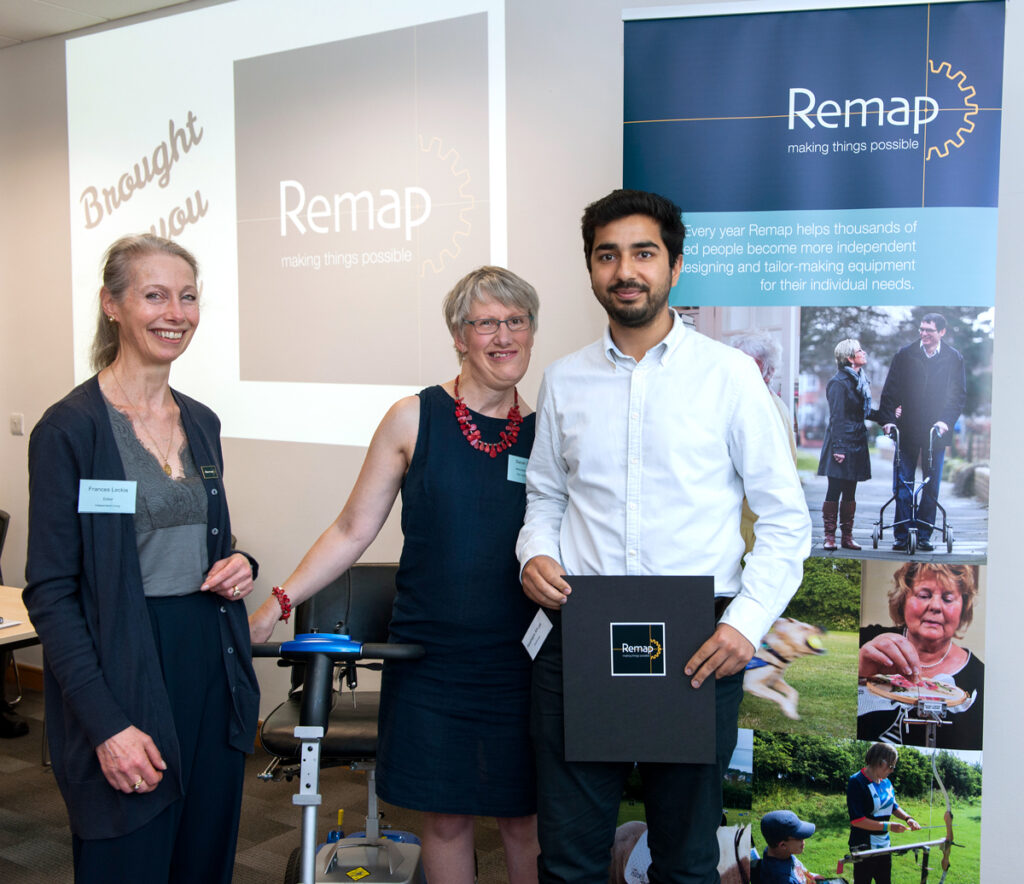
Mechanical engineer Akshaya Ahuja, wins the prestigious Wolff Award at Remap’s National Award Ceremony after creating a special gadget to help a woman with cerebral palsy.

Akshaya Ahuja recently travelled to a national award ceremony in London to receive an award for his charity work. Akshaya, created a solution to help Sarah Stones, who has cerebral palsy, improve her posture while using a computer.

Akshaya, 27, has been working at Cambridge Design Partnership (CDP) as a mechanical engineer for 18 months. He explains how his invention works: ‘Sarah finds that due to lack of core muscle strength she leans too heavily on her left arm when she is working on her computer. This causes her shoulder problems and pain, so she needed something to remind her to correct her posture and sit upright.’

Akshaya came up with the light, rechargeable electronic armband that Sarah wears on her left forearm. ‘If she leans too heavily on it for too long, an alarm sounds which reminds her to adjust her posture,’ he explains. “The settings can be changed as her core strength improves, so it should bring benefits to her overall health in the longer term.”

Sarah, who lives in Cambridgeshire, says she is delighted with the result. ‘When I’m working if I lean too much over to the left, which I very often do, it reminds me to sit up straight again.

‘I’ve been wanting this gadget to be made for years and never knew that there was someone out there that could do it. So thank you so much and keep doing the amazing work.’

Akshaya helped Sarah through the charity Remap, which makes equipment to help disabled people live more independent lives. Remap volunteers, who mostly have engineering training, work on projects throughout the country. Akshaya’s design won the prestigious Wolff Award at Remap’s national award ceremony recently. Both he and Sarah travelled to London to receive the prize.

The design process was carried out by Akshaya in his spare time, using the facilities at CDP. ‘Sarah and I went back and forth with prototypes, refining the armband until it was just right,” he explains. ‘I’m lucky to have an employer that supports Remap and is happy for me to use the design software and lab facilities here at work. I was also able to get helpful advice from my colleagues on the project.’

Now that Sarah’s gadget is fully functioning, Akshaya is working on a second project for Remap, working out a way for a disabled blogger attach a video camera to a mobility scooter. ‘I’ve found working on these projects very rewarding and I’m sure I will carry on volunteering with Remap in the future,’ Akshaya says.

Mike Beadman of CDP says the company encourages staff to take part in voluntary projects such as this one: ‘We are delighted that Akshaya has won this award, which shows real flair and imagination. Our colleagues here are able to use our facilities to work on projects such as this and we offer flexible working hours so that they can carry out these charity projects while they are at work. We’re very proud of the contribution they make.’

Another CDP staffer who is volunteering for Remap is Jess Carroll, who has been working at CDP as a mechanical engineer since January 2019. Jess is working on a modification for a mobility scooter. ‘The client has problems working the throttle with her hands so I’m working on creating some sort of throttle rocker. At the moment I’m at the stage of contacting lots of scooter companies for advice and suggestions. I’m really lucky that CDP takes such a flexible approach to work schedules, so I can call up these companies in working hours. I will also be using the CDP 3D printer, tools and design software, so I feel very supported by the company in taking on this project.’

More details on Remap.

CDP-190619-0019_Happy

Women’s work?

Women are still hugely under-represented in STEM (Science, Technology, Engineering and Mathematics) careers. Only 22% of the UK STEM workforce is made up of women according to a 2018 study. In Engineering specifically, the stats are worse: only 12% of all professional engineers are women.

Here at Cambridge Design Partnership, the company is taking active steps to improve the situation. “Our aim is to redress the balance and encourage as much diversity in our workforce as possible,” says Matt Schumann, Mechanical Engineer and Partner at CDP.

With International Women in Engineering Day falling on June 23rd 2019, we thought this was a good moment for some of CDP’s female staffers to talk over their careers so far and share their experience of working at CDP.

Round the table: Jessica Carroll, Mechanical Engineer; Jeanette Milbourn, Senior Regulatory expert; Miranda Dobson, year in industry student; Helen Simons, Quality Specialist; Caroline Zakrzewski, Drug Delivery Devices Scientist, Amy Livingstone; Electronics Engineer.

Have you faced any gender-specific challenges working in the STEM industries?

Helen: My course at Durham University 1998 – 2002, had 126 students of which 15 were women but I didn’t find this to be a problem. I first encountered real difficulties in my first graduate job, in the drawing office of a small manufacturing firm. I arrived to find I was the only women in the company in a technical role and I was more qualified than my boss. The guys on the shop floor were really encouraging but the managers didn’t support me at all.
Jess: For all three of my university internships and also my first job after university in 2017, I was the only female engineer. I’ve not had major problems, but I have noticed a series of seemingly insignificant comments like, ‘You’re a girl, you can draw’ and being called ‘motherly’ for being caring towards others. I’ve had to ignore it, for my own sanity.
Caroline: The gender bias regarding how women in science are perceived has certainly lessened, but male opinion is frequently seen as of more value. Look at any technical conference – one I attended recently had less than 20% female representation in its speaker and panel roles.
I was once at a high-level project meeting where the female team members were justified by a male colleague because “we get really nice cakes at the team meetings”. The females in question were the technical lead, quality lead and project co-ordinator. We made him bake the cakes for the following month’s meeting.
Miranda: I’m working at CDP on my gap year before going to university. Throughout my schooling there has been a distinct lack of participation from my female peers in STEM based activities. I have been the only girl in STEM groups for a long time, from the engineering club at school when I was nine to my Further Maths and Physics class at A level. Personally, I have got used to being outnumbered by male peers, but it could be off-putting for others looking to join in.

What problems have you had with being a woman in STEM employment?

Caroline: When I worked in a lab or cleanroom I was consistently hampered by oversized lab coats and huge gloves that restricted my dexterity. The design of equipment as ‘one size fits all’ usually means ‘one size fits a large man’.
Jeanette: When I had children (my first child was born in 1992) – part-time employment was almost impossible to get. So that is when I went freelance. I am now working part-time at CDP which is a perfect balance for me of interesting work while leaving time for my other interests.

How have you found CDP as a workplace?

Helen: I think CDP is pretty accommodating and flexible about working patterns which helps keep women in STEM. In a previous company the MD hated part-time workers and made them change all their contracts. This resulted in the majority of technical women leaving the company because they were the ones who needed part time working to deal with childcare. CDP has also been really good at giving opportunities to female Year In Industry students, which helps get them on the right path from the start.
Amy: At CDP the general level of support is so good that I don’t feel I need any extra. My appraiser is very supportive of additional training and I’m part of a new mentoring scheme, so I now have even more guidance in my career.

Who was your female STEM role model growing up?

Jeanette: My mother was a biology teacher and I was always encouraged to pursue what I wanted to do.
Helen: I guess I grew up with Carol Vorderman on TV which helped a bit. I mainly went into STEM because my dad was an engineer. I visited his work and understood what it was to be an engineer.
Amy: Only if Artemis Fowl counts!
Jess: There wasn’t anyone female I could look up to when I was thinking of this sort of career. One way to inspire the next generation is to be the role model you wish you had – and that’s what I’d like to do here at CDP.

Do you believe that women bring any extra contribution to STEM companies?

Jess: One of the problematic issues in the technology industry is gender-blindness. When technology is designed by an all-male team, considerations towards how women may use that tech may never be discussed, not out of maliciousness but rather ignorance. Having a diverse team, not just for gender, but race and disability, means that whole groups of people are not forgotten in design considerations.
Caroline: Even recent history has shown that designing for the ‘average white man’ can treat women as outliers – Apple created what they called the ‘world’s best workplace’ but omitted to include childcare facilities. FitBit came up with an app that tracks all manner of biometric exercise data but forgot to allow women to track their menstrual cycle.
Jeanette: Women often contribute valuable ‘soft skills’ such as being more of a team player and better listening skills. And, dare I say, not so many of the big egos that get in the way sometimes!

How do you view the future of women in STEM?

Jess: Young women and girls should be encouraged to study/work in STEM because they already have natural drive and curiosity. They just need the confidence to pursue it.
Miranda: I’ve always felt I have to work harder and perform better than my male counterparts to be seen as equal to them and to break down assumptions of my inferiority. I don’t know how effective positive discrimination is but I am optimistic that views on women in STEM are changing due to the likes of Harvard’s Dr Katie Bouman, who worked on capturing the first ever image of a black hole. Overall, I’m optimistic that, as my career develops, the gender imbalance in STEM will become less and less of an issue.

Redressing the balance

Here’s what CDP is doing now to encourage women to consider STEM careers;

• CDP actively supports female Year in Industry candidates.
• CDP female staff visit local primary schools to promote Engineering as a career open to all.
• CDP has signed up to the national Industrial Cadets scheme for all students aged 9-21.
• Flexible working is available to staff.
• Female CDP staffers act as role models for Industrial Cadets and Year in Industry students.

It’s all about the UX

It’s all about the UX

There is no doubt that User Experience (UX) is a hot topic throughout today’s design world. But how is the personal approach to product development affecting the field of healthcare? Lucy Sheldon, people-centered designer, and Andres Barrera, user experience designer, went along to the first ever User Centred Design (UXD) Healthcare conference to find out…

Lucy and Andres write: Here at Cambridge Design Partnership, one of our specialisms is designing healthcare devices, from asthma inhalers to blood sugar monitors, that are used by patients rather than health professionals. In such situations, the experience of the user/patient is key to the success of the product. Do they like using the design or will they give up on it?
Because of this, we were intrigued by a new conference devoted entirely to User Experience (UX) within the world of healthcare.  So we headed off to the User Centred Design (UXD) Healthcare conference in London this spring to find out more and report back:

Who was there?

Attendees ranged from new start-ups to digital health specialists employed by global pharmaceutical companies. This was a chance for us to check out what’s happening right across the board in healthcare UXD.

What was the focus?

Many of the presentations were about the ways in which digital technologies can deliver a cost-effective and successful preventative healthcare model. Loud and clear came the message: a people-centered healthcare approach requires great UX at its heart. Healthcare solutions that the patient uses in their own home have to be problem-free and a joy to use. Otherwise compliance becomes a real problem.

Which innovations stood out?

We liked the look of the myCOPD app, an app which offers patient education for people with Chronic Obstructive Pulmonary Disease. This app delivers advice from world experts and is, in effect, a complete online pulmonary rehabilitation class. Another interesting project is the Babylon Health start-up, which offers online GP consultations. This company is already working with the NHS, allowing patients the option of signing up with Babylon Health rather than a traditional GP surgery.

Why is UX so much at the forefront of healthcare these days?

The rising incidence of long-term health conditions such as diabetes, heart disease and asthma is driving investment with a shift in emphasis. Now the focus is on helping patients to cope with their chronic illness, in terms of both reducing symptoms and improving outcomes. There is also much more investment in preventing lifestyle-related illnesses occurring in the first place.

What is the aim of UX in healthcare today?

Several of the speakers referenced the term healthspan (quality of life), which is now considered alongside lifespan as a measure of healthcare success. The question is no longer just: how long will you live? What matters is now how long you will live in good health.

What else is new?

Presentations which outlined how augmented reality in digital tech could be used in healthcare. Gaming-based digital tech allows users to overcome phobias in virtual reality. One idea we heard being discussed was a digital game in which the user overcomes their fear of heights by travelling up escalators, going onto balconies, etc. This is proving genuinely effective in helping people overcome debilitating phobias.

Did AI feature?

Absolutely. We were struck by a presentation which outlined the ways in which Artificial Intelligence (AI) – or perhaps more specifically machine learning – frees up healthcare professionals to do their high-level work more effectively. Algorithms can analyse patient data such as heart-rate, flagging up noteworthy results and saving hours of human time poring over charts to spot anomalies.

The appetite for digital therapeutic treatments is certainly growing and, for conditions such as depression there are, we discovered, several therapies that the patient uses themselves that have already been clinically validated. This impressed us a lot.

Did you come back to Cambridge Design Partnership feeling inspired?

Definitely. Here at CDP we work on a wide range of healthcare projects that have UX at their heart and we know just how crucial it is. For example, we designed the First Response Monitor as a way of helping first responders such as paramedics triage patients. The monitor helps assess which patients need help soonest via nose clips which record oxygen levels and display results using AI on a smartphone dashboard. In such a high-pressure situation as. Say, a serious road accident, kit needs to be reliable and simple to use. Our UX design, both for the physical product (the nose clip) and the digital tech (the smartphone dashboard) was key to its success.

How can CDP offer the best UXD to its clients?

We offer global companies the opportunity to create healthcare products – be they digital or physical – that not only fulfil the brief but truly delight the user. Our Potential Realised product design process, which links research, design, technology, engineering and manufacturing into a single integrated process allows us to meet and exceed customer expectations for UX.

Finally, how is the future looking for UXD in healthcare?

There is an exponential growth of health-tech start-ups right now and design in healthcare is evolving towards a more holistic and democratic approach. Patients no longer simply expect a prescription or a pill to solve their problems. Instead, they are taking ownership of their treatment and their health, often using digital technology. Where this is supported by machine learning, we are convinced that UX has the potential significantly to enhance healthcare delivery.

S.M.A.R.T. innovations for the food industry

Last month, I had the honour of speaking at the annual NSF International conference, held at the British Library in London. This year’s conference theme was focused on ‘Addressing New Realities’, looking at how mainstream food producers can take advantage of technology innovation to compete effectively and survive in today’s rapidly changing world. 

Alongside industry experts, academics and futurists, examples of what we mean by ‘smart’ technology and how it is influencing the food industry were explored. These included drones that assess harvest maturity, artificial meat cultured in labs and new packaging materials and waste infrastructures that are helping reduce plastic waste. The main message throughout the day was clear – as digital technology and other applied sciences are transforming the future, we need to ensure the future remains people centered! Future proof organisations will be those who clearly understand what their consumers really want.

My keynote centered on the belief that innovation happens where consumer insight, technology enablers and business opportunities coincide. While technology plays a vital role in enabling opportunities, innovation requires all three ‘stakeholders’ and, the most fundamental starting point is having a clear understanding of the consumer. Building on this belief, I was delighted to address the conference delegates and share with them a S.M.A.R.T approach to innovation:

S

Solve a problem that customers really care about: often human behaviour is driven by a desire to solve problems, which can be functional, emotional or social in nature. We adopt Jobs-to-be-Done (JTBD) to define and understand the ‘jobs’ consumers are trying to solve. Done properly it provides a clear, solution-agnostic understanding of customer needs and desires across complex markets. The advantage over conventional market research methods is that jobs tend to stay the same over the long term, while technologies come and go and enable different point-in-time solutions that may become quickly obsolete.

M

Measure your success: Generally, consumers seek the best solution that enables them to solve their problem, and by understanding their needs we can create a multi-dimensional analysis of how well this has been done. We monitor eight mega trends which also help us understand how consumers make choices and measure how successfully the solutions have solved their problem. For example, personalisation is driving consumers growing desire for new experiences, while provenance is driving consumers transparency and traceability expectations.

A

Attitudes to Innovation: We seek evidence to understand and adapt to different consumers innovation attitudes and bring them on a compelling journey. Often organisations try to innovate by starting with a technology, this can result in new products and services that appear to be ‘tech for tech sake’. In order to make innovation meaningful to consumers you can begin by understanding their established behaviours and rituals. Be mindful of who your audience is here, for instance Millennials are the ‘Instagrammable’ generation and I love the expression ‘if a millennial eats a meal but didn’t Instagram (or ‘gram’) it first, did it really happen?’ Think about what makes something meaningful and attractive to your target audience.

R

Right to Play: when exploring innovation opportunities, be sure not to lose site of the baseline expectations and requirements that exist in your industry. These may be regulatory constraints that should always be addressed first. Consumers also have a set of baseline expectations within the food industry, both tangible (e.g. premium food ‘codes’) and perceived (e.g. attitudes and expectations around single-use plastic). These expectations can create tensions for organisations to innovate around, and we are seeing brands (even those competing with each other) adopting innovative new ways to try and solve such problems.

T

Transferable learning: innovation usually isn’t unique, meaning you can learn a lot from adjacent markets, in terms of technology enabled innovations that work…and those that don’t! For the Food industry, boundaries are blurring with both Beauty and Health making these industries highly attractive to learn from. We can already see examples where simple NFC technology is making both Beauty and Food more convenient, and how DNA science is enabling tailored Health and Food solutions. By exploring adjacent industries, we can see how business models could empower new social economies within the Food industry, as well as new material innovations which can inspire us to start experimenting with single-use plastic alternatives, for example.

Technology set in the context of consumer needs can unlock innovation and by implementing a S.M.A.R.T. mindset, it will help ensure you make the right technology investments for your business: By truly understanding your consumers’ problems, giving consumers measurable proof points to show that you have solved their problem making your innovation both attractive and meaningful to your target audience, ensuring you deliver against the baseline expectations first and foremost, and looking beyond your direct competitors to learn about both what to do, and what not to do, when it comes to successful technology-enabled innovation.


For highlights of the NSF International conference, featuring comments from Martha, please watch the following video.


Is ‘Design Thinking’ how successful innovators think?

So where does Design Thinking come from? Design is a creative problem solving skill that has evolved over centuries. It was the Modernist movement that in the early 20th century helped set the scene for today’s practical and aesthetic design solutions that can be manufactured at low cost. The ideas behind Design Thinking started life in creativity research in the 50’s and 60’s and more recently crystallised at Stanford University before being popularised for the wider business community by David Kelly, founder of IDEO.

As a designer at the start of my career in the ‘80s I was struck by the radically different approaches to design taken by the engineering and industrial design professions. You could say engineering design was based on the scientific method (collect data, analysis and conjecture, hypothesis, experiment and review) with plenty of mathematical analysis and optimisation based on first principles. In contrast, industrial design placed personal creativity, taste and empathy with consumers as the most important skills, validated by stories of the design heroes of the past with their seminal work displayed in museums and galleries.

In business, academic research has shown companies tend to adopt one of three generic models of innovation; technology lead, market lead and ‘fast following’. It’s a generalisation, but you can see how those from the engineering design camp might resonate with the technology lead strategy, believing that innovation flows from a technology breakthrough. Those from the industrial design camp naturally align with a market lead approach, looking to new trends and needs in society to create opportunities. Finally, those who are most interested in the short-term bottom line may adopt the ‘fast follower’ model as the most pragmatic strategy.

If you look at the hot innovation sectors today, take Digital as an example, success depends on integrating both the technology and market lead strategies. Creating completely new business models by better meeting customers’ needs using the most effective technology. This needs a truly holistic innovation approach and exemplars are simply today’s most valuable companies, so this logic is undeniable.

So is Design Thinking a joined up approach that integrates traditional engineering and industrial design processes? It is certainly associated with the well-known Venn diagram linking what customers want with what is technically possible and commercially viable.

But is it the way that successful innovators think today? OK, this is an unfair challenge. Design Thinking is a simplified model that resonates with a wide audience and succeeds in encouraging some important behaviours. It makes the customer the primary reference point for innovation, something that is surprisingly easy to forget when technology becomes too exciting or daunting. It encourages questioning assumptions and the group working that is often absent in siloed organisations, essential when agile disrupters are snapping at your company’s heels. It also champions creativity that is a skill often driven out of companies in their search for operational efficiency. It finally encourages a learning approach using experimental iteration and minimum viable products, to improve ideas based on customer feedback, avoiding the confirmation bias that can sometimes fool teams into inadvertently launching a product that won’t succeed in the market.

However, on the other side of the coin I believe Design Thinking can introduce fatal flaws for the unwary innovator and this is why we have created our own proprietary approach to innovation at Cambridge Design Partnership, called Potential Realised. Like Design Thinking, our approach is people centric, creative and based on learning, but it’s a more demanding, professional framework that requires an expert delivery team with a broad range of specialist skills, particularly because it is compatible with the ISO13485 and FDA standards for medical device development.

There are three major differences between Design Thinking and Potential Realised. While keeping the consumer at the heart of the program, Potential Realised fully integrates the key role that technology plays in innovation and the specialist capabilities needed. There is a focus on the fundamental principles of the scientific method, placing learning and evidence center stage. This is essential to deliver technically complex products efficiently and to minimise the cognitive biases that can adversely influence outcomes. A good example is the emphasis Potential Realised places on gathering objective evidence at the front end of innovation when it can be difficult to obtain, rather relying on ‘empathy’ with the target market. Evidence is vital at this stage because the right decisions have a profound effect on the final commercial outcomes and project costs. Built into Potential Realised are the stages needed to obtain these vital facts.

It also recognises that iteration, while an efficient approach when costs are low at the front end, becomes an expensive mistake as investment rises and as the innovation gets closer to market. When implementation costs are in seven or eight figures your process has to include a high level of integrity.

Finally, Potential Realised is firmly based on the holistic nature of innovation, recognising a successful product launch is only as good as its weakest link and making sure all the design, technical, and business activities have their place and integrate together throughout the project to avoid pitfalls and most importantly, to allow the innovation process to be optimised financially.

While Design Thinking is certainly a part of how successful innovator thinks, Potential Realised’s scope is much bigger; it is scalable to even the largest projects and it actively optimises the return on your investment in innovation. It achieves this with building blocks that uncover the best possible commercial opportunity and create an efficient technical implementation and manufacturing capability.

If you would like to learn more about how Potential Realised can do this for your business, please get in touch.

Bridging a cultural gap in product innovation

Bridging a cultural gap in product innovation

Industrial design (ID) and engineering skills are different, yet both are crucial to successful new product development (NPD). But as anyone involved will have experienced, tensions can arise due to the approaches and goals of different members of the team.

Having attended both art school to study ID and university to study mechanical engineering, I work between the two disciplines, from front end ‘user centred’ concept generation through to detailed design for manufacture. As such, I have experienced these tensions, engineers often pressing for performance and the industrial designers for the user experience they believe is so essential. The worst-case scenario is when everyone misses their goals. So how do we achieve the best outcome?

This is where speaking both design languages can provide benefits. Having empathy and taking the time to understand the underlying design aims from both sides allows for better integration of the end product.

It is important that the NPD team recognises this gap and actively works towards creating a culture where collaboration is the norm. Fortunately, there are some simple measures that can encourage a culture of information sharing and a free flow of ideas. We do this here at CDP and one example is our ‘Friday Innovation Forum’, a weekly event involving different themes and speakers sharing learnings across all disciplines. Another format is a jumbo size computer monitor in our central coffee area which displays new ideas to inform and educate, stimulating coffee time discussions around hot topics and helping to align thinking across disciplines.

With my design hat on, I have a natural appreciation of ID so I spend time trying to understand the artistic intent of what the industrial designer has created and what they are trying to achieve, you can then start working with them to create solutions that embody everyone’s requirements. For example, to start this process, I like to ask:

“What is the ‘hero shot’ you have in your mind for the product, if it was on a billboard or on the side of a building – what is it that you are trying to convey?”  By asking that question I’m probing into what the industrial designer’s thought process is and creating a space where we can consider alternative solutions that could benefit all parties.

This is much easier if all the project disciplines are involved right from the start of the project. As an engineer I try to communicate the development journey, performance requirements and operating constraints across the whole team as they become known or change. By highlighting the difficulties as and when they occur it allows the ID team, or any other skill group for that matter to react and develop concepts in parallel that consider the new realities. This is best achieved through informal chats as the program progresses, it doesn’t always have to be in an official review meeting.

I favour elegant design solutions and try to stay away from what I call “glamour caps”, mouldings that have no other purpose than to hide an undesired feature. If the team all think in this way then you can create integrated designs with purpose as well as aesthetics.

It’s never a good idea to crowbar a new design into an already developed architecture. And similarly, it’s never easy to develop the usability and aesthetics of the product when too much is set in stone. By bridging the gap between these two disciplines and steering the development journey away from the ‘it’s your problem’ attitude you can create fantastic products that look good and have high performance.

How a sideways look can help you get ahead

How a sideways look can help you get ahead

For some innovation challenges, solutions already exist – it’s just that your industry doesn’t know about them yet. Dyson is the classic example – its iconic vacuum cleaner cyclonic separation technology was originally being used to separate particulates in sawmills. By identifying and linking a seemingly unrelated market opportunity with the technology for cyclonic separation, a $4.8 billion revenue vacuum giant was born.

Cyclonic separation is now considered the norm in vacuum cleaners. But it is only after the dots have been connected between the consumer’s requirement for separating dust from air and the cyclonic separation technology, that the link seems painfully obvious. Making these links is something which we do systematically through a process called technology mapping.

Inspiration by analogy – or design by analogy – is an outcome from our technology mapping process, finding broadly related industries, products or services that share a common focus yet often use a different perspective to find solutions. The idea of observing and ‘borrowing’ technology from other industries is a powerful tool for creative concept generation and tech scouting exercises.

So, what can be gained from borrowing technology? There’s a chance that someone, somewhere else is doing what you’re trying to do in a better, cheaper, more efficient way. Tapping into this knowledge opens up possibilities for radical innovation with novel solutions. But where might you start the process of searching for analogous solutions and how do you extract value from this technique?

The value of design by analogy will start with how your challenge is defined – you have to identify the right job and need to address. The well-quoted example is if you are a power tool company designing a new drill, the customer actually does not want a bigger motor or better speed control, but a better way of making holes in walls. By focusing on the job and associated needs, and abstracting their definition, you invite solutions that you may never have considered.

A well-defined challenge is essential to successfully scoping analogous fields – more difficult than you may think because it can lead to unintended consequences. You probably already know how your product should work, what it should look like, how it should be manufactured and how much it must cost to be profitable. By knowing what a product should and should not be, you can iterate, optimise and improve. While this works very well, however, it is unlikely to inspire anything game-changing.

To tap into the benefits of design by analogy, stay clear of the detail of today’s solutions. Broaden the definition of the challenge and consider the basic elements of the need you are trying to meet. The definition has to be expressed in such a way that almost anyone can understand it. Now you’ve opened up the contextual relevance to expert problem solvers from distant fields who can understand the context of your challenge. They may know nothing of how your product works, what it looks like, how it’s manufactured or how much it should cost – but fundamentally they could be doing exactly what you’re trying to do every day.

It is by framing the challenge in a way that others can relate their field-specific knowledge to – and by not getting buried in the specifics – that novel ideas are conceived and technologies sourced. The obvious candidate solution others deal with every day in their field could be a breakthrough revelation in your industry.

Let’s say you’re trying to design a coronary stent. You might look for analogy in scaffolding structures or perhaps aeroplanes or a plant lumen – all of which have engineered minimalist support structures to deal with external loads. Once these analogous fields have been identified, the right science and technology knowledge is required to develop them. You’ll need people with a deep understanding of those areas. This is where collaboration or ‘open innovation’ can become powerful.

The beauty of working within such a collaboration is the ability to explore much further afield by pooling together creative thinkers with expertise of different backgrounds versed in a range of analogous fields. Through collective knowledge and experience, you have the power to look at problems in a new light with a healthy variety of perspectives, without ingrained constraints and assumptions.

So next time you’re defining a challenge and tech scouting, it may be worth considering design by analogy. Find fresh insight beyond the usual assumptions and constraints within your industry for ideas that are truly novel and a source of groundbreaking innovation.

Defining a strategy for design history file remediation

When pharmaceutical companies launch a new product, often it is a combination of a new drug in an existing, proven delivery device. Because all new pharma products have full regulatory scrutiny, it is important to make sure the medical device design history file (DHF) is up to date and meets the latest standards. This is particularly critical when considering design history file remediation to ensure ongoing compliance.

DHFs can become surprisingly complex documents because they may have been through long-running development programmes incorporating many changes or they may have been acquired from other companies and contain significant legacy elements. Sometimes the passage of time has meant a DHF is no longer of the standard needed to pass FDA audit so it presents a business risk.

In any of these cases, factors such as new standards and regulations or changes in intended use, risk profiles or manufacturing processes make it important to defining an appropriate strategy for design history file remediation at the outset.

There are several aspects central to defining an effective strategy – such as building a detailed narrative, using a suitable quality management system (QMS) framework and effective planning. In fact, design history file remediation can be an intricate process that requires careful consideration of all these elements.

A design file history remediation story

Central to the concept of generating a robust DHF is the aspect that should frame the mindset of both development and remediation projects – to create a narrative, or history, of the development journey. The goal should ideally be not to create a clean set of ‘Revision A’ documents but to use and develop the tools of an efficient quality system to create a narrative of the complete development process. This is, most importantly, about creating visibility of all the technical decisions, learnings and changes along the way but can include broader aspects such as changes of ownership, changes to major standards or evolution of the supporting quality systems. Creating a narrative can be more challenging in remediation projects but employing the right philosophy can create opportunities to simplify a complex challenge.

Fit for purpose

The two key elements of the DHF generation are the specific technical content and the quality system framework used to collate and describe the format of the file.

It’s critical to define early on what success looks like for the revised DHF and understand the strategic decisions that need to be made to facilitate creating a robust file.

Remediation projects are usually not an ideal time to implement a comprehensive change to QMS processes in parallel, however appealing that may seem, so a best-practice approach leveraging existing processes is usually a sound strategy.

It is, of course, vital to check that the resulting DHF complies with the current guidance of key standards such as ISO13485 and FDA 21 CFR Part 820. In cases where a comprehensive QMS framework is not available, it is important to use other tools – such as a fully detailed quality or development plan – to describe approaches and adaptations to be employed to create a robust DHF. Therefore, proper planning during design history file remediation is essential to achieve regulatory requirements.

Planning

With these two key aspects in mind, the planning activities can then be focused on establishing the framework and resources required to move forward.

A fully detailed project plan will describe all the tasks to be delivered but is also vital to ensure any relevant experts and stakeholders are in place and available when required. The early planning of workshops and stage-gate reviews is very important to ensure smooth progress.

An effective and fully detailed quality plan with scope, objectives and a clear set of deliverables will greatly help to get alignment on the specific goals with all relevant stakeholders and help to assess the skills and resources needed.

Employing an effective stage-gate process is a great way to monitor progress and assess the status as the project progresses. Communication and stakeholder engagement are vital to progressing effectively so using stage-gate meetings to record open actions, assess risks and assign tasks gives visibility of issues and allows detailed planning.

A successful remediation project depends on many elements – but a robust strategy, expert resources and effective communication are vital aspects that will certainly reward additional investment. In summary, design history file remediation not only mitigates business risk but also ensures products remain compliant and fit for market.

MainImageResized

WORLD-CLASS INSPIRATION Launch of new Pyrex range of cookware designed by CDP and International Cookware

28 February 2018 – Technology and product design firm Cambridge Design Partnership (CDP) has joined forces with International Cookware to help shape a new generation of Pyrex dish designs that can take centre stage on the table. The new Inspiration ovenware range pushes the boundaries of material and manufacturing technology, with aesthetic influence drawn from traditional handcrafted finishes and bold geometric detailing.

It’s the second successful design collaboration between the two companies – following on from the launch of the centenary Pyrex ovenware range Optimum in 2015. Pyrex is renowned as a pioneer in premium glass cookware. But recent research highlighted that the very qualities which made the brand so dependable in the kitchen – functionality, practicality and resilience – were discouraging customers from presenting the cookware on the dining table.

The collaborative research uncovered crucial insight which offered a new perspective on the functional and aesthetic design. The new range also had to deliver consumer value and appeal across a variety of sizes, while adhering to challenging industrial borosilicate glass manufacturing requirements.

“The result is an addition to Pyrex’s market-leading range of products that can take centre stage on any dinner table,” said Ben Strutt, a partner at CDP. “Presentation of food is central to the dining experience and the ideologies of being a good host – and the Inspiration range delivers new levels of beauty and refinement without sacrificing legendary Pyrex performance and durability.

“From front-end consumer research through to industrial design and design for manufacturing, our comprehensive understanding of the whole process enabled us to propose credible design concepts which helped Pyrex push the boundaries of what is possible with the material. We are uniquely placed to tackle this kind of challenge as we can draw on expertise from different disciplines, as well as our experience of working within very specific client marketing and manufacturing requirements.”

The research for the new range highlighted an opportunity for an ‘occasional’ piece of cookware that combined practicality and style, would not look out of place with personal crockery set choices, and would support a range of food types and occasions. Ease of cleaning was critical, as was the depth of the cookware to prevent food overflowing in the oven.

“The design of the handles – often utilitarian in nature – required a fundamentally different approach to meet the aspirational project objectives,” said Ben. “The final design has integrated handles that blend into the sides of the dish, appearing as attractive features when not in use.” The new design is manufactured in tempered borosilicate glass, which can withstand temperature variations of up to 220°C – so the Inspiration range can go straight from the fridge to the oven.

“Working with CDP has helped us balance the complex list of demands and create an attractive new range of cookware that is equally at home on the table or in the oven,” said Xavier Frappier, senior product manager at Pyrex licensee International Cookware. “The new Inspiration range combines traditional values with cutting-edge manufacturing and design to give our customers the very best in elegant but practical cookware for any occasion.”


Notes for editors

Cambridge Design Partnership is a technology and product design partner focused on helping clients grow their businesses. Some of the world’s largest companies trust CDP to develop their most important innovations. Located in both Cambridge (UK) and in Palo Alto, California (US), CDP specialises in the consumer products, healthcare, energy and industrial equipment markets. Its multidisciplinary staff have the expert knowledge to identify opportunities and tackle the challenges its clients face. For more information, visit: www.cambridge-design.co.uk

Pyrex is a trademark of Corning Incorporated, used under licence by International Cookware. The iconic cookware brand has offered families new ideas to help prepare, cook and serve at the table since 1915. Combining tradition and innovation, the brand now includes a wide range of cookware, available in several materials, shapes, designs and colours. International Cookware has its own borosilicate glass manufacturing plant in Châteauroux, France, and employs more than 500 people. For more information, visit: www.pyrex.eu

For further information, contact the marketing team:
+44 (0)1223 264428
marketing@cambridge-design.co.uk

Patient-friendly packaging with intuitive design and an injection of fun, CDP takes a fresh look at pharma packaging

Technology and product design firm Cambridge Design Partnership (CDP) has unveiled a new approach to pharmaceutical packaging. An intuitive design coupled with an injection of fun has resulted in a single-use medicine pouch that is a world away from traditional pharmaceutical packaging.

The BeeBetter pouch is easy to use – the patient simply pushes on the childproof mouthpiece, which then pops up ready for use. The correct amount of medication is dispensed as the user squeezes the pack and sucks on the mouthpiece. And there’s a sweet surprise at the end – in the form of a spoonful of honey – to encourage the patient to finish the whole dose.

The concept has been designed to demonstrate how putting the patient at the centre of packaging design can transform the user’s experience. Once opened, the BeeBetter could be given to a child to hold and operate themselves – safe in the knowledge that they are getting the correct amount of medication. And the honey acts as an incentive for the child to finish the dose – once the top section of the foil pouch is empty, the user’s sucking action breaks the frangible seal inside separating the honey at the bottom from the rest of the contents.

“We wanted to challenge the misconception that children’s medicine needs to come out of a bottle and involve a measuring spoon or plastic syringe and an unpleasant experience for a child who is already not feeling great,” said Bastiaan de Leeuw, head of drug delivery business development at CDP. “So we decided to look at the problem from the child’s perspective and design packaging that is not only easy to use but also has a fun element.”

The innovative design of the BeeBetter could, for example, benefit elderly patients who struggle with traditional medicine bottles – and particularly those with memory problems, as it would make it easier to keep track of each dose. Even younger adults could find it useful – when travelling, for example, as it would be more convenient than carrying a whole bottle of cough medicine and risking it leaking. The packaging idea could also have a variety of non-medical applications – ranging from energy gels for cyclists to a replacement for the ketchup sachets that spill everywhere.

The CDP team will be demonstrating the BeeBetter concept – along with other innovations such as its diialog user insight service and Klarus drug delivery system – at the Pharmapack event, 7-8 February, at the Paris Expo, stand D55.

Notes for editors

Cambridge Design Partnership is a technology and product design partner focused on helping clients grow their businesses. Some of the world’s largest companies trust CDP to develop their most important innovations. Located in both Cambridge (UK) and in Palo Alto, California (US), CDP specialises in the consumer products, healthcare, energy and industrial equipment markets. Its multidisciplinary staff have the expert knowledge to identify opportunities and tackle the challenges its clients face. For more information, visit: www.cambridge-design.co.uk

For further information, contact the marketing team:
+44 (0)1223 264428
marketing@cambridge-design.co.uk