|CDP - Featured in The Times
By Cambridge Design Partnership

Introducing the World’s First ‘Touchable Memory’: A Device Shining a Light on Usher Syndrome

We are honored to announce our involvement in a remarkable awareness campaign with Cure Usher, Havas Lynx, and Push Films: the world’s first ‘touchable memory’ device.

This awareness campaign seeks to shed light on Usher syndrome, a genetic condition that causes varying degrees of hearing and sight loss from an early age. Despite its significant impact, Usher syndrome remains underrecognized, with a misdiagnosis rate of 40%, underscoring the critical need for heightened awareness and understanding.

Our collaboration on this project perfectly encapsulates our commitment to improving lives through innovation.

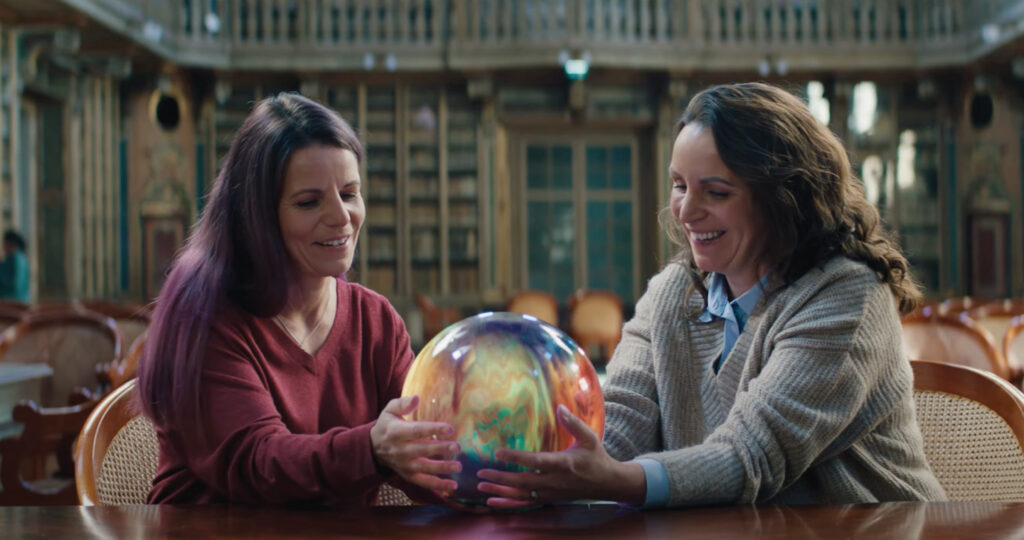
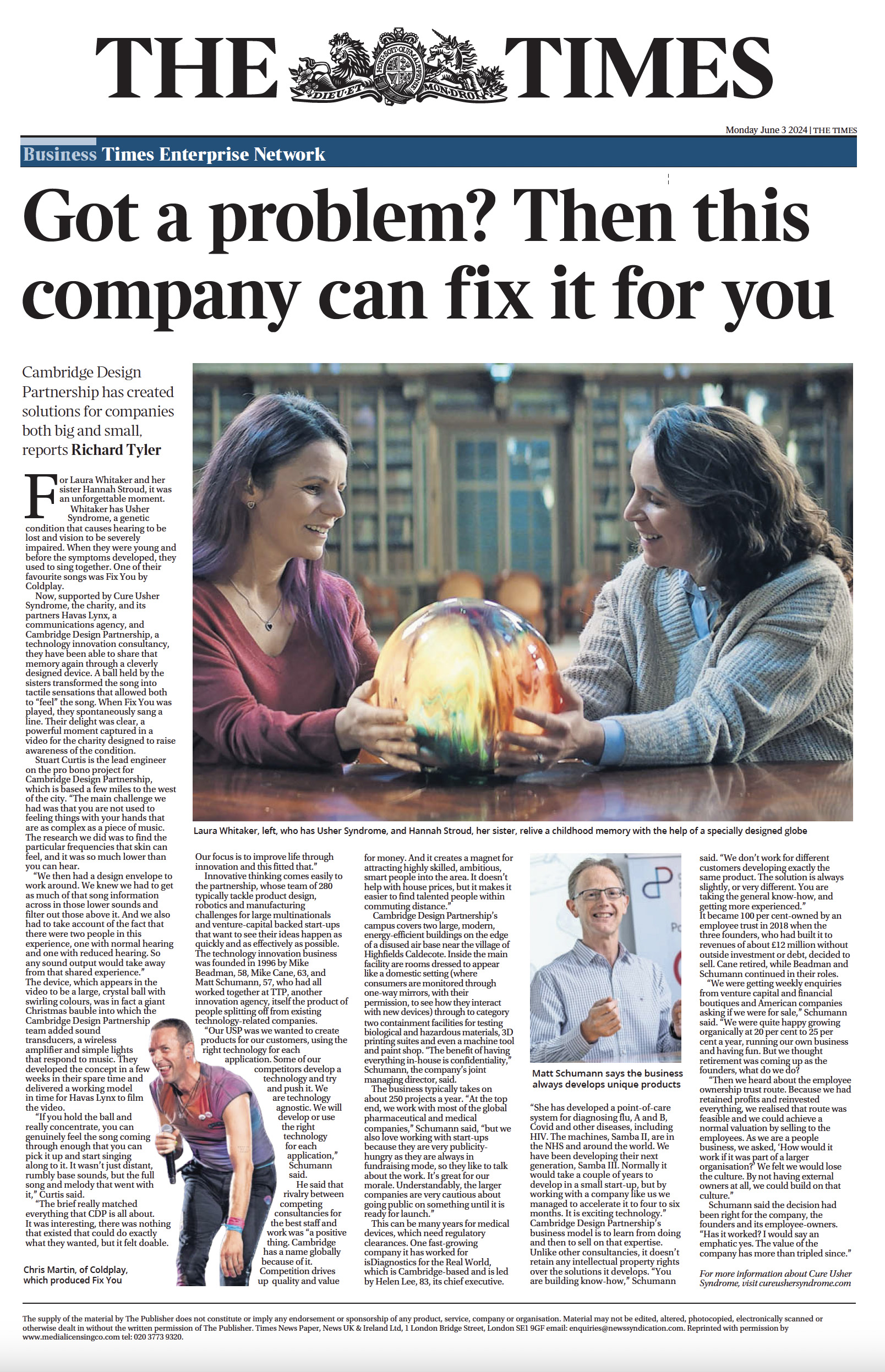
By developing a device to appear in the campaign film that converts sounds into tactile sensations, we enabled the campaign’s real-life sisters – Laura, who has Usher syndrome, and Hannah – to reconnect with a memory in a uniquely inclusive manner.

We invite you to watch the emotional film and explore the press release below.

https://youtu.be/SQXHR3sfoZw?feature=shared


The World’s First Touchable Memory. A Device Created To Raise Awareness About This Impairing Genetic Condition

  • Usher syndrome is a genetic condition that develop in children and young adults causing the loss of hearing and sight in different degrees.
  • Awareness of Usher is low with doctors misdiagnosing 40% of the time leading to uncertainty for families. In the UK around 11,000 people have been diagnosed with Usher, with an estimated 400,000 people worldwide.

Cure Usher Syndrome, a patient-led charity dedicated to raising awareness of Usher Syndrome, has launched its new brand awareness initiative, kicking off with an emotional short film which shows two sisters experiencing the world’s first touchable memory.

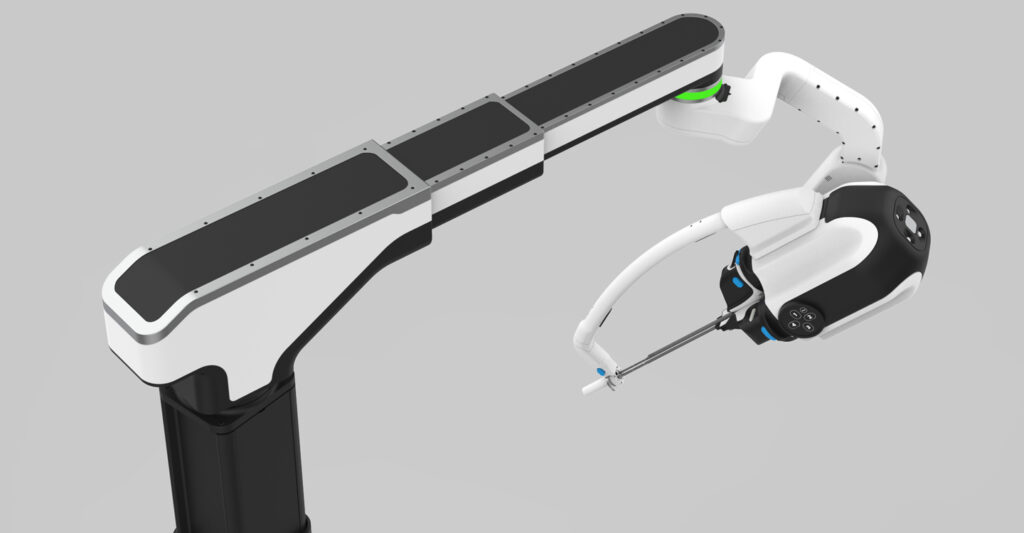
Conceived by leading global healthcare communications agency, Havas Lynx, and transformed into a real device by tech-experts, Cambridge Design Partnership, the device transforms stimuli such as sound or music, into tactile sensations. The frequency of these vibrations is adjusted for the hand’s receptors, which research shows can detect almost nothing over 1,000Hz.

The emotional short film features Laura Whitaker, a woman who has lived with Usher syndrome since a young age and her sister Hannah Stroud. It shows the real-life sisters interacting with the ‘Touchable Memory’, which allows them to experience a moment in time the same way despite Laura’s hearing and sight limitations.

In preparation for the film, Laura and Hannah undertook a series of interviews which allowed the Havas Lynx team to collate information to select a memory to hide in the device.

Not only does the device translate sounds into vibrations, but it was also designed with a specific shape, light, and colour for people with limited concentric sight.

Stuart Curtis, Engineer at Cambridge Design Partnership, said: “Results showed that skin receptors on the hands respond best to low-frequency sound and can detect almost nothing over 1,000Hz compared to our hearing which can detect 20,000Hz. With the use of surface transducers, we translated a synthetic baseline from a MIDI track, into a sensorial experience. These frequencies became physical and allowed Laura and Hannah to feel the music rather than hear it.”

Alex Okada, Chief Creative Officer at Havas Lynx, said: “Since this condition is still incurable, we had to be very careful how to raise awareness without spreading fear. The device was a way to grab attention but the emotional connection between the sisters was what made it meaningful.”

Mark Jordon and Laura Norton are Patrons at Cure Usher Syndrome, they have two young children who both have the condition. Talking about the campaign, both said: “We are proud and privileged to be joint patrons of Cure Usher, and to support this charity in raising awareness of Usher syndrome.

“The film is unbelievably powerful, I think it is going to have a huge impact in raising awareness of usher syndrome and what it means to find a cure. The human element of Laura and Hannah’s story is invaluable, and I can’t thank them enough for sharing their memories and the power that their story holds.

“A huge thanks also to Havas Lynx, Cambridge Design Partnership, and Push Films, all bringing the magical elements to make this emotional film.”

Cure Usher Syndrome is working to raise awareness, support families and raise money for vital medical research. It currently has an agreement with University College London (UCL) where donations directly fund research as part of the Institute of Ophthalmology.

You can donate to Cure Usher Syndrome via its website: https://cureushersyndrome.com/donate-support/

For more information contact: robyn.houghton@havas.com

Matt Schumann
Find the authors
on LinkedIn:

The company that defined innovation – celebrating 25 years of CDP

“We constructed a medical prototype from a borrowed high-resolution tank gunsight, of all things. It looked like some form of Frankenstein’s monster, but it worked,” says Matt Schumann of one of CDP’s early projects.

Alongside his fellow co-founders, Mike Beadman and Mike Cane, he’s celebrating our 25th anniversary with a look back at CDP’s challenges and triumphs.

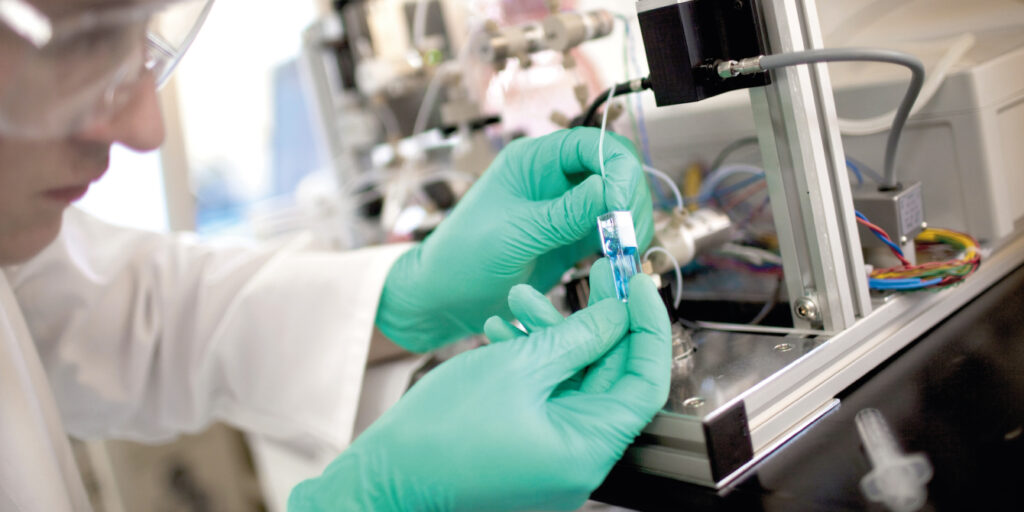
The experimental creation Schumann describes developed into a first-of-its-kind skin cancer diagnostic device. The non-invasive technology has transformed thousands of lives thanks to its unique technology combined with people-centered design.

This is exactly what Cane and Beadman set out to do when they created CDP in 1996, with Schumann joining two years later.

From child’s play to a new design approach

The trio met at a Cambridge technology company, where the two Mikes worked on the world’s first children’s digital camera for Fisher-Price (it took and printed Polaroid-style pictures at a thrifty ¢1 a copy). Influenced by Cane’s engineering and industrial design background, they developed a reputation for taking a different approach from their competitors.

“We weren’t focused on developing a technology and making use of it, but on finding a market need and creating a solution,” Beadman says.

Their employer had other ideas and rejected their suggestion to set up a user-first product design team. A trip to the pub later (and to the initial shock of their young families), they had both resigned. CDP was born.

“It has always seemed obvious to us to start innovation by finding out what customers actually need to solve the challenges that they face,” explained Cane, “and only then start to develop the technology to make this possible.”

The early years

Working from Cane’s living room, they scribbled down three goals for their new company.

The first was to target both consumer products and medical devices. Both industries have specific technical needs and CDP could help remove this barrier to entry for their clients; the second was to spend half of their time consulting, and the remainder licensing their own inventions; the third was a recruitment policy that remains firmly in place today:

“From day one, we took the view that anyone we took on should be more talented than we were. It means you’re always pushing yourself and creates a much more exciting place to work,” says Beadman.

Schumann passed this test in 1998, bringing with him experience in power tools and medical devices (both of which, he points out, require elegant mechanical designs).

A successful spin-off

By then, CDP had moved to a converted stables, which also housed its first spin-off company, Astron Clinica, to develop their cancer diagnostic tool. The project gave the team a valuable insight into the challenges its consulting clients face, as well as some important lessons in business finance.

“Medical device development can take up to ten years to get a return and a small single product company like Astron struggled to build a market fast enough,” says Schumann, “but we also learned that we were pretty good at rapid medical device development and the value of getting into clinical trials as fast as possible.”

The clinical success of the device enabled CDP to sell Astron Clinica in 2001. Buyers were also keen to invest in CDP itself but it was a firm ‘no’ from the co-founders.

“Venture capitalists made long arguments as to why they should invest in the core company, but we believed it would limit our ability to implement long-term plans if we had to answer to people with different goals. It became a turning point in our approach, and we’ve never sought outside investment,” says Beadman.

A turning point

The Astron Clinica development helped CDP gain a reputation in the Cambridge cluster just when a new US medical device company, Pelikan Technologies, was looking for help to design a next-generation blood glucose monitor.

Competing against large established consultancies, the small team worked frantically to complete a series of novel design concepts. As a final touch, they delivered them in person to the Pelikan team’s hotel in Cambridge. Their creativity, collaboration and dedication impressed, and it was on to Phase Two.

The challenge was to design a handheld blood lancing device that would offer users low pain and store 50 lancets. The team worked 20 hours a day in shifts to meet the Christmas deadline for the first working prototype. As Beadman assembled the device for presentation in the client’s California office, Cane and Schumann were still working on design improvements and new components in the UK, to be flown in at the last minute.

“We’ve probably never worked so hard in our lives. There was no alternative if we were going to take this opportunity to move CDP to the next level,” says Beadman.

Pelikan became a major client until it was acquired in 2009, in the process granting CDP the security to expand its workforce and grow a diversified client base, working on projects from DIY tools to industrial printers and new treatments for breast cancer.

From stables to international business

By 2002, CDP had outgrown the stables and moved to a small business center in Toft, Cambridge, eventually occupying all the other units on the same site.

It also set its sights on international markets, setting up a North American sales office in California in 2011 to serve the growing number of startups in the Palo Alto area. By 2019, the US accounted for 25% of CDP’s sales, prompting a move to a new state-of-the-art innovation center in North Carolina. The R&D facility is growing fast and now employs 17 engineers, giving CDP a firm foothold in the state’s famous Research Triangle.

Potential Realized

As it expanded, CDP developed new tools and processes to offer its clients an end-to-end service, from identifying the innovation opportunity to manufacturing. In 2016, this was formalized into a trademarked process called ‘Potential Realized.’  This model helps its clients plan their product development process to make it as commercially successful as possible.

“Over decades of product development experience and thousands of innovation projects, we found the same issues coming up again and again. These programs are major investments for our clients, so it is vital that together we plan them to maximize their return on investment. Potential Realized is a logical framework that we adapt for each project to do this,” says Cane.

Collaboration

The key to making Potential Realized work is cross-functional collaboration, an ethic the co-founders model with their easy-going relationship as joint managing directors (they shrug their shoulders when asked who’s the task-master of the three).

“It’s very well balanced actually,” says Schumann, “CDP doesn’t feel like work. It’s another fun thing that you do when you’re not at home.” Their leisure time, however, sounds pretty fun, too: the trio’s shared passion for aviation led them to build an airplane and buy a second for staff to learn to fly.

A company-wide ethos of collaboration also proved effective in more serious circumstances. In 2020, a large multidisciplinary team came together amid strict UK lockdown and distancing conditions to help deliver an RT-PCR device that can detect COVID-19 within 30 minutes.

Designing the future

As the company continued to expand exponentially, the keen investor interest that CDP attracted from its early days never went away.

“When people want to buy a company, they ask you to name the assets. There’s only really one asset in our business and that’s a highly skilled, flexible and well-organized team of people with a common vision,” says Beadman.

Concluding that a sale to private equity or a big manufacturer would risk the ethos of the company, they decided to sell it to people they could trust. In 2018, CDP became employee owned.

“If we’d ended up in the hands of a much bigger company, it was likely the whole culture that has made us successful would have gone out of the window. Through a diligent process of organic growth and sticking to our principles, we now have a company that provides a stable future for over 250 people. How good is that!” says Beadman.

New owners, new home: next year (2022), CDP will move into an 83,000 sq ft purpose-built headquarters in Bourn, Cambridge. The new facility will have labs, workshops, a healthcare manufacturing facility, user observation suites and a 200-seat conference facility.

While they hope there will still be a few Frankenstein-esque prototypes produced in this new facility, CDP’s design approach is generally more sophisticated nowadays. The founding vision, however, remains: a team of world-class experts collaborating to create the best possible results. It’s this, agree the co-founders, that will set CDP up for another 25 years of innovation success.

Cambridge Design Partnership take on new state-of-the-art headquarters
By Cambridge Design Partnership

CDP takes on new premises as it doubles in size

Exciting times for local innovation company as it announces major expansion and move to new state-of-the-art headquarters in Cambridgeshire

Cambridge Design Partnership (CDP) is expanding to new premises, capping years of growth with a doubling of turnover over the last 12 months. The company, which creates breakthrough products and technologies for leading companies and brands, is moving from its base in Toft, Cambridgeshire to a state-of-the-art, purpose-built facility in nearby Bourn. The move will be completed in 2022.

“This is a great marker of our success and especially pleasing as 2021 is CDP’s 25th anniversary year,” said CDP’s founding partner Mike Beadman. “In just the last 12 months, we’ve served more clients than ever before and grown our headcount by over 50%. Our new headquarters will be more than twice the size of our current base, with a range of product and technology development facilities to compare with any in the world,” he added.

The new CDP headquarters will have 7,500 square metres of space, including labs, workshops, a manufacturing facility and 200-seat auditorium. It will be sited at Bourn Quarter, part of a 25-acre site previously occupied by Thyssen Krupp. Planning permission to start the net-zero-carbon-ready industrial development was secured from South Cambridgeshire District Council by Savills Investment Management. Developed by Aitchison Developments, construction of the new facility began in May 2021. CDP will be the anchor tenant within this prestigious redevelopment which is set to bring the region’s dynamic research and technology cluster to the brownfield site. The move confirms the company’s commitment to the Cambridge area, where it’s able to access the best talent at every level.

Founded in 1996, CDP is an end-to-end innovation partner, delivering market-defining technologies and extraordinary commercial returns for clients in the consumer, healthcare and industrial markets. In 2018, CDP joined a small number of pioneering companies that are 100% owned by their employees. This ensures that CDP’s growing workforce of employee owners is fully committed to client success and to the long-term vision of improving lives through innovation. Alongside strong growth in the UK, CDP recently announced the opening of its new US headquarters, a state-of-the-art R&D centre in Raleigh, North Carolina, and an ambitious recruitment programme in North America.

Among the new facilities will be a world-class consumer research facility for consumer and healthcare insights research and innovation workshops. This will be equipped with observation suites and one-way mirrors for physical focus groups and consumer trials and networked to enable global client participation. CDP is also ramping up its short-run manufacture capability with a large manufacturing facility on site at the new headquarters.

Working in close collaboration with clients has been a core value from the earliest days of CDP. The new building will be unique in being designed to maximize creative collaboration while maintaining the highest standards of client confidentiality. This will be a fundamentally interactive workspace, allowing scientific labs and workshops to be connected to desk areas. There will be a spacious central atrium with a fully-catered kitchen serving breakfast and lunch, as well as a breakout space where staff and clients can meet informally and for meetings. A 200-seat auditorium will be used for company events, conferences, and creative workshops.

“We’re committed to integrating CDP into the wider Cambridge cluster and welcoming clients and peers into our new headquarters. The space will ensure we give our clients excellent service in the very best, cutting-edge facilities and will also offer our employee owners an environment in which they can thrive. Among the many reasons for CDP’s impressive expansion is the fact that the team is closely involved in the company’s future. The collaborative and creative possibilities of our new headquarters make this an excellent time to be an employee owner at CDP,” said Mike Beadman. April 2021 saw CDP kickstart its bid to secure the region’s brightest talent, launching the biggest recruitment drive in the company’s history.

For further information and media enquiries, please contact: marketing@cambridge-design.com or call 01223 264428