Satmap Active 20 Collaboration

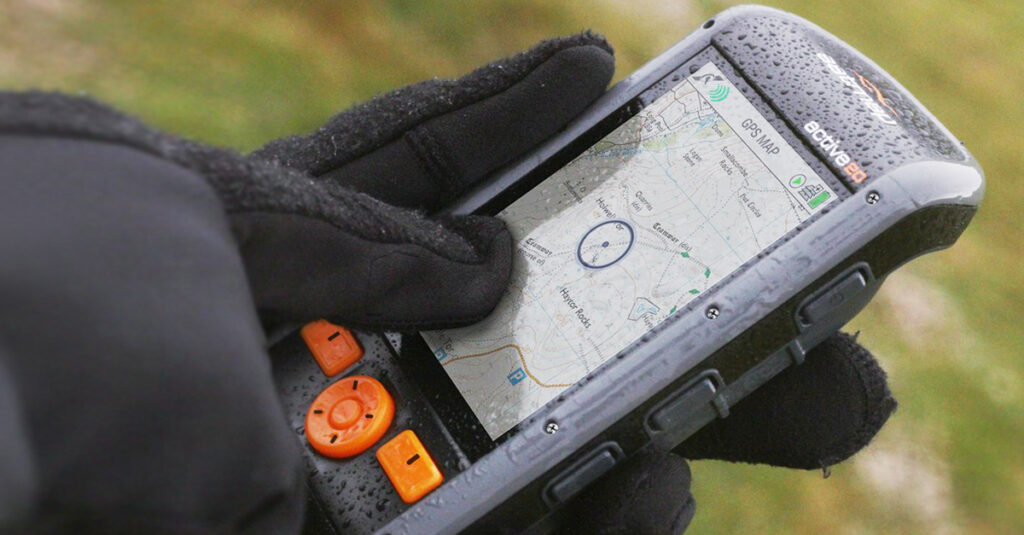
Satmap Active 20 Collaboration with Satmap Systems to create the ultimate rugged, high-performance sports GPS device

The Challenge

Following the success of its Active 10 and Active 12 GPS devices, Satmap Systems decided to create the next generation of Active devices – with improved screen toughness, button functionality and waterproofing. It also wanted to incorporate new features such as a touchscreen, Wi-Fi connectivity, improved GPS and a unique dual-battery system.

APPLIED EXPERTISE

  • Research & strategy
  • Human factors
  • Industrial design
  • Packaging
  • Technology development
  • Mechanical engineering
  • Electronic engineering
  • Software engineering
  • Wireless & connected
  • Short run manufacturing
  • Manufacturing processes
  • Supply chain management

The Solution

Our first step was to gain human factors insights and gather customer feedback from previous models to feed into the design process. Our industrial design team then worked to maintain and enhance the brand, while our engineers integrated the new functionality and developed the mechanical design to meet the extreme requirements of Satmap customers.

Proof-of-concept tests ensured that the custom Gorilla Glass touchscreen within the ultra-rugged case design exceeded IK7 grading in impact tests and achieved IP68 rating for water submersion.

Benefit to Client

The new Active 20 was a sell-out success within days of its launch.

“We’re really pleased with the Active 20 – we’ve integrated all the exciting new technologies we were hoping to, while maintaining our customers’ favourite features. We are confident the Satmap experience will be better than ever.”

Howard Dyson, managing director and founder, Satmap Systems

IMG_8697-1

Celebrating 21 years of innovation

We celebrated Cambridge Design Partnership’s 21st birthday this month with a cruise down the River Thames followed by a black tie dinner for our staff at the Houses of Parliament in London.

Mike Cane, founding partner, said: “It was thrilling for us to be able to stage a very special dinner for the company in the Members dining room at the Houses of Parliament to celebrate 21 years of excellence in research and development. It was a great privilege to be shown around the House of Commons – the centre of government and democracy in the UK – before retiring to the dining room for our celebration. Standing under statues of prime ministers including Churchill and Thatcher in the members lobby brought home the amazing history of the palace, and added resonance and gravitas to our celebration.”

It was back in 1996 that CDP opened its first office near Cambridge, UK.  Founders Mike Cane, Mike Beadman and Matt Schumann shared a vision that product development would be best executed by taking a more holistic approach compared with more specialist agencies. Mike Beadman said: “When we started CDP we did not quite know what to expect and initially we just focused on survival from month to month. However, we are very pleased that we have been able to grow consistently for 21 years by providing a great service to our customers and reinvesting our profits to develop the world-class team needed to be the best at what we do.”

CDP’s emphasis is on putting the customer at the centre of a 360-degree innovation process that encompasses design, engineering, manufacturing and strategy to deliver complex and challenging products to market with an increased chance of commercial success.

This insight has stood the test of time and recently matured into ‘Potential Realised’ – CDP’s industry-leading and state-of-the-art innovation process. The team and facilities have also grown to deliver this vision, with more than 100 scientists, researchers, engineers and designers operating from a new R&D centre close to the original offices near Cambridge, and from an office in Silicon Valley in the US.

Matt Schumann, the third founding partner, said: “Our success is certainly thanks to our committed and talented team – and our loyal customers who come back to us time and time again. At the heart of the company’s DNA is a passion for innovation and a commitment to excellence in whatever we do. We are certainly looking forward to another 21 years of innovation.”

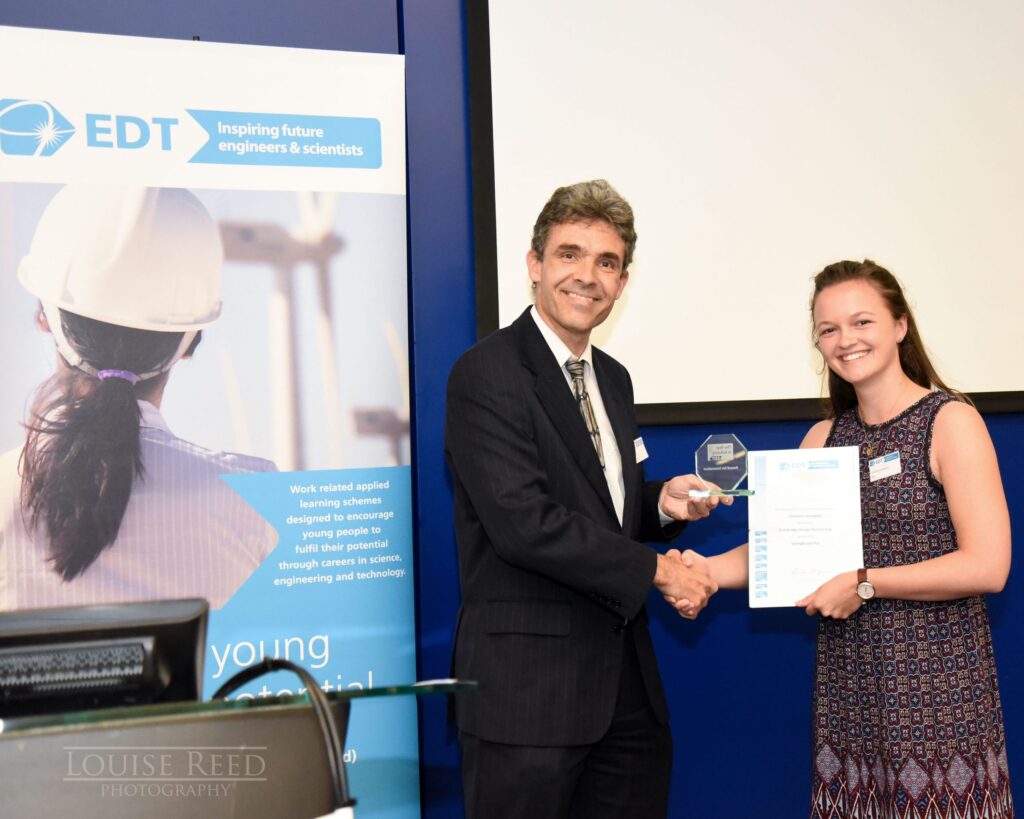
Charlotte won the Engineering Development Trust’s ‘Award for Innovation’||

CDP interns wins engineering innovation award

Following the recent and very popular blog “How to succeed as ‘Year in Industry’ students without burning the place down”, we are pleased to announce that our Year in Industry Student, Charlotte, has recently won the Engineering Development Trust’s ‘Award for Innovation’ at a competition in London on 3rd July.

Charlotte explained, “Each finalist presented for five minutes about the projects they have been working on during the year, ranging from cutting-edge heart surgery techniques to sustainable transport in Wales.  I talked about an exciting project where I helped create a novel fluidics kit for sample preparation for medical diagnostics. This work could lead to a new technology to enable point of care devices that will give patients immediate test results at a relatively low cost.”

She continued, “I am proud to have won this award. ‘Year in Industry’ is a spectacular scheme and I knew I would take a great deal away from my year, but I never expected this to include a little glass trophy.”

CDP Partner Jez Clements added, “Our congratulations go out to Charlotte for winning this exciting award. It just highlights the value the scheme has in developing the next generation of engineers. We have certainly enjoyed our students’ contribution over the last year and we wish Charlotte and Immy every success when they go to University in September.”

Cambridge Design Partnership launch a new digital insight service

Research, design and technology consultancy Cambridge Design Partnership is pleased to announce the launch of diialog™, a new insight service that helps gain a deeper understanding of consumer behaviour.

diialog™ uses miniature sensing technology discreetly fitted to products or packaging to capture quantitative data during user tests. Our team of experts monitor activity in real-time or at the end of a trial to generate a conclusive analysis of consumer behaviours and usage patterns.

Being largely unseen, diialog™ encourages natural behaviour and can be particularly useful in sensitive consumer goods, personal or healthcare contexts to record specific actions and routines. Furthermore, the data is totally factual and impartial, removing any ambiguity or misreporting.

The quantitative research inputs that diialog™ generates are invaluable when translated by our experts into actionable insights and fed into the product design process. The outcome is the creation of market-led products that are more closely tailored towards the end user with enhanced or entirely new product experiences.

Many studies suggest the failure rate of new product introductions is high, according to Crawford C Merle, 35% of products fail to deliver significant return1. When a product successfully meets, or exceeds the expectations of users the returns can be high, therefore delivering an optimised experience is of fundamental importance to protect the innovation investment and brand reputation. The thinking behind the diialog™ service is that a modest increase in investment at the front end to develop deeper insights, and validate new concepts and experiences can achieve greater confidence and save vital time and money downstream.

Tom Lawrie-Fussey, Cambridge Design Partnership’s Technology Development Leader explains, “We’re excited about diialog’s™ ability to help our clients’ make more informed innovation investment decisions and better manage risk. It will benefit brand owners and manufacturers who believe in a consumer-centric approach to product design, as they now have access to additional, highly accurate information that complements existing qualitative and quantitative research techniques that can be combined and compared with contextual ethnographic insight to deliver further confidence of potential in-market success.”

diialog™ has already been successfully deployed in the cosmetics and sports industry and there is a great deal of interest in other sectors such as the food and drink, healthcare packaging and medical devices.

CDP will demonstrate the diialog™ system at this year’s FEI 2017 conference in Boston. Please come and join us on May 8th – 10th for a discussion and live demonstration at booth 7.

To find out more about diialog™ contact us at hello@cambridge-design.co.uk.

 1Why Products Fail

ABOUT CAMBRIDGE DESIGN PARTNERSHIP

Cambridge Design Partnership is located in both Cambridge UK and in Palo Alto California, USA. It is a leading technology and product design partner focused on helping its client’s businesses grow. Some of the world’s largest companies trust CDP to develop their most important innovations.

Cambridge Design Partnership specialises in the consumer products, healthcare, energy and industrial equipment markets and its multidisciplinary staff have the expert knowledge to identify opportunities and solve the challenges its clients face.

Visit Our Site 

Contact us at hello@cambridge-design.co.uk

B6 Berrelium CDP pic 3

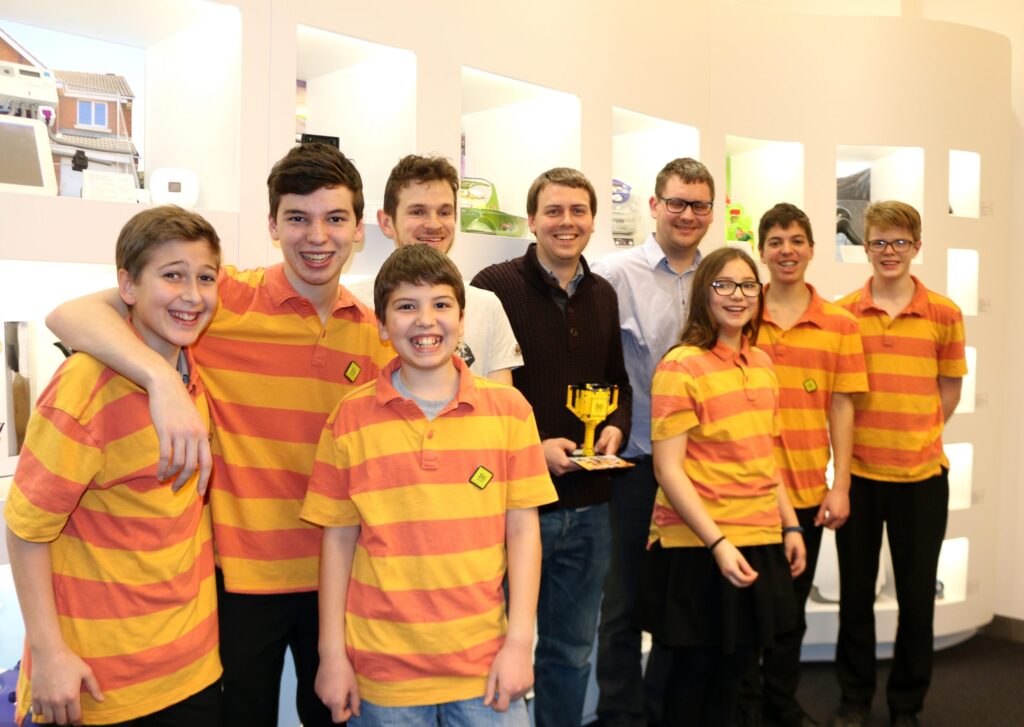
CDP mentor young engineers who go on to win the UK fist Lego League

FIRST® LEGO® League (FLL) is a global science and technology challenge for teams of students from 9 to 16 years, which encourages interest in science and technology and can develop key skills that are crucial for their future careers. The students work together to explore a topic and to design, build and program an autonomous LEGO robot to solve a series of missions.

CDP engineers have been mentoring our local team ‘B6 Berrellium’, and we are very pleased to report that last month they won the UK First Lego League in Bristol.

B6 comprises of six members, Albert, Quim, Oscar, Joan, Iona & Lluis, aged from 11 – 15 years. If you spend more than five minutes in a room with them you can’t fail to be impressed by their enthusiasm, creativity and ingenuity.

B6 first knocked on CDP’s door last year, as they’d heard ‘there was lots of cool stuff happening’ in our Cambridge R&D centre, and asked for a tour. We showed them the labs, Hackspace, workshops, and some of the products we have designed that are now on sale. Their enthusiasm soared on discovery that CDP staff have been both FLL contestants and judges in the past, and that we were only too happy to offer some advice and guidance.

From then on, CDP’s Adam Pledger, Oliver Hart, Mike Worth and Stuart Curtis had regular get-togethers with B6 to discuss potential projects for the FLL competition. With this year theme being Animal Allies, B6 settled on working out how they could use technology to protect honey bees from Asian hornets. For our mentors this meant trying to bring a practical perspective to some extremely ambitious technical solutions as the B6 team bounced ideas off each other. We empathised as we do the same thing here every day!

The second part of FLL competition is the Robot Game where they must build and program a robot to autonomously complete a series of missions. Each time we met they updated us on their progress. One requirement was to transfer barrels from one end of the board to the other in a limited time period with all machinery starting off in one corner. Their solution was to build a deployable structure to bridge the gap and send the barrels all in one go, which required lateral thinking, neat design and careful planning.

These solutions allowed B6 to win the UK FLL competition. The next challenge is to take their project and robot to the FLL World Festival in St Louis, USA in April and we wish them luck!

To find out more about B6 Berrellium, visit their website or tweet them @berrellium.

CDP’s new Hackspace helps us design better products

We have recently opened a new Hackspace within our Cambridge R&D centre to complement our extensive lab and traditional workshop facilities. We asked the team what the rationale is behind this new facility.

Mike Cane, partner at CDP explains, “Our mission at CDP is to create market-leading new products for our clients as quickly and efficiently as possible. To achieve this we take an evidence-based approach to make the right design and engineering decisions along the way.  The new Hackspace gives our engineers and visiting clients an informal space to collaborate, produce rapid prototypes and conduct proof-of-concept testing.”

He added, “When I was an undergraduate at Cambridge University one of our tutors told us that the only way to gain knowledge is through experimentation. It was one of those career defining moments for me. While inspiration and analysis are crucial to solve problems quickly they only get you so far. When you are creating something new you have to engineer it, build a prototype and test it in the lab. Unfortunately there are no short cuts. This is why we have invested heavily in lab and workshops facilities at our Cambridge R&D centre so we can do this quickly to a high standard.”

Reece Gale, site and workspace manager continues, “CDP has a large, well-equipped traditional workshop that includes several CNC machine tools, injection moulding machines and two high-end 3D printers. We encourage all our project teams to get hands on and use these facilities. But recently we are finding that the new generation of engineers joining us from university are more at home with digital prototyping methods than traditional workshop machines. That’s why we have opened the Hackspace. It brings together 3D CAD with the new generation of low cost 3D printers and laser cutters in an environment that is collaborative and creative. It’s a different way of working that is natural to the emerging digital generation. You can make almost anything using Delrin sheet, a laser cutter and a 3D printer!”

NEW DESIGN YEARBOOK 2017 Read all about our landmark year in 2016 and partnering on innovation with the best in FMCG and healthcare

Cambridge Design Partnership (CDP) had a landmark year in 2016, demonstrating global application of its holistic end-to end innovation approach, ‘Potential Realised’. Linking a combination of research, science, technology, engineering, manufacturing and design into a single integrated process, it developed many successful innovations for clients in FMCG and healthcare – collecting some prestigious industry awards along the way.

Through its office in Palo Alto, its presence in the US market grew significantly, with the likely changes in the healthcare landscape a major focus for clients. Furthermore, CDP’s Front End Innovation (FEI) capability matured with researchers regularly meeting consumers in locations including Brazil, Germany, USA, Sweden, Japan and Mexico. It also launched a new connected packaging/activity-logging platform, diialog™.

First Response Monitor
Measuring and monitoring vital signs of trauma patients remains a time-consuming, manual process for first response medics. It becomes much harder in a mass casualty situation when rapid triage, evacuation and safety are critical factors. CDP identified the need for a low-cost/oneuse device to bridge the gap between manual patient monitoring methods – which can be laborious and challenging in a disaster zone – and more expensive, less portable monitoring systems. The resulting First Response Monitor (FRM) is a lightweight, sterile, single-use, connected wearable device that attaches to a patient’s nose. It displays real-time vital signs patient data and connects to a smartphone or tablet, allowing medics to perform simultaneous multiple-patient triage.

Early in the project, CDP’s researchers and designers spent time with civilian and military medics to understand the conditions they worked in, tasks performed and the challenges presented. Rather than trying to improve existing devices, CDP reviewed what was actually needed: a fast way of assessing and monitoring key human biometrics (heart rate, breathing rate and SpO2). Focusing on measuring ‘breathing rate’, CDP soon identified that a patient’s nose region could provide all indicators necessary via low-cost sensors usually found in consumer products. A number of rapid prototypes centring on a nosewearable device followed.

Integrating device connectivity led to custom app development which enables medics to monitor several patients simultaneously and be notified instantly if their vital signs start to deteriorate. Since its launch, CDP has received sales enquiries from around the world and won a number of awards including two Red Dot: Concept Best of the Best awards and an Electra European Electronics Industry Award for Design Team of the Year. FRM was also included in the Nominet100 list of the 100 most inspiring examples of Tech for Good.

Read the full article here…

CDP hosts European entrepreneurs to share innovation insight

In recent weeks CDP hosted two delegations of entrepreneurs from Europe, who were keen to learn more about how they could use innovation to create value in their early stage businesses.

The entrepreneurs, from universities in Finland, Latvia and Estonia, visited Cambridge Design Partnership as part of a Venture Camp organised by Professor Alan Barrell.

Cambridge is a key destination for entrepreneurs seeking to learn what makes one of Europe’s largest technology hubs so effective at generating and commercialising new ideas. While Cambridge is best known for its world-leading university, recent statistics show that the Cambridge cluster hosts over 4,300 knowledge intensive companies, employing nearly 60,000 staff and turning over £11bn.

Alan Cucknell, CDP’s Front End of Innovation Leader, hosted the Finnish group. Together they explored why so many innovations fail and identified some common pitfalls. Alan highlighted the importance of building innovation for both entrepreneurs and bluechips on an evidence-based framework. He also introduced them to CDP’s process for identifying market insights, translating these to compelling ideas and then developing optimised products. (CDP calls this Potential Realised). Alan reflects on the visit, “I’ve learnt a lot about innovation from entrepreneurs and start-ups. It was super to spend the afternoon meeting entrepreneurs from such a range of industries and sharing our experience of what it takes to succeed with innovative businesses.”

Mike Cane, Partner and Founder hosted the Latvian and Estonian teams. The energetic entrepreneurs were keen to pitch their business concepts and receive feedback from CDP’s team. They were developing an exciting range of businesses including micro car parks for busy cities, laser therapy devices and an app-based incentive scheme for food brands.

“It’s always great fun meeting entrepreneurs”, explains Mike. “Turning ideas into commercial products is our expertise and we’re passionate about it. So meeting enthusiastic entrepreneurs who are at an early stage in their business journey is very exciting. We had so much experience to share with them and wish them every success in their respective projects.”

Uri Baruch CDP HR

Uri Baruch appointed Partner at Cambridge Design Partnership

Press Release Issued 17/1/2017: Cambridge UK, Head of Drug Delivery, Uri Baruch has been appointed as a partner at the Cambridge-based product design and innovation consultancy.

Uri is a senior mechanical engineer and expert in drug delivery devices. For more than four years, he has led the Drug Delivery sector at Cambridge Design Partnership (CDP), delivering a wide range of design projects including an award-winning needle safety device, an emergency auto-injector and pen injector packaging designs for delivery devices and inhalation products. These led to successful submissions to both FDA and EMA in several submission categories.

Uri has a Master’s degree in Engineering from the IIT where he specialised in MEMS (Microelectromechanical systems) design and materials engineering. He’s worked across a number of industries including aerospace and defence, medical devices, automotive and Inkjet. He has extensive knowledge in design for manufacturing and process design and was involved in setting up and transferring several production lines around the world.

Uri commenting on his appointment,

“My appointment to partner shows the importance of Drug Delivery to CDP and the global healthcare marketplace. The healthcare landscape is changing in all of the world’s key geographies due to a combination of rapidly ageing populations, increased patient load on healthcare infrastructures and financial pressures on providers.
CDP is already innovating in this space with a number of the world’s leading manufacturers who are seeking to address these challenges. Among areas we can discuss, we’re looking at the managing high viscosity formulations in drug products, how device connectivity can support dosage adherence and continuing to increase usability and compliance across all new device developments.

I look forward to spearheading the further expansion of our Drug Delivery capability and team here [in the UK] and in our US office in Palo Alto to support this work.”

CDP partner and founder, Mike Cane on Uri’s appointment to partner — “He [Uri] will lead the expansion of the important Drug Delivery Device sector at CDP. He’ll be building on the success that our dedicated team has enjoyed so far, with a series of initiatives to enhance the services that we provide to our global customers. We are pleased to announce his appointment.”

IMPLEMENTING MEDICAL DEVICE CYBERSECURITY James Baker is guest columnist on Med Device Online

Connectivity is ubiquitous – it’s moved beyond an overhyped buzzword and become part of life. Offering ever-advancing levels of access, control, and convenience, widespread connectivity also increases the risk of unauthorised interference in our everyday lives.

In what many experts believe was a world first, manufacturer Johnson & Johnson recently issued a warning to patients on a cyber-vulnerability in one of its medical devices. The company announced that an insulin pump it supplies had a potential connectivity vulnerability. The wireless communication link the device used contained a potential exploit that could have been used by an unauthorised third party to alter the insulin dosage delivered to the patient.

It’s not hard to imagine the devastating impact to both consumers and the company if the reported vulnerability had been exploited. However, risks such as security will not prevent evolution of connected devices – demand for ever-increasing levels of convenience and access are driving the continued evolution and adoption of these products and services.

Cyber-security considerations shouldn’t be viewed as stumbling blocks for the connected device concept. Rather, it’s another of the many product requirements which, if considered and specified correctly at the design stage, can be implemented robustly. Above all, cybersecurity can be validated as part of a wider-reaching regulated device development process. It can’t be considered an isolated element to be bolted on, since it inherently helps to define the system architecture of what is developed.

Read full article.