Sustainable music festivals

Why are music festivals leading the sustainability agenda?

In 2019 the music festival industry experienced a sea change in their attitude to single-use plastic, with many large live events making the decision to ban it altogether. As the festival season draws to a close, CDP’s Matt Morris, mechanical engineer, sustainability expert and live music fan, looks at what product designers can learn from festival greening in 2019.

Matt says: The big change in the world of festivals this year was the move away from single-use plastics, all part of a general shift towards sustainability and better environmental practices at live music events.

In February 2019 the UK’s biggest festival, Glastonbury, announced it was banning single-use plastic bottles – saving the production of a million plastic bottles. Then many others followed, pledging to stop single use plastics by 2021.

Here at Cambridge Design Partnership, our aim is always to design out unnecessary waste so our clients are as sustainable as possible. So having attended several festivals myself this summer, and having seen the changes taking place first-hand, I am struck by what we can learn from these temporary communities as they strive to go plastic-free.

Join us to address some of the greatest environmental challenges of our era

We’re currently recruiting for a Sustainable Design Consultant, Life Cycle Assessment Engineer and a Head of Sustainability.

Starting with a closed system

Cutting out single-use plastic and greening your market is easier in a small enclosed community where the same organisation controls both the input of products and output of waste. This is, of course, the case at a music festival, where the sale, distribution and disposal of plastic is all within the remit of the same festival organisers.

It is far more straightforward, for example, for Emily Eavis to announce that Glastonbury is banning plastic bottles given that all the drink sales points and backstage hospitality facilities are licensed by Glastonbury Festival itself. The festival also organises the collection and recycling of waste after use, which means they are heavily invested in getting the recycling and disposal right.

However, in the wider world, communities and nations are faced with a far more challenging and fragmented proposition. Traditionally supply chains are one way, from manufacturers to consumers, and are motivated by maximising sales and minimising costs. Consumers are not encouraged by manufacturers to see any value in packaging, they often believe it is somehow free so don’t value the materials and energy encapsulated within it. In addition, waste systems are there to collect and dispose of packaging in isolation of its use and production. This means there is little incentive to coordinate the cycle of production, use and recycling. Although some forward thinking communities are now aiming to change this, for example via the plastic-free towns movement.

Here at CDP, we have been working with food service providers to create plastic-free packaging for closed environments such as transport systems, schools and hospitals. This allows those in charge of these institutions the choice to remove single-use plastic, and can act as a test bed for new solutions prior to more widespread adoption.

Considering the alternatives

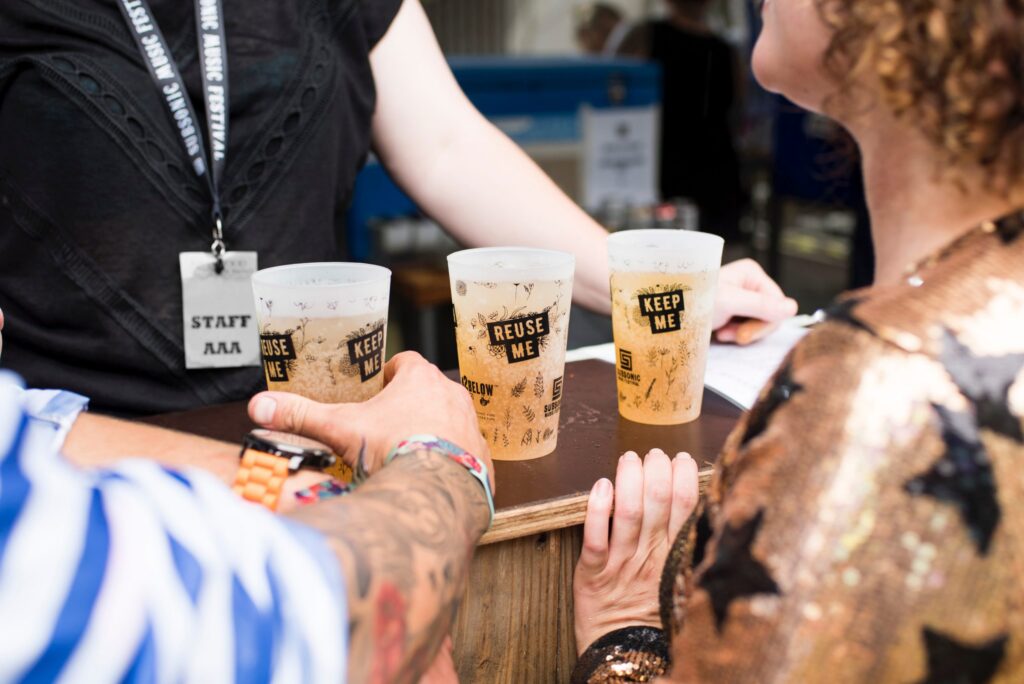
Many festivals in 2019 chose to replace disposable plastic cups with sturdier ones that could be reused at any bar within the grounds. However, I was intrigued to see that plastic pint glasses were replaced at Glastonbury this year by stainless steel tumblers. These cost £5 each to buy and festivalgoers could either keep them or return them for a full refund on departure. It seems that the backlash against plastic has extended beyond just single-use plastics, prompting designers to consider materials that would not have been on the table just a few years ago.

However, material selection needs careful consideration. In terms of its impact on the planet, a steel cup may need to be reused many more times than a re-useable plastic one to offer a net benefit. Good design can help with this conundrum, by creating things that are a joy to use again and again. Judging by the fact that the Glastonbury 2019 stainless steel cups are now selling for £12 on eBay, leveraging the Glasto brand seems to have worked in this case!

It helps to engage with cultural influencers

Changing consumer habits takes significant effort. But at Glastonbury this year, I lost count of the performers who lent their approval to the plastic-free initiative. From rappers to rockers, many of the artists (who could only drink canned water on stage) spoke out during their sets in favour of the plastics ban, helping it to gain traction with a captive and approving audience.

What’s more, within the festival setting, there are dozens of ways to keep the initiative in the crucial ‘top of mind’ spot for peak consumer awareness. With kiosks everywhere offering free water and selling reusable cups, a festival is a great place to pioneer sustainable practices and encourage early adopters.

To replicate this in the wider economy is less immediate but not impossible. Frequent positive reinforcement through influencers, marketing and advertising does eventually have an impact.

Taking a holistic view

One of the ways in which CDP designs genuinely more sustainable products is by analysing the impact of the product through its entire life cycle. At festivals, it can be all too easy to take the feelgood option while the real environmental implications are more complex.

For example, the widespread switch at festivals this year to disposable cardboard or wood food packaging instead of plastic may create that positive vibe – but does it have less conspicuous drawbacks? It certainly reduces plastic waste, which is a very visible problem, but equally crushing a tree down into small fibres, mixing the wood pulp into a slurry and then passing it through huge rollers takes lots of energy and water. By contrast, plastic is light, durable and its manufacture is generally not particularly energy intensive. So we may be trading a plastic waste problem for an energy and water problem.

And if we rolled out this transition globally, could our forests (which, frankly, are in need of some TLC right now) support the demand for wood and pulp? It’s important to factor this into your environmental calculations before making a knee-jerk decision to switch materials or abandon plastic packaging. As designers, we have an obligation to weigh up these impacts, because it’s not fair to expect every consumer to have the necessary expertise.

At CDP we work with major beauty product manufacturers to develop packaging and products. Often, it’s important to look at the way the product is used, as well as its constituent parts, before making changes. For example, there can be as much benefit to the planet from encouraging consumers to switch off a running tap when brushing their teeth (wasting potable water and its processing and distribution energy) as there would be from asking them to switch to a bamboo toothbrush. At CDP we look at the entire lifecycle of a product, and the context in which it is used, to get a clear view of all the impacts on the planet.

This holistic view is also the key to creating genuinely innovative sustainable products and services. As consumers grow ever more discerning and the environmental movement becomes the mainstream, this approach will be critical to successful and sustainable product innovation.

In packaged products

In packaged products, context is king

Chris Houghton leads Brand Innovation & Packaging at Cambridge Design Partnership, he has worked on an array of successful insight, design and strategic innovation projects with top consumer goods names including Arla, Carlsberg, Coca-Cola, Diageo, Nestle, PepsiCo, Procter & Gamble and Unilever.

Following his ‘Context is King’ keynote speeches at PACE in Amsterdam and AIPIA in New Jersey, he summarises five key questions brands need to answer when building an innovation pipeline.

Bill Gates famously wrote, Content is King back in 1996. His forecast…“Content is where I expect much of the real money will be made on the Internet”…

How right he was as we’ve seen the digital revolution establish over the past decade. On demand streaming services have overtaken traditional audio and video formats with gaming next on the horizon. Coupled with new business models, the likes of Uber and Airbnb have tapped into consumer demands making brands sit up and think what should we do to take advantage of this fertile digital landscape?

Context #1. Who?

Who are you designing for? Do you understand their cultural sensitivities, their customs and established rituals? Do you know their values? Their gender or generation? Their mental and physical abilities? Are they tech-savvy – do they need to be? The better you understand specific population cohorts the better your chance of successfully meeting their expectations.

Each culture and country has its own technology trajectory and utilisation levels. The worldwide average for time spent on the internet is now 6hrs 42mins which is just above USA’s average but some way short of chart toppers the Philippines clocking in at over 10hrs per day (source Digital 2019, wearesocial.com users aged 16-64).

Some categories like beauty and cosmetics are ahead of the curve with high digital engagement. L’Oreal was one of the first brands to realise this with their Makeup Genius app which allows users to compare before/after make-up and hair effects on-screen. This pre-purchase, augmented reality tool enables fast navigation of product choices to help consumers decide what to buy – within two years L’Oreal said it had 20 million users worldwide.

For decades, beauty brands have been heavily reliant on celebrity endorsements or experts in lab coats to target and assure consumers but today that paradigm is changing. Millennials increasingly seek individuals that they can relate to, building seemingly intimate relationships with those they follow on Instagram and YouTube channels, who ultimately steer their lifestyle decisions. This mix of opinions, edited evidence, facts and ‘fake news’ can confuse many consumers, so building trust is more important than ever.

Context #2. What?

What category does your brand belong? Beverages, confectionery, personal care? The answer to this is obvious, of course and you’ll invest great effort closely tracking the activities of your competitors. But that is just the start. Innovations don’t always come from your direct competitors. Instead, brands are often blindsided from an unassuming left field competitor, arriving at speed with disruptive and transformational innovations. For instance toothpaste brands didn’t expect their category to be impacted by confectionary companies making chewing gum with teeth whitening claims.

We look at the ‘what’ in a solution agnostic way using the ‘jobs-to-be-done’ methodology. In a nutshell this approach states that when consumers become aware of a job they need to get done, they look around for a product or service that they can hire to do so.

Procter & Gamble’s Tide is a good example of a brand that have extended their portfolio to cater for changing contexts. The core range is unsurprisingly traditional powder, liquid and convenient pod packaging, but more recently Eco-Box was introduced to address e-commerce shipment and improved sustainability stats. The brand has even stretched beyond products solutions with the test market launch of Tide Cleaners. A direct to consumer, digitally enabled, subscription service that targets ‘generation rent’ to simply drop/collect dirty/clean laundry. This cleverly allows the brand to reach new consumers whilst experimenting with new business models, partnerships and logistical infrastructures in a low risk way.

Context #3. Where?

Where is your product used? At home, at work or on the go? Each location may present a different hierarchy of jobs. In fragrance, for example perfumes have clearly defined packaging conventions. Consumers expect a thick-walled glass bottle, an elegant closure with a precise dispensing atomiser. This objet d’art is entirely appropriate to adorn a home dressing table. However, if on the go,  this format no longer seems so practical for a handbag.

In 2017 British parfumier Jo Malone launched Fragrance Paintbrush under the brand Jo Loves. A compact perfume gel applicator that is crucially handbag friendly. This delivers an entirely different application ritual, delicately brushing quick drying fragrance onto the skin rather than the traditional perfume spritz.

In a digital, augmented world understanding the ‘where’ is crucial to enable or enhance the experience, especially when leveraging the surrounding environment. Whilst outside the packaged goods world, I find EuroStar Odyssey an insightful and charming experience to entertain children during a long train journey. Instead of uninspiring views inside a concrete tunnel beneath the English Channel, the carriage is virtually transformed into an underwater viewing gallery with dolphins and whales swimming besides you to help families kick start their vacation.

Context #4. When?

When is your product used? This can have a crucial bearing on consumer engagement levels especially regarding available time and tolerance levels. For example, a parent making up baby formula has very different functional, emotional and social ‘jobs’ depending on the time of day. Sterilizing equipment, measuring and mixing powder at 3pm is very different to 12 hours later for the 3am feed in the dark whilst you’re still half asleep, was that 4 scoops or 5?

When is a crucial dimension for digital interaction too. Many successful smart packaging examples have come from high engagement categories like alcoholic beverages and beauty where consumers make extra time for interaction and brand owners see sufficient ‘value’ to deploy cost sensitive technologies and/or content.

Context #5. Why?

Why should we choose your brand? What motivates us? What jobs are we trying to achieve? ‘Why’ ties together all of the other contextual considerations and forms the heart of any value proposition and reason to believe.

Take PepsiCo’s Gatorade brand for instance with their emotive message of #WinFromWithin. They understand people are motivated to ‘win’ especially in a sporting context. This reinforces how the brand was created in 1965 by scientists to provide athletes competitive advantage through superior hydration. Fast forward 50 years and the brand found themselves losing share with an influx of competitors big and small. To reverse this trend they identified contextual consumer jobs to cater for their needs more comprehensively. This prompted the launch of G Series, primarily a ‘When’ based product range to help athletes before (Prime), during (Perform) and after (Recover) sporting efforts. This triggered their portfolio to grow beyond solely sports drinks into food to create an ecosystem of sports fuels, from chews, bars, powders, drinks etc. More recently we’ve seen the launch of the Gx Bottle, a smart hydration system that helps individuals to customise their own products, with connected sweat tracking and variable carbs and electrolyte pods, the Nike ID of the hydration world.

So ask yourself, is your brand prepared for this revolution? Do you cater for those consumers that don’t accept one-size-fits all? Whilst Content may be King in the purely virtual, service-based world, Context is King for physical, packaged offerings where content can augment and enhance the physical experience rather than be able to entirely replace it.

Mars Petcare – smart-pill illustration

CDP create a remarkable ‘smart pill’ for Mars Petcare

A team from Cambridge Design Partnership has created a ground-breaking ‘smart pill’ to gather crucial nutritional information to help develop innovative new pet foods.

CDP scientists and engineers worked with the world-renowned Waltham Centre for Pet Nutrition on an electronic pill to collect food samples inside the canine gut during digestion.

“It was certainly an unusual request and a major challenge,” says Will Bradley, who led the project for CDP. “Mars Petcare wanted to find out more about how dog food is digested, with the aim of improving their pet food. So they asked us here at CDP for help.”

“They needed samples of partially-digested food that they could gather in complete safety for the dog.”

Part of Mars, Incorporated, Mars Petcare has a portfolio that spans pet nutrition and health through brands including ROYAL CANIN®, WHISKAS® and PEDIGREE®. For Mars, CDP created a smart pill about the size of a grape that a dog could easily swallow.

“We gave it a sensor so that it knows when it has left the acidity of the stomach and entered the first part of the intestine,” explains Will. When it is correctly located the pill opens and takes a food sample, using a miniature piston-type mechanism. “This needs to be absolutely foolproof. The pill then closes, to contain and protect the sample as the pill moves through the remainder of a dog’s digestion.”

CDP was approached by Mars Petcare to bring to life an idea for intestinal sample collection in dogs. CDP created the pills at its laboratory in Cambridge, which were trialled at the WALTHAM Centre for Pet Nutrition in Melton Mowbray, the global pet research centre for Mars. There were many studies and iterations needed to refine the design.

The samples that are collected will be used to analyse the way various nutrients are absorbed during digestion. “The scientific understanding of this whole process had basically stalled for decades,” explains Mike Cane at CDP, who has worked on the project for the past 18 months, “because no one could retrieve these samples without invasive surgery to the dog.”

Working with animals is not straightforward, Mike admits: “At all times, there were such high welfare standards. An independent observer was on hand whenever we worked with the dogs. If any dog was looking uncomfortable they would intervene to stop that day’s trial. They really do pride themselves on the way the animals are treated there.”

Once the pill passes through the dog and is excreted, it is retrieved and the data from it is collected. “The data from the trials has been analysed by the lead scientist from WALTHAM, David Wrigglesworth, who will soon be publishing his findings in peer-reviewed scientific journals,” explains Mike.

In addition to surviving the rigours of a dog’s digestion, the pill can also be tracked on its journey. “Once it was clear that the pill worked well, Mars Petcare asked us if we could also find a way of knowing accurately exactly where it was as it passes through the dog,” says Mike. “So we also devised a special interactive coat worn by the dog which picks up a radio signal from the pill.”

The smart pill is so unique that it has been patented by the team.

“Here at CDP, we’re very proud of our achievement,” says Will. “I feel sure that it will enable Mars to create innovative new pet foods for many years to come.”

For further information and media enquiries, please contact: media@cambridge-design.com or call 01223 264428

A future for food||

A future for food; the need for innovation in agriculture

Currently agriculture is facing challenges from many directions. Modern hyper-intensive farming (demanding the highest crop yield from monocultured crops with less regard for long-term fertility or ecosystem metrics) is interrelated with the great environmental threats; destabilising climate change, biodiversity, oceanic dead zones and poor global soil health. In turn these issues are impacting agriculture.

Often it is trends in our society that influence business strategy and investment. CDP has an in-house team dedicated to tracking them and based on the mega-trends we see today, we think that agriculture is heading for a revolution.

CDP’s Year in Industry Students Charles Griffith and Isaac Blanc, give us a Gen Z view of the future.

The Big Picture

Agriculture has undergone three great revolutions. The first was ten thousand years ago, which saw humans first begin to cultivate seed crops and domesticate animals. The second was three centuries ago during the Industrial Revolution, which saw human and animal muscle power replaced by machinery. The third came about in the last half of the 20th century, which saw the start of modern intensive food production, and has supported an ongoing boom in the human population. This revolution was characterised by increased agrichemical use and highly specialised and lately GMO crops.

Perhaps today we are starting to see signs of a new agricultural revolution, with the emergence of a new technology called Controlled Environment Agriculture (CEA). As the name suggests, this involves producing crops for food or pharmaceutical products, using technology to control many or all growth parameters. Whilst typically referring to controlled indoor environments for plants, it also extends to animal agriculture. Here, factors like animal autonomy, reproduction and hormonal balance, as well as environmental conditions, may be controlled to maximise feed conversion ratios. Taking control of traditionally “natural” factors in this way is allowing CEA to offer significant gains in productivity, reliability and quality of produce. Currently, commercial CEA is chiefly producing leafy greens, while more complex crops like nuts, coffee or avocados are trickier and require the technology and market to mature further.

However, we can see four mega-trends that we think together will stimulate the innovation needed to create a fourth revolution in agriculture.

Health and Wellness

Consumers are increasingly becoming aware of how the food they eat can further their health and wellbeing. As an example, we’ve all heard that leafy greens are good for us (they are rich in many micronutrients) and so it’s resulted in an increased demand for them. However, leafy greens are highly perishable and, due to the logistical challenges in supplying these foods year-round with traditional farming methods, their prices are high for what is essentially just a leaf.

It makes sense that in its early days, most current commercial CEA crops are leafy produce as no pollination is required, the plants have a small form factor and offer fast ROI as their lifecycle is short. Consumers concerned with chemicals and pollutants in their food can seek solace in the bio-secure origins of controlled agriculture produce. Additionally, leafy greens from vertical farming or controlled greenhouse operations (like BrightFarms, which was born in New York) can boast higher mineral profiles compared to outdoor crops.

Premiumisation and Traceability

Mega-trends of ‘premiumisation’ and ‘traceability’ are also catered for by CEA. In terms of premiumisation, with affluent consumers becoming ever more interested in the quality and production of their food, some CEA warehouse operations market their produce as being more local, grown with minimal or no insecticides, herbicides or fungicides, and offering superior quality compared to outdoor plants, both in perceived freshness but also nutritionally.

In terms of traceability, there has been an increasing desire amongst consumers to buy locally, which has emerged from several factors including supporting the local economy, eating fresher food and reducing carbon emissions and pollution caused by transport. However, with an increasing proportion of the global population now living in urban areas the question is: how can you buy locally grown food when you live in a huge city?

CEA start-ups have a unique opportunity to capitalise on this dilemma, as the technology is ideal for urban agriculture. For instance, Gotham Greens, which run three high-tech greenhouses in NYC and one in Chicago, boast that their produce is “hyper-local” and even grow a type of rocket they call ‘Chicago Crisp’. Business seems strong for companies like this; BrightFarms have grown about 10x in crop capacity between 2015 and 2019.

Sustainability

Perhaps the trend with the widest impact is sustainability. The Earth has finite resources and it’s critical that we use these in a more efficient and circular manner. Taking water as an example, the global freshwater supply is under increasing strain and water prices are rising. Outdoor agriculture can consume an enormous amount of water whereas when using techniques like hydroponics, aeroponics, deep water culture or the nutrient film technique (NFT), CEA warehouse projects are able to make saving upwards of 90% when compared to similar crops grown outdoors.

There is also a huge strain on arable land. Industrial agriculture has led to degradation of much topsoil while deforestation and heavy tilling have rendered land unabsorbant and vulnerable to extreme weather (of course, more likely with progressing climate change). Heavy agrichemical use can decimate the soil microorganisms that play a crucial role in decomposing and upcycling nutrients (therefore more fertilisers are needed for the same growth, and the cycle continues). The reduction in agricultural capacity contrasts with the growing human population, not to mention the need to rewild and reforest in order to capture carbon and foster the recovery of our biodiversity.

Clearly, innovation is needed here and while single-story controlled agriculture can significantly boost productivity and reduce land use, there is another somewhat more hyped branch of CEA – ‘Vertical Farming’. This practice of producing food in vertically stacked layers increases the yield per square metre. However, the construction cost is high, and so is better suited to urban environments where the land use savings will counteract this. Artificial lighting, most often provided by LED lights, consumes power which may not come entirely from renewable energy sources. There is a great need for increased efficiency in vertical farming, in both building and running the systems.

Changing the demand side

Of course, while we all want to eat more greens, we can’t discuss food sustainability without mentioning the impact of animal agriculture. The most comprehensive study on agriculture to date, found meat and dairy provides 18% of global calories and 37% of protein, yet requires 83% of currently used farmland and produces 60% of agricultural greenhouse gas emissions, when all production factors are included. The UN has urged, for the sake of sustainable resource management, for humans to shift away from meat and dairy. The impact of animal agriculture is not bound to land either; for example, the fishing industry is responsible for a significant amount of plastic found in the ‘great pacific garbage patch’. Meanwhile, other studies have shown that such a shift would be better for public health too.

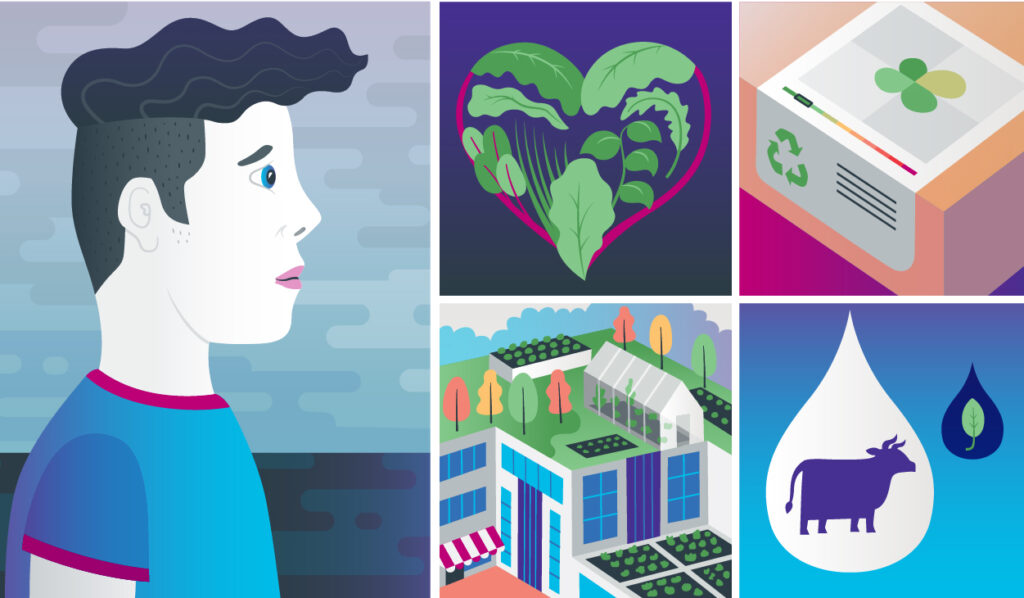
This has all led to our final mega-trend: the rise of flexi’s, veggies and vegans. Changing what we eat has the most potential of all to reduce the environmental impact of our food. Consumers would benefit from help to do so, one way to do this would be the introduction of environmental labelling on food. We have labelled household appliances in this way for years, and they have improved so much in response that we have had to create new energy efficiency categories. The top right image in this article’s illustration is an example of such a label, inspired by a proposal from Joseph Poore at the University of Oxford. Additionally, rapid advances in alternative meats mean this transition is looking increasingly attractive to those consumers who don’t want to change their diet.

Conclusion

Innovation in agriculture is not only being driven from evolving consumer preference, but also from the needs of our planet. We are living in an age of widespread intensive agriculture, for all its achievements, it has also brought about environmental challenges. Without wide reaching, transformational innovation to change our food system, there may not be enough capacity in the future to feed us all.

Fortunately, innovation is emerging, for example advances in CEA are facilitating new food systems that offer benefits on many fronts from increased freshness, locality and nutritional profiles to reduced environmental impact. However, many challenges remain to increase efficacy, reduce costs and upscale. Solving these will require inspirational engineering, new digital approaches, robotics, AI as well as biology and commercial innovation.

As young engineers at the start of our career, we are looking forward to addressing these challenges!

It’s all about the UX

It’s all about the UX

There is no doubt that User Experience (UX) is a hot topic throughout today’s design world. But how is the personal approach to product development affecting the field of healthcare? Lucy Sheldon, people-centered designer, and Andres Barrera, user experience designer, went along to the first ever User Centred Design (UXD) Healthcare conference to find out…

Lucy and Andres write: Here at Cambridge Design Partnership, one of our specialisms is designing healthcare devices, from asthma inhalers to blood sugar monitors, that are used by patients rather than health professionals. In such situations, the experience of the user/patient is key to the success of the product. Do they like using the design or will they give up on it?
Because of this, we were intrigued by a new conference devoted entirely to User Experience (UX) within the world of healthcare.  So we headed off to the User Centred Design (UXD) Healthcare conference in London this spring to find out more and report back:

Who was there?

Attendees ranged from new start-ups to digital health specialists employed by global pharmaceutical companies. This was a chance for us to check out what’s happening right across the board in healthcare UXD.

What was the focus?

Many of the presentations were about the ways in which digital technologies can deliver a cost-effective and successful preventative healthcare model. Loud and clear came the message: a people-centered healthcare approach requires great UX at its heart. Healthcare solutions that the patient uses in their own home have to be problem-free and a joy to use. Otherwise compliance becomes a real problem.

Which innovations stood out?

We liked the look of the myCOPD app, an app which offers patient education for people with Chronic Obstructive Pulmonary Disease. This app delivers advice from world experts and is, in effect, a complete online pulmonary rehabilitation class. Another interesting project is the Babylon Health start-up, which offers online GP consultations. This company is already working with the NHS, allowing patients the option of signing up with Babylon Health rather than a traditional GP surgery.

Why is UX so much at the forefront of healthcare these days?

The rising incidence of long-term health conditions such as diabetes, heart disease and asthma is driving investment with a shift in emphasis. Now the focus is on helping patients to cope with their chronic illness, in terms of both reducing symptoms and improving outcomes. There is also much more investment in preventing lifestyle-related illnesses occurring in the first place.

What is the aim of UX in healthcare today?

Several of the speakers referenced the term healthspan (quality of life), which is now considered alongside lifespan as a measure of healthcare success. The question is no longer just: how long will you live? What matters is now how long you will live in good health.

What else is new?

Presentations which outlined how augmented reality in digital tech could be used in healthcare. Gaming-based digital tech allows users to overcome phobias in virtual reality. One idea we heard being discussed was a digital game in which the user overcomes their fear of heights by travelling up escalators, going onto balconies, etc. This is proving genuinely effective in helping people overcome debilitating phobias.

Did AI feature?

Absolutely. We were struck by a presentation which outlined the ways in which Artificial Intelligence (AI) – or perhaps more specifically machine learning – frees up healthcare professionals to do their high-level work more effectively. Algorithms can analyse patient data such as heart-rate, flagging up noteworthy results and saving hours of human time poring over charts to spot anomalies.

The appetite for digital therapeutic treatments is certainly growing and, for conditions such as depression there are, we discovered, several therapies that the patient uses themselves that have already been clinically validated. This impressed us a lot.

Did you come back to Cambridge Design Partnership feeling inspired?

Definitely. Here at CDP we work on a wide range of healthcare projects that have UX at their heart and we know just how crucial it is. For example, we designed the First Response Monitor as a way of helping first responders such as paramedics triage patients. The monitor helps assess which patients need help soonest via nose clips which record oxygen levels and display results using AI on a smartphone dashboard. In such a high-pressure situation as. Say, a serious road accident, kit needs to be reliable and simple to use. Our UX design, both for the physical product (the nose clip) and the digital tech (the smartphone dashboard) was key to its success.

How can CDP offer the best UXD to its clients?

We offer global companies the opportunity to create healthcare products – be they digital or physical – that not only fulfil the brief but truly delight the user. Our Potential Realised product design process, which links research, design, technology, engineering and manufacturing into a single integrated process allows us to meet and exceed customer expectations for UX.

Finally, how is the future looking for UXD in healthcare?

There is an exponential growth of health-tech start-ups right now and design in healthcare is evolving towards a more holistic and democratic approach. Patients no longer simply expect a prescription or a pill to solve their problems. Instead, they are taking ownership of their treatment and their health, often using digital technology. Where this is supported by machine learning, we are convinced that UX has the potential significantly to enhance healthcare delivery.

S.M.A.R.T. innovations for the food industry

Last month, I had the honour of speaking at the annual NSF International conference, held at the British Library in London. This year’s conference theme was focused on ‘Addressing New Realities’, looking at how mainstream food producers can take advantage of technology innovation to compete effectively and survive in today’s rapidly changing world. 

Alongside industry experts, academics and futurists, examples of what we mean by ‘smart’ technology and how it is influencing the food industry were explored. These included drones that assess harvest maturity, artificial meat cultured in labs and new packaging materials and waste infrastructures that are helping reduce plastic waste. The main message throughout the day was clear – as digital technology and other applied sciences are transforming the future, we need to ensure the future remains people centered! Future proof organisations will be those who clearly understand what their consumers really want.

My keynote centered on the belief that innovation happens where consumer insight, technology enablers and business opportunities coincide. While technology plays a vital role in enabling opportunities, innovation requires all three ‘stakeholders’ and, the most fundamental starting point is having a clear understanding of the consumer. Building on this belief, I was delighted to address the conference delegates and share with them a S.M.A.R.T approach to innovation:

S

Solve a problem that customers really care about: often human behaviour is driven by a desire to solve problems, which can be functional, emotional or social in nature. We adopt Jobs-to-be-Done (JTBD) to define and understand the ‘jobs’ consumers are trying to solve. Done properly it provides a clear, solution-agnostic understanding of customer needs and desires across complex markets. The advantage over conventional market research methods is that jobs tend to stay the same over the long term, while technologies come and go and enable different point-in-time solutions that may become quickly obsolete.

M

Measure your success: Generally, consumers seek the best solution that enables them to solve their problem, and by understanding their needs we can create a multi-dimensional analysis of how well this has been done. We monitor eight mega trends which also help us understand how consumers make choices and measure how successfully the solutions have solved their problem. For example, personalisation is driving consumers growing desire for new experiences, while provenance is driving consumers transparency and traceability expectations.

A

Attitudes to Innovation: We seek evidence to understand and adapt to different consumers innovation attitudes and bring them on a compelling journey. Often organisations try to innovate by starting with a technology, this can result in new products and services that appear to be ‘tech for tech sake’. In order to make innovation meaningful to consumers you can begin by understanding their established behaviours and rituals. Be mindful of who your audience is here, for instance Millennials are the ‘Instagrammable’ generation and I love the expression ‘if a millennial eats a meal but didn’t Instagram (or ‘gram’) it first, did it really happen?’ Think about what makes something meaningful and attractive to your target audience.

R

Right to Play: when exploring innovation opportunities, be sure not to lose site of the baseline expectations and requirements that exist in your industry. These may be regulatory constraints that should always be addressed first. Consumers also have a set of baseline expectations within the food industry, both tangible (e.g. premium food ‘codes’) and perceived (e.g. attitudes and expectations around single-use plastic). These expectations can create tensions for organisations to innovate around, and we are seeing brands (even those competing with each other) adopting innovative new ways to try and solve such problems.

T

Transferable learning: innovation usually isn’t unique, meaning you can learn a lot from adjacent markets, in terms of technology enabled innovations that work…and those that don’t! For the Food industry, boundaries are blurring with both Beauty and Health making these industries highly attractive to learn from. We can already see examples where simple NFC technology is making both Beauty and Food more convenient, and how DNA science is enabling tailored Health and Food solutions. By exploring adjacent industries, we can see how business models could empower new social economies within the Food industry, as well as new material innovations which can inspire us to start experimenting with single-use plastic alternatives, for example.

Technology set in the context of consumer needs can unlock innovation and by implementing a S.M.A.R.T. mindset, it will help ensure you make the right technology investments for your business: By truly understanding your consumers’ problems, giving consumers measurable proof points to show that you have solved their problem making your innovation both attractive and meaningful to your target audience, ensuring you deliver against the baseline expectations first and foremost, and looking beyond your direct competitors to learn about both what to do, and what not to do, when it comes to successful technology-enabled innovation.


For highlights of the NSF International conference, featuring comments from Martha, please watch the following video.


Patient-friendly packaging with intuitive design and an injection of fun, CDP takes a fresh look at pharma packaging

Technology and product design firm Cambridge Design Partnership (CDP) has unveiled a new approach to pharmaceutical packaging. An intuitive design coupled with an injection of fun has resulted in a single-use medicine pouch that is a world away from traditional pharmaceutical packaging.

The BeeBetter pouch is easy to use – the patient simply pushes on the childproof mouthpiece, which then pops up ready for use. The correct amount of medication is dispensed as the user squeezes the pack and sucks on the mouthpiece. And there’s a sweet surprise at the end – in the form of a spoonful of honey – to encourage the patient to finish the whole dose.

The concept has been designed to demonstrate how putting the patient at the centre of packaging design can transform the user’s experience. Once opened, the BeeBetter could be given to a child to hold and operate themselves – safe in the knowledge that they are getting the correct amount of medication. And the honey acts as an incentive for the child to finish the dose – once the top section of the foil pouch is empty, the user’s sucking action breaks the frangible seal inside separating the honey at the bottom from the rest of the contents.

“We wanted to challenge the misconception that children’s medicine needs to come out of a bottle and involve a measuring spoon or plastic syringe and an unpleasant experience for a child who is already not feeling great,” said Bastiaan de Leeuw, head of drug delivery business development at CDP. “So we decided to look at the problem from the child’s perspective and design packaging that is not only easy to use but also has a fun element.”

The innovative design of the BeeBetter could, for example, benefit elderly patients who struggle with traditional medicine bottles – and particularly those with memory problems, as it would make it easier to keep track of each dose. Even younger adults could find it useful – when travelling, for example, as it would be more convenient than carrying a whole bottle of cough medicine and risking it leaking. The packaging idea could also have a variety of non-medical applications – ranging from energy gels for cyclists to a replacement for the ketchup sachets that spill everywhere.

The CDP team will be demonstrating the BeeBetter concept – along with other innovations such as its diialog user insight service and Klarus drug delivery system – at the Pharmapack event, 7-8 February, at the Paris Expo, stand D55.

Notes for editors

Cambridge Design Partnership is a technology and product design partner focused on helping clients grow their businesses. Some of the world’s largest companies trust CDP to develop their most important innovations. Located in both Cambridge (UK) and in Palo Alto, California (US), CDP specialises in the consumer products, healthcare, energy and industrial equipment markets. Its multidisciplinary staff have the expert knowledge to identify opportunities and tackle the challenges its clients face. For more information, visit: www.cambridge-design.co.uk

For further information, contact the marketing team:
+44 (0)1223 264428
marketing@cambridge-design.co.uk

What really happened in Vegas – Cambridge Design Partnership

What really happened in Vegas

Las Vegas is crazy – and the CES tech show is even crazier. I needed a long drive through Death Valley and Yosemite afterwards to work out what on earth I’d witnessed.

CES is full of ideas and new, shiny gadgets – but, just like Vegas, not all that glitters is gold. Here are some of the major themes that struck me walking the stands, and some of the little touches that maybe provide real innovation:

1. Measurement – we’re going to measure everything! The first overwhelming slap in the face is that the ‘Internet of Things’ (IoT) is really here. It was hard to find products that didn’t provide some kind of internet interaction or capture data for someone. Is all of it really useful? Does all of it really link to a user or system benefit? I couldn’t help thinking of The Circle – a futuristic book by Dave Eggers about the IoT, where convenience, supervision and feedback rule over common sense and broader human needs. Many of the ‘innovations’ at CES (mentioning no names) seemed to be traditional devices with a comms module to provide some simplistic single data route. Some of the more interesting devices have begun to incorporate multiple functions as a result of the connection – for example, the LG Hom-Bot vacuum cleaner that integrates cleaning with home security and home monitoring. But this is not exactly an obvious combination of functions – and I can’t help wondering whether there aren’t other, more relevant, tasks the vacuum cleaner would be better suited to.

Although I found many of the connected concepts a little over the top, I was very impressed with Qualcomm’s running shoe sole with a promised ‘life of sole’ battery performance – very exciting.

2. Smarter products – having used a sleep monitor last year, I Iearnt how badly I sleep sometimes. Well, at least that’s what the data told me. At CES there were endless sleep gadgets. There were rooms full of connected pillows, mattresses, headbands, headphones and monitors, all to improve sleep. But I can’t help feeling we are responding to the symptoms of a connected world with more connections and data. As an innovator, I’d like to explore a different approach to the very real issues of sleep and look at the root causes – stress, diet, exercise, daylight – to see if smarter tech really can help with these.

A refreshing development away from the typical so-called ‘smart’ technologies was a breakthrough in clothes washing. Xeros Technologies, a developer of polymer technologies, demonstrated three technologies which drastically improve sustainability – water-reducing beads, ‘in-drum’ technology and improved filtering to prevent microplastics entering the water cycle. This technology has been around for many years – the ‘innovation’ at CES was a move from the commercial to the consumer market. It’ll be interesting to see whether this will be the future of laundry in the home.

3. Maturing user interfaces – I love the phrase that products are magical when the technology gets out of the way. The explosion of voice recognition and the battle of Google Assistant vs Amazon Alexa was hard to miss. Below is a fraction of a display showing the proliferation of Google Assistant into hundreds of devices. Almost as many as the hundreds of white boilersuited minions they sent to the show.

But I was excited to see more ways we could interact beyond the touchscreen. Two examples of this were an incredibly robust demo from Osram on eye monitoring and face metric monitoring. I have seen this technology before but never from such a neat sensor which provided incredible robustness for eye direction monitoring and facial recognition. The potential to improve driver safety by monitoring microsleep could clearly save lives on the road, with no obvious user interaction needed. Imagine a yellow warning light on the dashboard that says the driver is falling asleep!

Another neat implementation of improved user interface – and technology getting out of the way – was a toothbrush using optical markers and a ‘magic mirror’ phone app to track these markers to help kids brush longer as they ‘kill the monsters’ on the screen by accessing and brushing different parts of their mouth.

4. System products – my final observation was the increasing number of products that were packed with multiple technologies to solve multiple issues. A simple example of this was a cycle helmet by Coros winning a Best of CES award. Its integrated lighting and bone conduction speakers help riders maintain road awareness whilst enjoying calls or music on their bike. To my mind, this is a useful application of technology – in contrast to the LG Home-Bot, where the combination of features seems somewhat forced.

The ‘innovations’ on display at CES were a really interesting demonstration of how technology – and our use of it – is advancing. However, the products that I believe will make the most impact in the next few years are not the ones with the greatest combination of technology. The winners will be the ones where the glitzy technology seems to disappear behind the crystal clear consumer need – whether that is saving time, saving water or saving lives.

NEW DESIGN YEARBOOK 2017 Read all about our landmark year in 2016 and partnering on innovation with the best in FMCG and healthcare

Cambridge Design Partnership (CDP) had a landmark year in 2016, demonstrating global application of its holistic end-to end innovation approach, ‘Potential Realised’. Linking a combination of research, science, technology, engineering, manufacturing and design into a single integrated process, it developed many successful innovations for clients in FMCG and healthcare – collecting some prestigious industry awards along the way.

Through its office in Palo Alto, its presence in the US market grew significantly, with the likely changes in the healthcare landscape a major focus for clients. Furthermore, CDP’s Front End Innovation (FEI) capability matured with researchers regularly meeting consumers in locations including Brazil, Germany, USA, Sweden, Japan and Mexico. It also launched a new connected packaging/activity-logging platform, diialog™.

First Response Monitor
Measuring and monitoring vital signs of trauma patients remains a time-consuming, manual process for first response medics. It becomes much harder in a mass casualty situation when rapid triage, evacuation and safety are critical factors. CDP identified the need for a low-cost/oneuse device to bridge the gap between manual patient monitoring methods – which can be laborious and challenging in a disaster zone – and more expensive, less portable monitoring systems. The resulting First Response Monitor (FRM) is a lightweight, sterile, single-use, connected wearable device that attaches to a patient’s nose. It displays real-time vital signs patient data and connects to a smartphone or tablet, allowing medics to perform simultaneous multiple-patient triage.

Early in the project, CDP’s researchers and designers spent time with civilian and military medics to understand the conditions they worked in, tasks performed and the challenges presented. Rather than trying to improve existing devices, CDP reviewed what was actually needed: a fast way of assessing and monitoring key human biometrics (heart rate, breathing rate and SpO2). Focusing on measuring ‘breathing rate’, CDP soon identified that a patient’s nose region could provide all indicators necessary via low-cost sensors usually found in consumer products. A number of rapid prototypes centring on a nosewearable device followed.

Integrating device connectivity led to custom app development which enables medics to monitor several patients simultaneously and be notified instantly if their vital signs start to deteriorate. Since its launch, CDP has received sales enquiries from around the world and won a number of awards including two Red Dot: Concept Best of the Best awards and an Electra European Electronics Industry Award for Design Team of the Year. FRM was also included in the Nominet100 list of the 100 most inspiring examples of Tech for Good.

Read the full article here…

Future Directions for Intelligent Packaging

Tom Lawrie-Fussey spoke to Packaging News at the recent Active & Intelligent Packaging World Congress

International names in retailing joined more than 300 attendees at the recent Active and Intelligent Packaging Industry (AIPI) World Congress, enough for 2016 to be marked a ‘breakthrough’ year for technologies putting new powers into the hands of brand owners, altering their perceptions of what packaging is and will become – an industry of tools for communication, quality control and shelf life extension.

Knowing the consumer
Knowledge is power, and smart packaging and smartphone together give brand owners a direct line to understanding what the consumer wants and how they behave. General Mills  brands have participated in a pilotQR digital labelling programme sponsored by the US grocery industry, and Kraft Heinz is exploring ‘frictionless’ tools to give mobile shoppers easier access to in-store promotions and improve customer insight data.

But the connected package and frictionless interaction comes at a high cost and, depending on the underlying job to be done, smart thinking might do the trick.

“Smart packaging can be zero-tech,” says Tom Lawrie-Fussey, Congress keynote speaker and leader of business development at Cambridge Design Partnership (CDP). For example, printing a picture of a flatscreen TV on a bicycle box saved a savvy Dutch company losses through damage in distribution of 70 to 80%. The boxes are similar in size and, as VanMoof predicted, shippers handle a TV with more care.

View the full article in the latest issue of Packaging News.