MDD render 2
Share:

DELIVERING PEACE OF MIND A novel approach to drug delivery from CDP is set to transform the patient experience

18 October 2017 – Help is on the horizon for patients juggling complicated treatment regimens for chronic diseases such as rheumatoid arthritis (RA). A novel approach to drug delivery from technology and product design firm Cambridge Design Partnership (CDP) is paving the way for a new generation of treatment that is easier for patients and cost effective for healthcare providers.

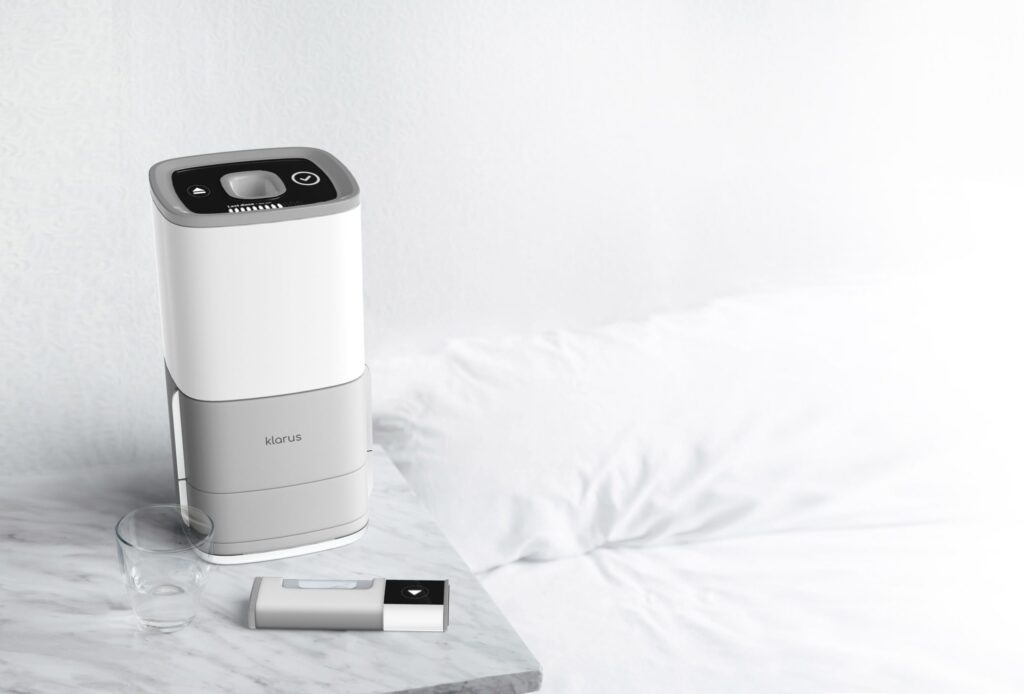
Klarus is set to transform the world of auto-injectors – doing away with the need for RA patients to worry about storing their drugs in the fridge, warming them up to the correct temperature for injection, preparing their auto-injector for use and disposing of the device safely. Klarus does everything for them – they simply have to pick up the reusable auto-injector from its base station when prompted to do so, inject themselves and then return the device to its cradle.

“It’s the Nespresso of auto-injectors,” said Uri Baruch, head of drug delivery at CDP. “Klarus will store drugs at the correct temperature and warm them up when required – minimising the pain of injecting cold medication. It will then prepare the auto-injector with the correct needle and medication cartridge, and prompt the patient to take their drug.

“After injection, Klarus will collect the needle and cartridge ready for safe disposal – alerting the patient when supplies are running low, and reordering if required. The base station technology could be adapted to cope with multiple users and different medications – either in the home or at a small clinic, for example. It uses fingerprint recognition technology to identify the correct user each time and a childproof lock to prevent accidental use.”

As well as RA, Klarus could be used to treat diseases such as multiple sclerosis or to administer vaccines. It could also enable some cancer patients to be treated at home using drugs that are currently only allowed to be given in hospital. And it opens the door to the emerging world of companion diagnostics and truly personalised medication, where treatment is tailored to each individual patient using genetic information.

“All too often, patients with a chronic disease face the additional burden of struggling with a complex treatment regimen at home,” said Uri. “Learning how to use a new drug delivery device and remembering multiple treatment steps can be challenging – particularly for the elderly or those with dexterity issues. That’s one of the reasons why adherence rates are often low – many patients just give up or fail to take their medication correctly.

“Our Klarus system alleviates that burden for the patient and helps ensure they get the full benefit from their treatment. It automates many of the use steps commonly missed or not carried out by patients – such as checking the use-by date or remembering to inject when following an irregular therapy schedule. We’ve used state-of-the-art technology and applied our user experience and human factors expertise – together with our knowledge of medical device regulation and our skills in electronics, mechanical engineering, software and connectivity – to create a radically new approach to drug delivery.”

The Klarus system could be offered to patients as a subscription-based service. It is expected to cost healthcare providers less than $1,000 per system, and the cartridges would be around $2 each. So Klarus would pay for itself in the space of just one year if, for example, a patient was having weekly injections for RA at a typical cost of $10 per single-use auto-injector. As well as helping to improve patient outcomes, it would also be more environmentally friendly – saving on packaging and involving the disposal of only a small cartridge each time, rather than an entire auto-injector.

Uri will be talking about the Klarus system in track B of the drug delivery technology presentations on 19 October at the Partnerships in Drug Delivery event in Boston, US. The CDP team will also be showcasing Klarus at PDA’s Universe of Pre-filled Syringes and Injection Devices event, 7-8 November, at the Austria Center Vienna, stand X92.

Notes for editors

Cambridge Design Partnership is a technology and product design partner focused on helping clients grow their businesses. Some of the world’s largest companies trust CDP to develop their most important innovations. Located in both Cambridge (UK) and in Palo Alto, California (US), CDP specialises in the consumer products, healthcare, energy and industrial equipment markets. Its multidisciplinary staff have the expert knowledge to identify opportunities and tackle the challenges its clients face. For more information, visit: www.cambridge-design.co.uk

For further information, contact the marketing team:
+44 (0)1223 264428
marketing@cambridge-design.co.uk

Sectors_Diagnostics_thumb
Share:

Point of care diagnostics: navigating systems architectures

Diagnostic testing is rapidly moving out of the lab and into the hands of untrained users. But developing the system architecture for a high-performance test that is also easy to use is a complex challenge.

A great example of advancements in point-of-care (PoC) testing is the pregnancy test. In the 1970s, Wampole’s 10-step test took two hours by a trained lab technician. Today it is carried out in minutes in the privacy of your own home using an off-the-shelf disposable device.

PoC diagnostic tests should be quick and simple – and ideally not rely on the user’s skill to generate a reliable result. But, unlike pregnancy tests, molecular-based tests currently need more complex steps. For example, sample preparation may be needed to lyse cells, remove inhibitors or increase titre and this can be extremely challenging to implement at the point of care at acceptable cost and device complexity.

Wampole’s test could be categorised as a ‘chemistry set’ where the skill of the operator is critical to generate an accurate result – there might be several critical timing steps, mixing and resuspension steps performed using a manual pipette, metering and sub-sampling precise volumes followed by vortexing and ‘gentle’ heating before looking for a subtle colour change. Lots to go wrong and not at all user friendly.

The Clinical Laboratory Improvement Amendment (CLIA) from the Food and Drug Administration (FDA) regulates laboratory testing for human diagnostics in the US and has categorised the complexity of a diagnostic test as either: waived, moderate complexity or high complexity. The level of complexity is determined by adding up the scores from seven criteria. A CLIA waived test means it is ‘simple to use, and there is little chance the test will provide wrong information or cause harm if it is done incorrectly’.

The simplest test for the user is to ‘add sample and walk away’ and the device carries out the necessary assay functions. This convenience typically generates significant market share over more labour-intensive competitor devices but there are trade-offs with device complexity and development risk. For complicated assays, ‘reader’ and ‘consumable’ system architectures are frequently used. However, consumables tend to be bulky and expensive, and the readers even more so.

Below I outline some high-level considerations when developing system architectures for a PoC diagnostic device, and how to navigate between the ‘chemistry set’ and ‘fully integrated product’.

Assay robustness

It all starts with the foundation of any diagnostic test – the assay. A correctly implemented assay is fundamental to providing high-performance, reliable and repeatable results in the intended use environment.

Identifying sensitive parts of the assay that require careful controls, and functions that are more tolerant to variability, provides the first insights into the required architecture. For example, flow-rate variations may have a significant impact on test performance, which necessitates the use of an automated pump – or the detection method may require special optics. An untrained operator may not be capable of performing these steps with the appropriate control, so reader hardware may be needed.

Ideally the assay is well characterised in the lab before the system architecture is developed – but this is seldom the case. Another issue is that lab processes can be difficult or costly to implement in a ‘highly useable’, low-cost PoC test. So designing a system architecture that is capable of accommodating the necessary functions based on preliminary lab results is a tricky challenge. Capturing risks and uncertainties, and carrying out feasibility testing of the high-risk aspects during early stages of the project, will better inform the system architecture and can avoid unpleasant discoveries later on.

User burden

Although CLIA waive is highly desirable, many PoC devices are categorised as ‘moderately complex’ – it may be a good option for the user to carry out certain functions if they are tolerant to sources of variability (i.e. by understanding assay robustness and assessing operation against CLIA scoring criteria).

User involvement can significantly reduce device complexity but operators are busy people and can easily get distracted in a PoC setting. Failure alerts and fail-safe features help reduce the risk of generating an erroneous result. Mechanical guides and ‘poka yoke’ mistake-proofing features, as well as electronic timeouts and sensing (e.g. QR code read by the reader), can notify the operator that an incorrect or expired component is used. In the event of inactivity, the reader may invalidate the test altogether.

Device complexity

Every project is constrained by time and money and, if the development team has done its job properly, the device will be just complex enough to satisfy user convenience and assay needs. Of course, it’s not as simple as that – other crucial factors such as cost of goods and ‘platform’ requirements also need consideration.

Estimating device cost early on – and continuously updating the estimates – informs the viability of the architecture and ultimate success of the product. If cost estimates are high, it may be necessary to re-examine the assay and explore alternative, lower-cost technical solutions or implement more of a ‘chemistry set’ approach (but understand the impact to the user and viability of the product). Directing functionality (and cost) away from the consumable and onto the reader is generally a good option as non-disposable parts are less cost sensitive.

When designing system architectures intended to be a ‘platform’, it is important to consider the requirements of future assays and, if necessary, build in redundant capability to minimise the effort to accommodate new tests. This is easier said than done under tight timescales. But modular system architectures and components that allow modification – for example, volume expansion or increased flow rate – allow potential flexibility.

Navigating the trade-offs to develop a system architecture that addresses all the considerations is a difficult challenge – and one that is often rushed as businesses are keen to meet their next milestone.

At Cambridge Design Partnership we use a holistic development approach involving close collaboration between our in-house human factors, mechanical, electronic, software and manufacturing engineers, as well as assay scientists. In the early phases of a project we identify the technical and market uncertainties – and thoroughly explore different architectures whilst characterising the assay and understanding user involvement, regulatory issues, manufacturing processes and ultimate device cost. This manages project risk and sets the course for a high-performance system delivered quickly to market. Get in touch for help with your next diagnostic challenge.

Connect with CDP

For more on navigating the trade-offs in point-of-care diagnostic system development, contact Cambridge Design Partnership.

Key trends from the American College of Cardiology Conference
Share:
Find the authors
on LinkedIn:

Key trends from the American College of Cardiology Conference

Reflections on two themes from the day;

– Usability: Continuity from marketing, through R&D, to regulatory
– Connected devices and systems: Realising the benefits

Usability: Continuity from marketing, through R&D, to regulatory

We were struck by the frequency at which we heard terms like “usability,” “workflow” and “seamless integration” during presentations on the latest cardiology suites – and by the consistency of that message across different vendors.  That’s in addition to the usual array of “smaller, faster, smarter” innovations which indirectly claim usability benefit.

We continue to be impressed by the variety we see in device companies’ approaches to usability as a function.  Since regulators took steps to clarify expectations around identification and mitigation of use risks from around 2007 (e.g. IEC 62366) there’s been a tendency for human factors / usability engineering to be addressed by regulatory departments.  We believe this approach places unnecessary constraints on achievable levels of both use risk mitigation (as required by the regulator) and especially user experience (not required by the regulator – but critical to market success)!

Happily, companies are increasingly realising that given their investment in bringing users and devices together for formative usability studies, an efficient opportunity exists to develop the user experience in parallel.  Hence we see the beginning of the rehabilitation of usability engineering as a function within R&D and new product development (NPD) groups –alongside other engineering disciplines.  Interesting variations include summative studies being run by the marketing team at one company we met, which stands to reason given the marketing function’s historical focus on user requirements.

However, rarely do companies achieve the continuity needed between upstream marketing, R&D and regulatory functions.

We strongly believe that both use risks and user experience should be tested from the earliest stages of concept development – enabled by means of prototyping at an appropriate level of fidelity for the stage of development.  In order to extend this continuity right back to upstream marketing it’s essential to objectively identify and prioritise user needs, to support development of a compelling set of user requirements before commencing concept creation.

Concepts can then be generated against user needs which are known to be both important and poorly met; and user-tested for how well they meet those needs. This is appropriate and seems obvious once articulated, especially considering the logical alternative: generating concepts in a vacuum and user-testing them without clear objectives.

Nevertheless in practice it remains a rarity to seeing this level of continuity, meaning that the competitive advantage available for getting it right should be compelling.

Connected devices and systems: Realising the benefits

With the global cardiac monitoring market projected to be worth $28 billion by 2021, it was no surprise to see numerous connected monitoring devices at ACC.  Whilst various innovations were on show, most fell into two groups: implantable cardiac monitors (ICMs) and mobile (wearable) cardiac telemetry devices (MCTs).

The prize for the successful development of this segment is surely great.  For example, up to 40% of ischemic strokes are caused by asymptomatic atrial fibrillation  and such cases are increasing.  Screening for (treatable) atrial fibrillation using low-cost devices and efficient systems promises to slash this figure, with clear benefits for patients and payer alike – but how to realise these in practice?

In hardware, we’re seeing a move away from dedicated “bedside” uplink devices (Medtronic’s Reveal LINQ), to Bluetooth smartphone connections (St Jude’s Confirm RX ICM), and perhaps towards on-board 3G/4G connectivity (National Cardiac’s upcoming Liba3 MCT).  The on-board option is not inevitable: whilst the Bluetooth solution has its challenges, the potential benefits are significant.  Challenges include regulatory (“app as medical device”) and cybersecurity (see James Baker’s column, Med Device Online).  However the potential benefits of Bluetooth versus on-board uplink may prove compelling, for example:

– device cost, weight and size;
– linking ECG data with patient observations (St Jude’s Merlin.net);
– enhanced patient engagement (and adherence) via app.

Done right, the adherence point may prove decisive.

The system side proved the more compelling conversation topic at ACC.  How should the system be developed in order to deliver the hoped-for benefits?  For example:

– Who will provide diagnoses based on these vast streams of data, and how will the health economics and reimbursement develop to support this activity?
– “The Cloud” will be a key enabler, as everyone seemingly agrees, but what functions will it provide?  Can algorithms make diagnosis more efficient – and, given the human challenges around accurately reviewing reams of data, less error-prone?  How will such algorithms be validated?
– Can the data from these devices be effectively made available to other parts of the healthcare system?  For example as an input to regular health checks, or to provide ECG history during treatment of adverse cardiovascular events?
– Can algorithms support clinical and treatment decision making by leveraging anonymised “cohort databases” of ECG data paired with treatment outcomes?

Much work remains in this space, and whilst improving device cost and usability will be important, the wider system view will be essential to achieve the prize!

1 Strokes atrial fibrillation patients rise despite improved treatments

Share:

First principles of biomedical engineering – they’re closer than you think

It’s important to realise that beyond the realm of classical engineering principles lays the softer, squishier world of biology and medicine. By being intimately familiar with human anatomy, biomedical engineers are able to more rapidly question whether their concepts are truly viable prior to embarking on further development, using an often-neglected set of first principles – the fundamentals of human body design.

Using a scalpel, I slowly cut the failed tricuspid valve out of the heart of the cadaver. We had been told that our donor body had died of heart failure but nothing prepared me for the sensory impact of the hard, black necrotic tissue surrounding the three leaflet structure – it appropriately reflected what “dead” should look like physically. That was about half a decade ago and not a day goes by where I don’t reflect on my time spent wrist deep in a cadaver, and how it shaped how I approach my work as a biomedical engineer.

When you start designing medical devices, it’s tempting to seek out simplifying assumptions in order to get 80% of the solution in 20% of the time. We can model the circulatory system with pipes, we can model the lungs with foam, and we can model the bones with metal. Reasoning by analogy is often the first step to taking a first principles approach, utilising equations that govern the fundamental processes of our world. And there’s nothing inherently wrong with this approach until you discover that by simplifying the problem definition you’ve missed out on a wealth of potentially more appropriate and lucrative solutions as well.

Let’s take, for example, the case of my former cadaveric colleague’s heart – he had had an aortic valve replacement at one point in his life. Simplifying the complex procedure of heart valve replacement, we could think of the problem like fixing a broken piece of plumbing: restrict the flow of fluid, remove the defective valve, put the new valve in, and let the fluid flow resume hoping that everything worked the first time. And for valve replacement, that’s been more or less the gold standard since advancements made to cardiopulmonary bypass (artificial heart and lung) machines enabled the heart (blood flow) to be stopped during surgery. Using the plumbing mentality, it’s difficult to imagine how you could improve on this procedure which is why it’s important to question and occasionally reject the simplifying models we use for medical device design. Finding the optimal level of detail at which to examine the problem is critical to the success of the endeavour.

In reality, heart valve replacement has started heading towards the plumbing equivalent of replacing leaky valves from your neighbours couch by snaking tools through their plumbing, into the main pipes, back into your flat to the leaky valve and there, instead of taking the old valve out, you just put the new valve in on top of it. This procedure, known as Transcatheter Aortic Valve Replacement (TAVR), in which a new valve is implanted into the heart by navigating through an artery in your leg, is expected to worth $5.5B USD by 2020. If we remained focused solely on the heart valve in absence of the larger circulatory system and body-scale system as a whole, the ability to utilise a less-invasive approach would have been lost before the first ideation session even began.

Ultrasound Elastography is another example where conventional analogies fall short of an optimal solution. Frequently surgeons will probe or palpate tissue with their fingers to try and differentiate boundaries of different structures, like a tumour amongst healthy tissue. This physical sensation can aid with the detection of diseases in certain organs, particularly when the tumour doesn’t show on certain imaging modalities but relies on subjective tactile feedback and cannot be used in regions that can’t be palpated. Obviously then we need to improve the ability of existing imaging systems to “see” the tissue but there’s something significantly cleverer available.

Researchers realised that “seeing” a tumour depended on the type of information being made available. Traditional x-ray imaging relies on the absorption of ionizing radiation by anatomical structures and maps this absorption onto a display, whereas palpation creates a tactile sensation map in the physician’s head. So instead of thinking, “we need a more sensitive imaging system to detect the differences in radiation absorption in the tissue”, they realised that they could blast the target tissue with ultrasound waves, mimicking a palpation then measuring the resulting mechanical properties by observing the response to this “push”. What was created is a novel imaging system that provides a tactile map of tissue stiffness, enabling doctors to more clearly see the tissue they’re interested in without requiring physical access to it.

As efficiency and cost reductions pressure healthcare systems globally, the demand from next generation medical devices requires successful inventions to not only improve outcomes but reduce costs compared to the existing gold standard. By recognising that your medical device needs to be designed with respect to not only the classical mechanical and electrical first principles but the anatomical first principles as well, you can get that much closer to a safer and more effective device.

To speak to Jeremy further or to find out more about our medical device and drug delivery capabilities contact hello@cambridge-design.co.uk or phone +44 (0) 1223 264 428.

Share:

CDP at MD&M West 2017 in Anaheim

Cambridge Design Partnership is exhibiting at Medical Device and Manufacturing West (MD&M West) in Anaheim, California from 7th – 9th February this year.

Our booth is number is 1425 in the Electronics West zone. Details on how to find us.

MD&M West is the world’s largest medical design and manufacturing event, with leading medical design experts attending to network and showcase latest innovations in medical device design and manufacturing.

Exhibiting for the fifth year running, Cambridge Design Partnership will have live demonstrations on its booth of two connected devices, the multi-award-winning – First Response Monitor and diialog™.

A number of our sector experts will attending MD&M West 2017 including:

Alan Cucknell, Front End Innovation Leader
Alan is a seasoned innovation professional. His systematic, evidence based approach builds on his formal engineering education and nearly fifteen years’ experience tackling strategic business and technology challenges. Alan will be happy to discuss your innovation challenges and suggest new approaches to help you achieve success.

James Baker, Senior Electrical Engineer and CDP Partner
James is a chartered engineer with a Master’s Degree in electronic engineering. He leads the connectivity and electronics capabilities at CDP, applying his experience to projects covering all forms of sensing, communications and wearable technologies. James can advise you on developing healthcare products that feature complex embedded functionality and are simple to use.

Dr Jez Clements, Senior Mechanical Engineer and CDP Partner
Jez is a professional engineer with a PhD in orthopaedic implants. He has led several major medical device development programs across diagnostics and drug delivery. Jez helps clients overcome tough engineering challenges and will be happy to discuss how CDPs capabilities can help accelerate your development portfolio.

Dr Dom Freeman, US Business Leader
Dom has over 30 years’ experience in the medical device design, with deep knowledge of the blood glucose monitoring market and magnetic resonance imaging. She is also an expert in IP strategy. Dom will be available to discuss how outsourcing product innovation and engineering development can benefit your business and overcome key challenges to growth.

To arrange a meeting during MD&M West, please get in touch.

We hope to see you in Anaheim.

Share:

CDP is heading to Paris for Pharmapack 2017

C’est le temps déjà? It certainly is. Pharmapack Europe’s premier pharmaceutical and drug delivery event is at Paris Expo, Porte de Versailles from 1st – 2nd February. Pharmapack is the European conference for the latest trends, developments and regulations impacting the pharma industry and this year will be no exception.

Our booth is number is B89, near the catering area. More details on how to find us.

Three of our healthcare experts will be available to explain how CDP can help you meet your innovation goals and answer your questions.  We’ll also be running live demonstrations of two of our connected innovations – the Red Dot winning, First Response Monitor personal vital signs monitor and our newest tool diialog™, that allows designers and human factors engineers to understand how patients actually use medical devices in the field.

Uri Baruch, Head of Drug Delivery and newest CDP partner

Uri has extensive knowledge of drug delivery device development and technology, including innovation strategy and the latest industry trends. He is your gateway to access the in depth development capabilities at CDP.

Stergios Bitisios, Packaging Leader

Stergios is a senior design strategist and research consultant, whose specialises in the  in-depth analysis of the patient-device interface.   He helps healthcare businesses find ways of placing the patient and healthcare professional at the heart of the innovation process.

Tom Lawrie-Fussey, Technology Business Development Leader

Tom specialises in developing innovative connected devices, including the technology and business models needed to create value from this rapidly developing field. He will be demonstrating two examples and will be happy to discuss your requirements.

If you’d like to arrange a meeting with Uri, Stergios or  Tom, get in touch.

Nous serions ravis de vous y rencontrer!

Share:

IMPLEMENTING MEDICAL DEVICE CYBERSECURITY James Baker is guest columnist on Med Device Online

Connectivity is ubiquitous – it’s moved beyond an overhyped buzzword and become part of life. Offering ever-advancing levels of access, control, and convenience, widespread connectivity also increases the risk of unauthorised interference in our everyday lives.

In what many experts believe was a world first, manufacturer Johnson & Johnson recently issued a warning to patients on a cyber-vulnerability in one of its medical devices. The company announced that an insulin pump it supplies had a potential connectivity vulnerability. The wireless communication link the device used contained a potential exploit that could have been used by an unauthorised third party to alter the insulin dosage delivered to the patient.

It’s not hard to imagine the devastating impact to both consumers and the company if the reported vulnerability had been exploited. However, risks such as security will not prevent evolution of connected devices – demand for ever-increasing levels of convenience and access are driving the continued evolution and adoption of these products and services.

Cyber-security considerations shouldn’t be viewed as stumbling blocks for the connected device concept. Rather, it’s another of the many product requirements which, if considered and specified correctly at the design stage, can be implemented robustly. Above all, cybersecurity can be validated as part of a wider-reaching regulated device development process. It can’t be considered an isolated element to be bolted on, since it inherently helps to define the system architecture of what is developed.

Read full article.

ablation-catheter-technology-cardiology
Share:

CDP and Kings College London develop innovative steerable catheter to treat cardiac arrhythmia

Innovative design and technology consultancy Cambridge Design Partnership has worked with King’s College London to develop a novel steerable catheter which King’s researchers had designed.  The catheter is designed to improve the treatment of cardiac arrhythmia – a range of conditions which can lead to stroke or heart failure that affects 2 million people a year1 in the UK alone.

The new steerable, micro moulded catheter enables targeted delivery of radio frequency energy to specific points in the heart tissue for corrective treatment. Compared with traditional catheters, the new device has been designed to be quicker and easier to manoeuvre into the correct position, improving the accuracy of positioning and minimising damage to healthy tissue, which should improve success rates of the treatment.

Cambridge Design Partnership won a four-way competitive bid to further develop the device created by King’s College London, involving helix-shaped interlocking tubes that would allow improved steerability and greater compatibility for robotic control over other catheters on the market. The team at Cambridge Design Partnership successfully refined the initial design, enabling the device to meet key regulatory and biocompatibility requirements, whilst ensuring suitability for commercial manufacture. Through CDP’s experience of developing highly technical medical devices, the team was able to miniaturise the design to allow improved space for the delivery of ablation energy and irrigation. The new catheter design is also assembled from micro injection moulded sections, incorporating features that enable the device to be built on an automated assembly line at reduced manufacturing cost.

Matt Brady, head of Medical Therapy, Cambridge Design Partnership, said: “The steerable catheter is an extraordinary product, with innovative features that enable corrective treatment to be delivered to very specific areas of the heart. By enabling greater accuracy and quicker treatment time, we believe it is possible to preserve more healthy heart tissue, and increase the success of the treatment. It’s been hugely exciting to be involved in this joint project with King’s College London and use our expertise to bring such an innovative product one step closer to commercial use.”

Professor Kawal Rhode, Professor of Biomedical Engineering at King’s College; London, commented: “We have been delighted with the results of Cambridge Design Partnership’s work on this project. The team was chosen for the strength of their existing experience in developing catheters across both start-ups and global corporations.  We were very pleased with the engineering approach and practical improvements that they managed to incorporate. They delivered fully moulded parts, and specified other components and the assembly route which fully met our aspirations for the project.”

King’s College London is now undertaking extensive lab testing of the catheter device, with clinical trials expected to be take place in two to three years.

1 Arrhythmia

For further information on this project, please email: hello@cambridge-design.co.uk

For Enquiries to King’s College London:
Please contact Dr. Rob Glen, King’s Commercialisation Institute
Robert.glen@kcl.ac.uk 020 7188 6209
Kings Commercialisation Institute

Share:

AAMI human factors for medical devices course returns to Europe

Innovative technology and design consultancy Cambridge Design Partnership today announced that due to the huge success of Europe’s first AAMI Human Factors for Medical Devices course they will be sponsoring more courses in 2015.

Cambridge Design Partnership worked with the US based Association for the Advancement of Medical Instrumentation (AAMI) and Pure Insight to bring the course to Europe for the first time in April 2014 and the course was hugely oversubscribed. In response to demand from medical device development companies, which deem the course content as a ‘must have’ piece of knowledge for their medical device development teams, a course has been scheduled for January 2015.

Cambridge Design Partnership have recognised the importance of Usability Engineering in medical device development programmes for many years and are keen to share this enthusiasm with the wider development community by teaming up with AAMI and Pure Insight to bring this definitive course to Europe.

This course delivers practical Usability Engineering techniques that can be implemented in any medical device development programme and gives insights into creating usability submissions for both the USA and the EU regulatory regimes.  With new guidelines proposed in the US, medical device companies worldwide need to be vigilant in understanding how to navigate these changing regulatory landscapes. The AAMI course not only addresses Usability Engineering itself, it also looks at the growing harmonisation between global standards, streamlining device submissions.

The course leaders are the highly regarded Dr. Ed Israelski who is the convener of international HF medical standards with IEC and ISO and Dr. Robert North, who is a co-author of the FDA human factors standards. This course is exclusively the only event held in Europe where companies can talk directly to an FDA representative who hosts a question and answer session and gives delegates the benefit of the latest insight into streamlining submissions as well as common submission errors and deficiencies.

“At CDP our experience developing novel medical devices shows us that effective Usability Engineering is crucial to commercial success, not only to meet regulatory requirements but to enable new products to succeed in a competitive marketplace. When developing fast moving consumer products companies naturally place the user at the centre of the design process,  but when it comes to safety critical medical devices sometimes the complex technical and clinical requirements overshadow basic patient needs. This course explains the processes you can use to ensure your devices are easy and safe for patients to use.  Medical device manufacturing companies must demonstrate this to the regulators and this course explains how this is achieved.” Comments Mike Cane, Founder, Cambridge Design Partnership.

Cambridge Design Partnership is a leading technology and product design partner focused on helping its client’s businesses grow. Some of the world’s largest companies trust CDP to develop their most important innovations.

Cambridge Design Partnership specialises in the healthcare, consumer, energy and industrial equipment markets and its multidisciplinary staff have the expert knowledge to identify opportunities and solve the challenges its clients face.

www.cambridge-design.co.uk/
hello@cambridge-design.co.uk

Contact Abbie Meliniotis or Laura Cavaliere at CDP for more information:
lc1@cambridge-design.co.uk / avm@cambridge-design.co.uk /+44 (0) 1223 264428

Media contacts: Andrea Berghäll, EML Wildfire Technology PR
cdp@emlwildfire.com / +44 (0) 208 408 8000