In packaged products
Share:
Find the authors
on LinkedIn:

In packaged products, context is king

Chris Houghton leads Brand Innovation & Packaging at Cambridge Design Partnership, he has worked on an array of successful insight, design and strategic innovation projects with top consumer goods names including Arla, Carlsberg, Coca-Cola, Diageo, Nestle, PepsiCo, Procter & Gamble and Unilever.

Following his ‘Context is King’ keynote speeches at PACE in Amsterdam and AIPIA in New Jersey, he summarises five key questions brands need to answer when building an innovation pipeline.

Bill Gates famously wrote, Content is King back in 1996. His forecast…“Content is where I expect much of the real money will be made on the Internet”…

How right he was as we’ve seen the digital revolution establish over the past decade. On demand streaming services have overtaken traditional audio and video formats with gaming next on the horizon. Coupled with new business models, the likes of Uber and Airbnb have tapped into consumer demands making brands sit up and think what should we do to take advantage of this fertile digital landscape?

Context #1. Who?

Who are you designing for? Do you understand their cultural sensitivities, their customs and established rituals? Do you know their values? Their gender or generation? Their mental and physical abilities? Are they tech-savvy – do they need to be? The better you understand specific population cohorts the better your chance of successfully meeting their expectations.

Each culture and country has its own technology trajectory and utilisation levels. The worldwide average for time spent on the internet is now 6hrs 42mins which is just above USA’s average but some way short of chart toppers the Philippines clocking in at over 10hrs per day (source Digital 2019, wearesocial.com users aged 16-64).

Some categories like beauty and cosmetics are ahead of the curve with high digital engagement. L’Oreal was one of the first brands to realise this with their Makeup Genius app which allows users to compare before/after make-up and hair effects on-screen. This pre-purchase, augmented reality tool enables fast navigation of product choices to help consumers decide what to buy – within two years L’Oreal said it had 20 million users worldwide.

For decades, beauty brands have been heavily reliant on celebrity endorsements or experts in lab coats to target and assure consumers but today that paradigm is changing. Millennials increasingly seek individuals that they can relate to, building seemingly intimate relationships with those they follow on Instagram and YouTube channels, who ultimately steer their lifestyle decisions. This mix of opinions, edited evidence, facts and ‘fake news’ can confuse many consumers, so building trust is more important than ever.

Context #2. What?

What category does your brand belong? Beverages, confectionery, personal care? The answer to this is obvious, of course and you’ll invest great effort closely tracking the activities of your competitors. But that is just the start. Innovations don’t always come from your direct competitors. Instead, brands are often blindsided from an unassuming left field competitor, arriving at speed with disruptive and transformational innovations. For instance toothpaste brands didn’t expect their category to be impacted by confectionary companies making chewing gum with teeth whitening claims.

We look at the ‘what’ in a solution agnostic way using the ‘jobs-to-be-done’ methodology. In a nutshell this approach states that when consumers become aware of a job they need to get done, they look around for a product or service that they can hire to do so.

Procter & Gamble’s Tide is a good example of a brand that have extended their portfolio to cater for changing contexts. The core range is unsurprisingly traditional powder, liquid and convenient pod packaging, but more recently Eco-Box was introduced to address e-commerce shipment and improved sustainability stats. The brand has even stretched beyond products solutions with the test market launch of Tide Cleaners. A direct to consumer, digitally enabled, subscription service that targets ‘generation rent’ to simply drop/collect dirty/clean laundry. This cleverly allows the brand to reach new consumers whilst experimenting with new business models, partnerships and logistical infrastructures in a low risk way.

Context #3. Where?

Where is your product used? At home, at work or on the go? Each location may present a different hierarchy of jobs. In fragrance, for example perfumes have clearly defined packaging conventions. Consumers expect a thick-walled glass bottle, an elegant closure with a precise dispensing atomiser. This objet d’art is entirely appropriate to adorn a home dressing table. However, if on the go,  this format no longer seems so practical for a handbag.

In 2017 British parfumier Jo Malone launched Fragrance Paintbrush under the brand Jo Loves. A compact perfume gel applicator that is crucially handbag friendly. This delivers an entirely different application ritual, delicately brushing quick drying fragrance onto the skin rather than the traditional perfume spritz.

In a digital, augmented world understanding the ‘where’ is crucial to enable or enhance the experience, especially when leveraging the surrounding environment. Whilst outside the packaged goods world, I find EuroStar Odyssey an insightful and charming experience to entertain children during a long train journey. Instead of uninspiring views inside a concrete tunnel beneath the English Channel, the carriage is virtually transformed into an underwater viewing gallery with dolphins and whales swimming besides you to help families kick start their vacation.

Context #4. When?

When is your product used? This can have a crucial bearing on consumer engagement levels especially regarding available time and tolerance levels. For example, a parent making up baby formula has very different functional, emotional and social ‘jobs’ depending on the time of day. Sterilizing equipment, measuring and mixing powder at 3pm is very different to 12 hours later for the 3am feed in the dark whilst you’re still half asleep, was that 4 scoops or 5?

When is a crucial dimension for digital interaction too. Many successful smart packaging examples have come from high engagement categories like alcoholic beverages and beauty where consumers make extra time for interaction and brand owners see sufficient ‘value’ to deploy cost sensitive technologies and/or content.

Context #5. Why?

Why should we choose your brand? What motivates us? What jobs are we trying to achieve? ‘Why’ ties together all of the other contextual considerations and forms the heart of any value proposition and reason to believe.

Take PepsiCo’s Gatorade brand for instance with their emotive message of #WinFromWithin. They understand people are motivated to ‘win’ especially in a sporting context. This reinforces how the brand was created in 1965 by scientists to provide athletes competitive advantage through superior hydration. Fast forward 50 years and the brand found themselves losing share with an influx of competitors big and small. To reverse this trend they identified contextual consumer jobs to cater for their needs more comprehensively. This prompted the launch of G Series, primarily a ‘When’ based product range to help athletes before (Prime), during (Perform) and after (Recover) sporting efforts. This triggered their portfolio to grow beyond solely sports drinks into food to create an ecosystem of sports fuels, from chews, bars, powders, drinks etc. More recently we’ve seen the launch of the Gx Bottle, a smart hydration system that helps individuals to customise their own products, with connected sweat tracking and variable carbs and electrolyte pods, the Nike ID of the hydration world.

So ask yourself, is your brand prepared for this revolution? Do you cater for those consumers that don’t accept one-size-fits all? Whilst Content may be King in the purely virtual, service-based world, Context is King for physical, packaged offerings where content can augment and enhance the physical experience rather than be able to entirely replace it.

Share:
Find the authors
on LinkedIn:

CDP engineer live on BBC news

Mechanical engineers Akshaya Ahuja & Jessica Carroll explain how they help people with disabilities in the local community by combining their knowledge of product innovation with CDP’s extensive resources to offer unique design solutions.

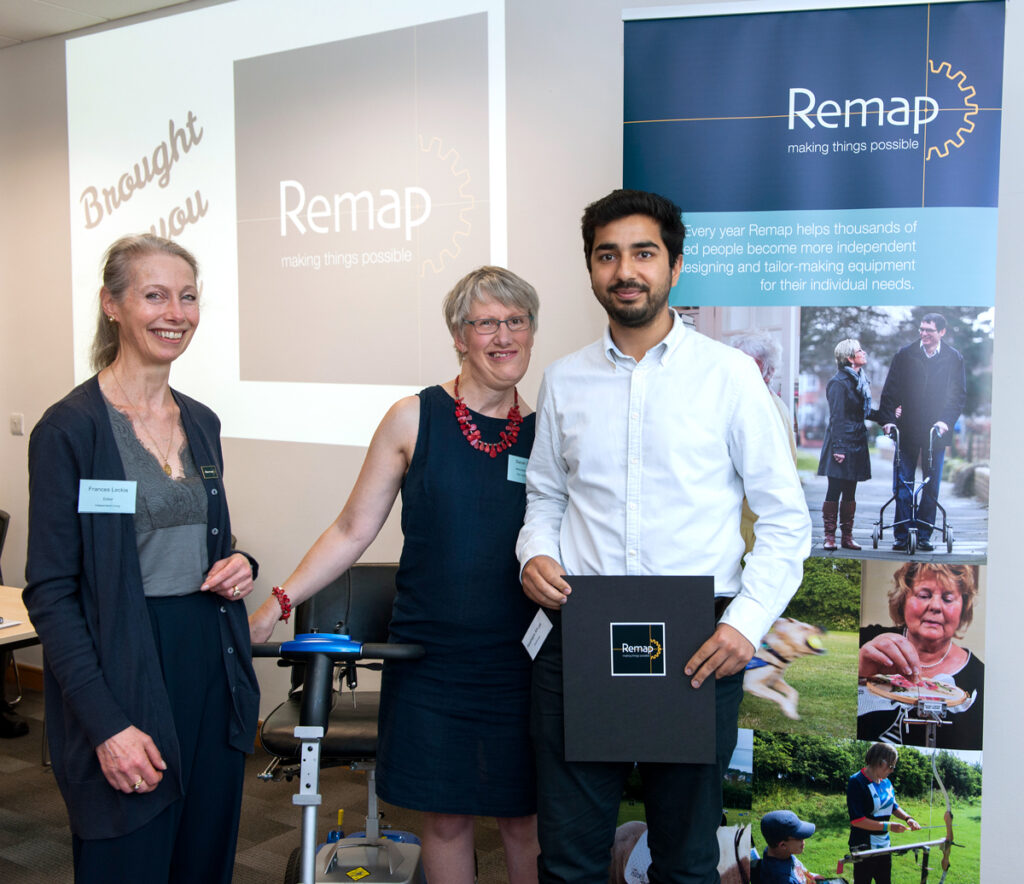
Akshaya recently won the prestigious Wolff Award at Remap’s National Award Ceremony for creating an electronic armband with a pressure sensor, shown in the report, to help remind Sarah to correct her posture and sit upright.

User centred innovation is at the heart of Cambridge Design Partnership’s expertise. Staff also use this capability for voluntary projects, such as those with Remap, with flexible working hours and state of the art facilities to help them.

Jess, who has currently been assigned a new project says working with Remap is “a great opportunity as an engineer to see what your skills can do to help people – and how it can help someone’s life dramatically”.

For more details on Remap, visit the site.

Mars Petcare – smart-pill illustration
Share:

CDP create a remarkable ‘smart pill’ for Mars Petcare

A team from Cambridge Design Partnership has created a ground-breaking ‘smart pill’ to gather crucial nutritional information to help develop innovative new pet foods.

CDP scientists and engineers worked with the world-renowned Waltham Centre for Pet Nutrition on an electronic pill to collect food samples inside the canine gut during digestion.

“It was certainly an unusual request and a major challenge,” says Will Bradley, who led the project for CDP. “Mars Petcare wanted to find out more about how dog food is digested, with the aim of improving their pet food. So they asked us here at CDP for help.”

“They needed samples of partially-digested food that they could gather in complete safety for the dog.”

Part of Mars, Incorporated, Mars Petcare has a portfolio that spans pet nutrition and health through brands including ROYAL CANIN®, WHISKAS® and PEDIGREE®. For Mars, CDP created a smart pill about the size of a grape that a dog could easily swallow.

“We gave it a sensor so that it knows when it has left the acidity of the stomach and entered the first part of the intestine,” explains Will. When it is correctly located the pill opens and takes a food sample, using a miniature piston-type mechanism. “This needs to be absolutely foolproof. The pill then closes, to contain and protect the sample as the pill moves through the remainder of a dog’s digestion.”

CDP was approached by Mars Petcare to bring to life an idea for intestinal sample collection in dogs. CDP created the pills at its laboratory in Cambridge, which were trialled at the WALTHAM Centre for Pet Nutrition in Melton Mowbray, the global pet research centre for Mars. There were many studies and iterations needed to refine the design.

The samples that are collected will be used to analyse the way various nutrients are absorbed during digestion. “The scientific understanding of this whole process had basically stalled for decades,” explains Mike Cane at CDP, who has worked on the project for the past 18 months, “because no one could retrieve these samples without invasive surgery to the dog.”

Working with animals is not straightforward, Mike admits: “At all times, there were such high welfare standards. An independent observer was on hand whenever we worked with the dogs. If any dog was looking uncomfortable they would intervene to stop that day’s trial. They really do pride themselves on the way the animals are treated there.”

Once the pill passes through the dog and is excreted, it is retrieved and the data from it is collected. “The data from the trials has been analysed by the lead scientist from WALTHAM, David Wrigglesworth, who will soon be publishing his findings in peer-reviewed scientific journals,” explains Mike.

In addition to surviving the rigours of a dog’s digestion, the pill can also be tracked on its journey. “Once it was clear that the pill worked well, Mars Petcare asked us if we could also find a way of knowing accurately exactly where it was as it passes through the dog,” says Mike. “So we also devised a special interactive coat worn by the dog which picks up a radio signal from the pill.”

The smart pill is so unique that it has been patented by the team.

“Here at CDP, we’re very proud of our achievement,” says Will. “I feel sure that it will enable Mars to create innovative new pet foods for many years to come.”

For further information and media enquiries, please contact: media@cambridge-design.com or call 01223 264428

CDP Engineer wins national charity design award
Share:
Find the authors
on LinkedIn:

CDP Engineer wins national charity design award

Mechanical engineer Akshaya Ahuja, wins the prestigious Wolff Award at Remap’s National Award Ceremony after creating a special gadget to help a woman with cerebral palsy.

Akshaya Ahuja recently travelled to a national award ceremony in London to receive an award for his charity work. Akshaya, created a solution to help Sarah Stones, who has cerebral palsy, improve her posture while using a computer.

Akshaya, 27, has been working at Cambridge Design Partnership (CDP) as a mechanical engineer for 18 months. He explains how his invention works: ‘Sarah finds that due to lack of core muscle strength she leans too heavily on her left arm when she is working on her computer. This causes her shoulder problems and pain, so she needed something to remind her to correct her posture and sit upright.’

Akshaya came up with the light, rechargeable electronic armband that Sarah wears on her left forearm. ‘If she leans too heavily on it for too long, an alarm sounds which reminds her to adjust her posture,’ he explains. “The settings can be changed as her core strength improves, so it should bring benefits to her overall health in the longer term.”

Sarah, who lives in Cambridgeshire, says she is delighted with the result. ‘When I’m working if I lean too much over to the left, which I very often do, it reminds me to sit up straight again.

‘I’ve been wanting this gadget to be made for years and never knew that there was someone out there that could do it. So thank you so much and keep doing the amazing work.’

Akshaya helped Sarah through the charity Remap, which makes equipment to help disabled people live more independent lives. Remap volunteers, who mostly have engineering training, work on projects throughout the country. Akshaya’s design won the prestigious Wolff Award at Remap’s national award ceremony recently. Both he and Sarah travelled to London to receive the prize.

The design process was carried out by Akshaya in his spare time, using the facilities at CDP. ‘Sarah and I went back and forth with prototypes, refining the armband until it was just right,” he explains. ‘I’m lucky to have an employer that supports Remap and is happy for me to use the design software and lab facilities here at work. I was also able to get helpful advice from my colleagues on the project.’

Now that Sarah’s gadget is fully functioning, Akshaya is working on a second project for Remap, working out a way for a disabled blogger attach a video camera to a mobility scooter. ‘I’ve found working on these projects very rewarding and I’m sure I will carry on volunteering with Remap in the future,’ Akshaya says.

Mike Beadman of CDP says the company encourages staff to take part in voluntary projects such as this one: ‘We are delighted that Akshaya has won this award, which shows real flair and imagination. Our colleagues here are able to use our facilities to work on projects such as this and we offer flexible working hours so that they can carry out these charity projects while they are at work. We’re very proud of the contribution they make.’

Another CDP staffer who is volunteering for Remap is Jess Carroll, who has been working at CDP as a mechanical engineer since January 2019. Jess is working on a modification for a mobility scooter. ‘The client has problems working the throttle with her hands so I’m working on creating some sort of throttle rocker. At the moment I’m at the stage of contacting lots of scooter companies for advice and suggestions. I’m really lucky that CDP takes such a flexible approach to work schedules, so I can call up these companies in working hours. I will also be using the CDP 3D printer, tools and design software, so I feel very supported by the company in taking on this project.’

More details on Remap.

manufacturing – we bridge the chasm
Share:

Bridging the design transfer chasm

The challenges of bridging the ‘design transfer chasm’ are well known in the medical device industry. If your approach to design and innovation has not fully anticipated the intricacies of volume production in a regulated environment, then difficulties will arise when it is sent to your manufacturing partner to be made at scale.

Developing high volume medical devices is a complex challenge, there are many issues beyond the design itself to consider such as usability, component cost, part variability and suitability for high-speed assembly and inspection.  Product designers creating new products from a clean sheet often rely on manufacturing engineers to rectify issues later down the line.

Unfortunately, rectification can be a tortuous process as each design change can have many unintended knock-on effects. When manufacturing delays impact the launch of a product, the direct costs and financial damage can be significant. The window of opportunity in which to sell a new product while it is still under a patent is limited, causing unforeseen harm to income potential.

Some contract manufacturers address this concern by offering a design and manufacture package, however this strategy can leave the manufacturer’s intellectual property and know-how embedded in the product. This ties in the manufacturer and restricts your ability to control supply chain profit margins in the long term by competitive second sourcing, adding risk in the future.

To address these challenges, Cambridge Design Partnership has created a product innovation model called Potential Realised. We find it offers a better solution by developing the new product within an environment where a holistic team of product development and manufacturing engineers work in parallel. The benefit of having the design and manufacturing teams working closely together is that production problems are foreseen, and issues fixed quickly, by either design or manufacturing changes.

The key step that leads to the success of this approach is a robust phase of short-run manufacturing organised by an extended design team towards the end of product development. The manufacturing team develops a comprehensive pilot manufacturing process which includes tooling and process qualification. This run provides both regulated product for clinical trials and verifies the capability of the design and manufacturing process.

The result is a detailed and tested package of manufacturing documentation alongside the completed technical file and clinical trial data. The designs are handed over with a quality control plan, standard operating procedures, jigs, and validated test methods. This means that all the intellectual property including the know-how relating to both the design and manufacturing process is transferred, enabling a competitive tender process to identify the most cost-effective volume manufacturing partner.

A key advantage of Potential Realised is revealed when conducting clinical trials. Trials normally start between design and full manufacture, so there is a danger that if design transfer requires alterations to the product, elements of the controlled clinical trial may need to be repeated. There are countless examples of pharmaceutical companies needing to repeat or extend clinical trials due to delivery device design changes during design transfer, or to take extra time to perform bridging studies to demonstrate to regulators that changes have not impacted clinical performance.  Instead, with the Potential Realised approach, a short manufacturing run for clinical trials is integrated into the development process and is conducted in a manner representative of how the product will be made once it goes into volume manufacture, thus significantly reducing these risks.

In the field of medical device innovation, Potential Realised integrates short-run manufacture into product development bringing a raft of advantages, not only saving both time and money in commercialisation but bringing forward product launch and vital product revenues.


To find out more, explore Transfer to Manufacturing.

Latest Prototyping Methods That Unlock Digital Innovation
Share:

How the latest prototyping methods unlock digital innovation

WEBINAR

How the latest prototyping methods unlock digital innovation

Wtih Tom Lawrie-Fussey
1 MAR 2019

Digital is a term that has become a way to describe how our products, and our interactions with them, mature from simple, local mechanical interfaces, to complex, distributed, connected eco-systems. A key driver for this is the desire of people and companies alike to better close the loop of product and experience, and digital services enable this ‘value’ to be extracted and monetised.

In this session, Tom Lawrie-Fussey (Digital Services Specialist), introduces the need for a pragmatic route to digital, and how Cambridge Design Partnership have created a number of toolkits to help our clients to prototype digital services. These services range from better capturing quantifiable evidence of real in-home consumer usage, through to creating a semi-simulated user experience, where technology propositions can be evaluated with consumers, long before the technology itself is actually implemented.

Bridging a cultural gap in product innovation
Share:
Find the authors
on LinkedIn:

Bridging a cultural gap in product innovation

Industrial design (ID) and engineering skills are different, yet both are crucial to successful new product development (NPD). But as anyone involved will have experienced, tensions can arise due to the approaches and goals of different members of the team.

Having attended both art school to study ID and university to study mechanical engineering, I work between the two disciplines, from front end ‘user centred’ concept generation through to detailed design for manufacture. As such, I have experienced these tensions, engineers often pressing for performance and the industrial designers for the user experience they believe is so essential. The worst-case scenario is when everyone misses their goals. So how do we achieve the best outcome?

This is where speaking both design languages can provide benefits. Having empathy and taking the time to understand the underlying design aims from both sides allows for better integration of the end product.

It is important that the NPD team recognises this gap and actively works towards creating a culture where collaboration is the norm. Fortunately, there are some simple measures that can encourage a culture of information sharing and a free flow of ideas. We do this here at CDP and one example is our ‘Friday Innovation Forum’, a weekly event involving different themes and speakers sharing learnings across all disciplines. Another format is a jumbo size computer monitor in our central coffee area which displays new ideas to inform and educate, stimulating coffee time discussions around hot topics and helping to align thinking across disciplines.

With my design hat on, I have a natural appreciation of ID so I spend time trying to understand the artistic intent of what the industrial designer has created and what they are trying to achieve, you can then start working with them to create solutions that embody everyone’s requirements. For example, to start this process, I like to ask:

“What is the ‘hero shot’ you have in your mind for the product, if it was on a billboard or on the side of a building – what is it that you are trying to convey?”  By asking that question I’m probing into what the industrial designer’s thought process is and creating a space where we can consider alternative solutions that could benefit all parties.

This is much easier if all the project disciplines are involved right from the start of the project. As an engineer I try to communicate the development journey, performance requirements and operating constraints across the whole team as they become known or change. By highlighting the difficulties as and when they occur it allows the ID team, or any other skill group for that matter to react and develop concepts in parallel that consider the new realities. This is best achieved through informal chats as the program progresses, it doesn’t always have to be in an official review meeting.

I favour elegant design solutions and try to stay away from what I call “glamour caps”, mouldings that have no other purpose than to hide an undesired feature. If the team all think in this way then you can create integrated designs with purpose as well as aesthetics.

It’s never a good idea to crowbar a new design into an already developed architecture. And similarly, it’s never easy to develop the usability and aesthetics of the product when too much is set in stone. By bridging the gap between these two disciplines and steering the development journey away from the ‘it’s your problem’ attitude you can create fantastic products that look good and have high performance.

CDP and ECCO - Step Forward
Share:

A unique step forward – wearable sensor breakthrough from CDP and ECCO heralds a new era of customisation

14 March 2018 – Technology and product design firm Cambridge Design Partnership (CDP) has worked with leading shoe brand ECCO on a breakthrough in data-driven customised footwear. It opens the door to a new generation of customised footwear for the mass market – heralding an evolution in engineered comfort. Consumers will get a full digital analysis of their foot structure and the way they move in just a few minutes – and shoes will be tailored to their specific requirements in just a few hours.

The QUANT-U (‘quantified you’) project will have an initial public release at W-21 Amsterdam –  ECCO’s concept shoe store – in April. A key element is the wearable sensor embedded in the soles of the test shoes. It collects a multitude of data using gyroscopes, pressure sensors and accelerometers – as well as the temperature and humidity inside each shoe – to create a unique digital footprint. This data is autonomously translated into geometries for in-store 3D printing of shoes based on each individual’s biomechanical and orthotic parameters.

“The biggest challenge was the fact that the sensors are very close to the ground, hidden inside shoes and covered by a human body – yet they need to send data from both shoes simultaneously to a connected device such as a mobile phone,” said Roberto Basile, a software engineer at CDP. “We needed to maintain reliable communication – using Bluetooth Low Energy – despite the human body acting as an obstacle to the wireless signals. The mechanical system inside the sensor had to be robust enough for people to walk on it, while the battery had to be small and last at least three days without being recharged.”

The first prototype of the wearable sensor was created by CDP and ECCO in less than four months. The inbuilt algorithm filters the raw biomechanical data from the sensor into functional information. This data creates the input parameters for a 3D-printed customised midsole for individual customers in approximately two hours. For the QUANT-U pilot, the customised midsole will be paired with ECCO’s iconic Flexure shoe.

“Throughout my experience in footwear design and engineering, the concept of perfect fit, perfect dynamics and ultimate performance has long been an obsession,” said Patrizio Carlucci, head of ILE (Innovation Lab ECCO). “With QUANT-U we are now combining future technologies in order to augment footwear functionality without interfering with its aesthetics.”

ENDS

Notes for editors

Cambridge Design Partnership is a technology and product design partner focused on helping clients grow their businesses. Some of the world’s largest companies trust CDP to develop their most important innovations. Located in both Cambridge (UK) and in Palo Alto, California (US), CDP specialises in the consumer products, healthcare, energy and industrial equipment markets. Its multidisciplinary staff have the expert knowledge to identify opportunities and tackle the challenges its clients face. For more information, visit: www.cambridge-design.co.uk

Founded by shoemaker Karl Toosbuy in Denmark in 1963, ECCO footwear has since grown into a global brand with factories and retailers across the world. ECCO manages the entire manufacturing process from start to finish – ECCO designers develop the collections, ECCO-owned tanneries produce the leather and ECCO-owned factories make the shoes sold across the world. ECCO, from the very beginning, has fused together premium raw materials with dynamic comfort platforms to produce an unparalleled wearing experience for its consumer. For more information, visit: www.ecco.com

ILE is ECCO’s independent cross-disciplinary design studio. ILE explores, creates and delivers projects embracing alternative production methods, advanced materials, new technologies and experiential solutions in footwear. Results of the work can be found via limited edition collections at the experimental shoe store W-21 Amsterdam.

For further information, contact:

Cambridge Design Partnership
Marketing Team
+44 (0)1223 264428
marketing@cambridge-design.co.uk

ECCO
Teo Pazanin
Research and Communication at ILE
+31 6 38 68 55 67
tepa@ecco.com

Jessica Paulus
Strategist and Communication at ILE
+49 1 51 68 12 04 81
jepa@ecco.com

General inquiries
info@Quant-u.com

ablation-catheter-technology-cardiology
Share:

CDP and Kings College London develop innovative steerable catheter to treat cardiac arrhythmia

Innovative design and technology consultancy Cambridge Design Partnership has worked with King’s College London to develop a novel steerable catheter which King’s researchers had designed.  The catheter is designed to improve the treatment of cardiac arrhythmia – a range of conditions which can lead to stroke or heart failure that affects 2 million people a year1 in the UK alone.

The new steerable, micro moulded catheter enables targeted delivery of radio frequency energy to specific points in the heart tissue for corrective treatment. Compared with traditional catheters, the new device has been designed to be quicker and easier to manoeuvre into the correct position, improving the accuracy of positioning and minimising damage to healthy tissue, which should improve success rates of the treatment.

Cambridge Design Partnership won a four-way competitive bid to further develop the device created by King’s College London, involving helix-shaped interlocking tubes that would allow improved steerability and greater compatibility for robotic control over other catheters on the market. The team at Cambridge Design Partnership successfully refined the initial design, enabling the device to meet key regulatory and biocompatibility requirements, whilst ensuring suitability for commercial manufacture. Through CDP’s experience of developing highly technical medical devices, the team was able to miniaturise the design to allow improved space for the delivery of ablation energy and irrigation. The new catheter design is also assembled from micro injection moulded sections, incorporating features that enable the device to be built on an automated assembly line at reduced manufacturing cost.

Matt Brady, head of Medical Therapy, Cambridge Design Partnership, said: “The steerable catheter is an extraordinary product, with innovative features that enable corrective treatment to be delivered to very specific areas of the heart. By enabling greater accuracy and quicker treatment time, we believe it is possible to preserve more healthy heart tissue, and increase the success of the treatment. It’s been hugely exciting to be involved in this joint project with King’s College London and use our expertise to bring such an innovative product one step closer to commercial use.”

Professor Kawal Rhode, Professor of Biomedical Engineering at King’s College; London, commented: “We have been delighted with the results of Cambridge Design Partnership’s work on this project. The team was chosen for the strength of their existing experience in developing catheters across both start-ups and global corporations.  We were very pleased with the engineering approach and practical improvements that they managed to incorporate. They delivered fully moulded parts, and specified other components and the assembly route which fully met our aspirations for the project.”

King’s College London is now undertaking extensive lab testing of the catheter device, with clinical trials expected to be take place in two to three years.

1 Arrhythmia

For further information on this project, please email: hello@cambridge-design.co.uk

For Enquiries to King’s College London:
Please contact Dr. Rob Glen, King’s Commercialisation Institute
Robert.glen@kcl.ac.uk 020 7188 6209
Kings Commercialisation Institute

Share:

Balancing design and engineering – New Design Magazine interview Ben Strutt

Cambridge Design Partnership was established in 1996 by three engineers (all of whom are still involved in the running of the business to this day). One of the founding partners, Mike Cane completed his Engineering degree at the University of Cambridge before studying Industrial Design at the Royal College of Art; it was his vision to create a company that balanced technological expertise and user-centred design in helping clients to innovate and make better products.

Ben Strutt, the company’s head of design, joined Cambridge Design Partnership in 2010 and the five years since have seen design become an increasingly important aspect of the business. “My vision was to drive the combined industrial design, consumer research and technical R&D offer,” he says. “These disciplines have now become fully integrated within the business.”

The consultancy works predominantly across four sectors: consumer (which includes subcategories such as consumer electronics and packaging); healthcare (medical devices, drug delivery systems, and surgical devices); energy (domestic heating technologies, control systems, and in-home monitoring systems); and industrial (process line equipment, safety systems and so forth).

2014 proved an exciting year for Cambridge Design Partnership in terms of growth. The company took on 18 new staff and in March opened a bespoke multi-million pound R&D centre. The new centre includes laboratories, consumer research facilities, a rapid prototyping suite, and workshop and modelling provision. Strutt adds: “The centre is integral to our ability to work and iterate quickly and support client confidentiality by keeping as much activity inhouse as possible.”

The year started with the exciting news that the consultancy had been successful in obtaining a grant from the Bill and Melinda Gates Foundation to help tackle the global HIV epidemic by developing a next-generation condom. “We felt it was a very user-centred problem: it wouldn’t just be about developing a new material or a new chemistry, it would be about focussing on the challenges that are experienced by users,” explains Strutt. “Many of the problems – social, emotional, cultural, accessibility, and so on – are unique to sub-Saharan Africa and other low resource settings.”

Through 2014 Cambridge Design Partnership worked on the first stage of the project, making links with health workers in Lesotho (where around a quarter of the population is HIV positive) and developing concepts to early prototype level.
In 2015 a Phase Two application will be made to the Foundation to support further development of certain concepts. Also in healthcare, the consultancy worked with Raumedic AG, a German medical device company, on a needle safety device that fits to their existing syringes in order to prevent needlestick injuries.

In response to new directives (in the US and Europe) introduced to reduce the number of such injuries, companies are attempting to create completely new products. However, one of the problems of starting from scratch is the product will need to go through a long and expensive validation process. “Raumedic AG recognised the opportunity for a needle safety device that could be retro-fitted to existing primary packs (the part that holds the drug),” says Strutt. “We created a spring-mounted telescopic sleeve which, once the syringe has been plunged and the drug delivered, springs out to surround and cover up the needle automatically. Modifying the existing vial avoided the long process of revalidation and helped the client get to market as quickly as possible.”

Also in 2014 Cambridge Design Partnership worked with Bloodhound SSC, the British land speed record team. The consultancy helped to design the steering wheel for the car, which it is hoped will be capable of speeds in excess of 1,000 miles per hour.

The project prioritized usability and ergonomics with the wheel designed specifically for the hands of driver Andy Green and carefully formed to take lines of sight into consideration. The wheel has been printed using an additive titanium technology making it incredibly strong as there is no need to remove a mould tool.

2014 was a particularly strong year in the industrial sector. To look at one example, Cambridge Design Partnership developed an industrial printer for Domino. “This is not your typical home printer,” comments Strutt. “These printers sit in factories labelling anything from sweets and eggs to mass-produced packaging.

Some of those environments are quite challenging, the products need to be very rugged and washed down regularly.” The main challenge for the designers was around ingress protection to ensure the printer met IP66 rating. There was an apparent fundamental conflict between keeping the electronics cool and a rugged enclosure. The design team did extensive work with thermal modelling and CFD to develop a solution in addition to industrial design work to enhance the user experience.

Having carried out qualitative consumer research in the US, Latin America, China and Europe last year, the company plans to extend and expand its front end process in 2015 to ensure primary insights are translated most effectively into concepts and products that people want and need. Furthermore, the team will continue to grow both at the consultancy’s Cambridge site and at its US office in Palo Alto, California.

See the article.

www.newdesignmagazine.co.uk

New Design Magazine 2015 Year book. Issue 114. February 2015