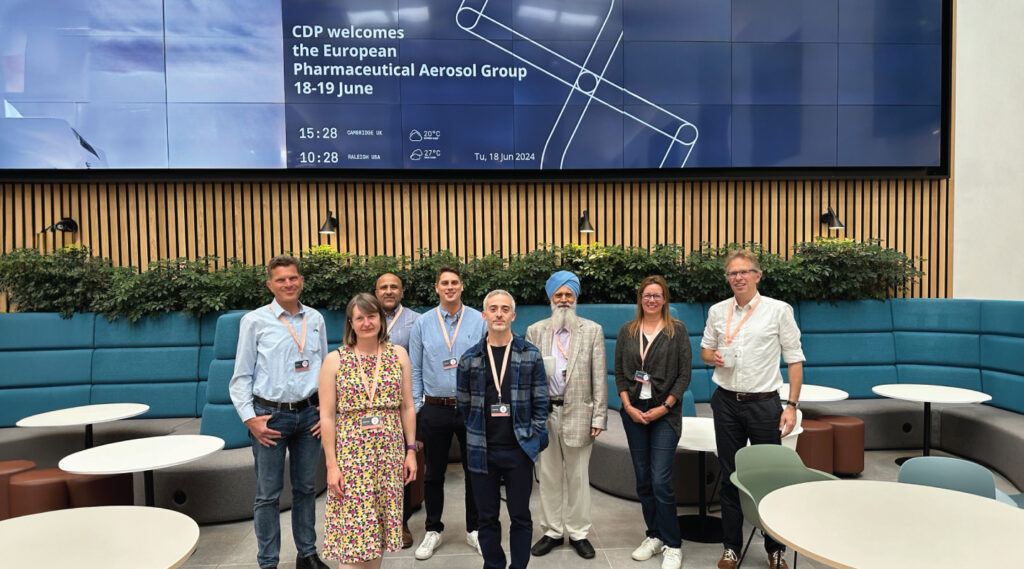
Members of the European Pharmaceutical Aerosol Group (EPAG) at Cambridge Design Partnership’s UK headquarters.
By Cambridge Design Partnership

Advancements, Challenges, and Opportunities in Developing Respiratory Drug Delivery Devices

Insights from Industry Experts on Training for Patient Technique, the Value of Connected Devices, and the Shift to Low GWP pMDIs.


Recently at Cambridge Design Partnership’s UK headquarters, we hosted an expert roundtable, bringing together some members of the European Pharmaceutical Aerosol Group (EPAG) to share invaluable insights. This article summarizes some of the themes emerging from that discussion, with additional perspectives from our own in-house experts, offering you a comprehensive view of the ideas that are shaping respiratory drug delivery.

The respiratory drug delivery landscape is undergoing change, driven by advances in technology, regulations, and evolving patient needs. While new trends open the door to innovation, they also bring about significant challenges that need to be addressed to ensure that respiratory care is optimal and accessible.

Training for Proper Technique

Highlights from the roundtable:

To simplify the use of inhalers, many companies have adopted an open-inhale-close (OIC) model for their products. However, a lack of standardization remains across different inhaler designs and can result in patient confusion. Addressing this issue will require enhanced training programs to improve patient proficiency in using inhalers.

CDP perspective:

Multi-dose respiratory devices offer unparalleled cost-per-dose benefits compared to many other delivery methods, except for oral drugs. However, within the three major inhaler families (pMDIs, DPIs and SMIs), there are significant differences in how the user accesses the drug and gets an effective, consistent dose. With some inhalers, opening a mouthpiece cover will expose the dose- whereas other inhalers require the user to advance a dose drive as well. Even if the patient can reliably access the dose, variations of inhalation technique can significantly alter the dose profile the patient receives. While it helps that many medications have a wide therapeutic index, erring towards excess dose rather than under dose, users can become confused about how to use their inhalers. Training, frequent check-ups, and easy access to user guides, videos, and healthcare professional (HCP) involvement is critical.

This article from The International Journal of COPD explores inhaler adherence with insight for improving patient compliance: https://www.ncbi.nlm.nih.gov/pmc/articles/PMC10697822/

Unlocking the Value of Connected Devices

Highlights from the roundtable:

Technology demos for connected inhalers have shown great promise, but this extra functionality comes with additional cost and complexity. The regulatory demands around patient privacy present a major obstacle. The investment required must be supported by tangible enhancements in patient outcomes. Furthermore, maintaining patient confidentiality and ensuring sustainability remain challenges. Numerous third-party tools are available for connecting inhalers and offering patient support but articulating a clear patient benefit from this data tracking hasn’t been demonstrated yet. The committee members also observed that getting users to pair a device with their phone could become another barrier to adoption.

CDP perspective:

Inhalers may seem like a natural fit for connectivity due to being multi-dose devices used to manage chronic conditions and prevent the emergence of life-threatening symptoms. However, given the cost considerations associated with developing respiratory devices, it’s essential for connectivity features to demonstrate tangible benefits. One way to prove their worth is by showing improvements in patient outcomes such as reducing adverse events for patients, especially those that have measurable economic impacts, like the cost of hospitalization. The challenge lies in convincing patients of the benefits of using connected devices and ensuring their consistent engagement with the technology to gather relevant data. Regarding sustainability, many pharma companies with a portfolio of respiratory drugs are getting a lot more serious about their environmental footprint. Against this focus on environmental impact, how can electronics (which aren’t essential to safe and effective delivery) be justified?

The Shift to Low GWP pMDIs

Highlights from the roundtable:

Any new low global warming potential (GWP) propellant for pressurized metered-dose inhalers (pMDIs) necessitates new testing, including a Phase 3 clinical trial, incurring additional time and cost in the effort to move away from the current gases used. EPAG experts were encouraged to note that the FDA is spearheading discussions on the updated regulations for drugs with these new propellants, with hope that this may streamline the process in future.

CDP perspective:

The current emphasis is on bringing legacy pMDI-based products to the market using one of the two low GWP gases under consideration – Honeywell’s 1234ze and Koura’s 152a. This shift in the market can have broad implications for inhaler construction, requiring extensive testing and confirmatory clinical trials. While the transition to low GWP gases is extremely important, some industry insiders believe that it is currently stifling innovation in the pMDI space. It is anticipated that once the new gases are established, innovation will benefit from the advancements made in transitioning to low GWP gases, expediting the process of bringing new treatments to previously underserved patient groups much quicker.

Respiratory drug delivery is at a juncture, marked by exciting trends and significant opportunities for innovation. However, the industry also faces considerable challenges that require strategic solutions and collaboration across the sector. By understanding these dynamics and leveraging expert insights, stakeholders can navigate this complex landscape, ultimately enhancing respiratory care for patients worldwide. The path forward involves embracing technological advancements, addressing regulatory hurdles, and prioritizing patient-centric design to achieve better health outcomes.


Watch the Recordings:

To view the presentations that prompted in-depth discussions within the EPAG and CDP teams, please use the link below.


Developing a Novel Device for Localised Deep Nasal Delivery – Rapid Development to First in Clinic

Andrew Fiorini | Healthcare Device Consultant and the second

Model of the Lungs – Applications to Respiratory Drug Delivery

Karla Sanchez | Head of Biomedical Engineering
Mark Allen | Consultant Biomedical Engineering

Bespoke device for targeted intranasal delivery

Taking a drug to first-in-human trials in a bespoke device for targeted intranasal delivery

Featured in ONdrugDelivery, Mark Allen, Andrew Fiorini, and Shai Assia discuss the need to develop delivery devices early when formulating nasally delivered drugs for systemic and local action, and a method by which the route to clinic can be made easier, faster and cheaper.

Systemic delivery has long been the mainstay of drug administration, whether via the oral, injectable, inhalable, nasal or another delivery route. There are, of course, many well-documented downsides of systemic delivery, including unintended side effects in locations beyond the drug target and reduced efficacy due to dose safety requirements to reduce those side effects. Targeted drug delivery can address many of those issues1 with targeted intranasal delivery, in particular, having the potential to treat many debilitating conditions, from as yet underserved conditions, such as cluster headaches, through to central nervous system (CNS) conditions such as Alzheimer’s disease. Indeed, there are currently many active studies on therapeutic delivery via this specialised route2. These targeted treatments have the potential to improve the lives of patients, their families and their carers immeasurably.

However, the key challenge lies in achieving the delivery of an accurate dose to a precise location within the nasal anatomy. A device that can enable that targeting is intrinsically linked to drug efficacy, meaning that it is necessary to consider device development earlier in the process than usual. In comparison, a drug intended for parenteral delivery has the well-trodden option of using a vial and syringe for administration by a healthcare practitioner during early development phases while proving basic safety and efficacy. A more complex drug delivery system can then be sourced or designed (if required) in parallel, ready for use in Phase III trials as part of a combination product development pathway.

“The key challenge lies in achieving the delivery of an accurate dose to a precise location within the nasal anatomy. A device that can enable that targeting is intrinsically linked to drug efficacy.”

This off-the-shelf-device approach, aimed at reducing the risk and cost associated with early-stage clinical studies, is not an option available to those developing highly targeted intranasal delivery – most of the currently available nasal devices are designed to coat as much of the nasal cavity as possible, making them unsuitable for delivery to a precise area. A nasal device with a broad spray pattern may even lead to the drug not reaching the intended target area at the required dose level.

So, how can a new, bespoke device be developed and made available for the initial Phase I and II trials? These are complex devices that need to be suitably well designed to ensure that patients or clinical professionals can use them during clinical trials to administer the drug accurately and repeatedly to the correct location, often deep in the nasal cavity.

To answer this, a minimum viable product (MVP) prototype device can be designed for the needs of the Phase I and II clinical trials. Designing for use within the controlled setting of a clinical trial and prioritising solely patient safety, spray geometry and usability (relating to holding and positioning the device) at this stage can considerably reduce the effort, cost and time required to reach the clinic. This MVP device will then allow the safety, efficacy and feasibility of the self-administered, targeted intranasal delivery method to be proven during these early clinical trials. The device performance and usability are critical to correctly delivering the drug, so learnings from this MVP device can be used in the further development and refinement of the device for Phase III trials, as well as the future commercial-scale device. Carrying out risk assessments and timely iterative testing (via formative studies) on the usability of the device is crucial; misuse or an inability to use the device could stop the patient from administering the drug to the intended location within the nasal cavity, or even cause harm, ultimately preventing the drug from achieving its intended therapeutic effect. Therefore, usability and human factors engineering must be incorporated into the design and development process from the start.

Defining a usable design

The challenge for the device development team is to successfully incorporate design for usability throughout a “lean” MVP device development process, meaning that a safe, usable device must be produced with reduced cost compared with traditional development processes. This can be achieved by careful adaptations to the typical design for usability process. When applying user-centric design principles, as outlined in ISO 9241-210, four steps should be followed:

  • Understand the context of use
  • Define the requirements
  • Build the design
  • Evaluate the design against the requirements.

Although this is not the only relevant ISO standard (others, such as ISO 62366, cover the application of usability engineering to medical devices), ISO 9241-210 provides a set of recommendations and requirements for applying user-centric design principles within design and development activities. These processes help to identify “real” user needs and usability challenges, which can then be used to establish a clearer framework for user interaction and interface design.

Understand the Context of Use

Consideration of the patient, including when and why they are receiving treatment, is essential. For example, if a new targeted nasal delivery device is to replace a healthcare practitioner-administered treatment, it is likely that the patient currently visits a clinic to receive their treatment, disrupting their schedule and placing an additional burden on the healthcare system. A self-administered device will naturally put the patient in control of their treatment and improve their quality of life – as has been witnessed through the advent of self-injection devices. However, targeted nasal delivery relies on the patient not only following the treatment regimen and using the device correctly, but also positioning the device accurately to ensure that the drug is delivered to the precise location intended.

“The best form of information gathering is to consult the patients themselves – they know their needs, and frustrations, better than anyone.”

Another key factor in the design process is predicting how a patient may interpret the device and, therefore, how they would go about using it. This is where the concept of mental models is useful, as it reflects the patient’s perception of how a device works and how to use it based on the patient’s experiences of similar devices. Perception is what a patient sees, hears, touches or smells, which, in turn, triggers mental recall and cognition, which then drives their actions.

The best form of information gathering is to consult the patients themselves – they know their needs, and frustrations, better than anyone. Clinicians and caregivers can provide additional information about patient behaviour and trends based on their experience across a wide range of patients, but their answers should take second place.

Speaking to patients is crucial to building an understanding of the context of use; however, care must be taken with the specific questions asked – they must be suitably phrased to avoid leading patients to give similar answers, but also to gather the information required to guide the device design via user needs. Working with experienced insight researchers and human factors experts can greatly increase the value gleaned from patient interaction throughout the design and development process.

Define the Requirements

Once the context of use is understood, the findings and needs of the patient must be converted from a range of opinions and perceptions into clearly defined requirements. It is essential to align patient needs with requirements in a format that can be validated. Similarly, technical requirements need to be verifiable, while also ensuring a cost-effective and usable device design.

User requirements should drive the technical requirements for the device. Requirements are living documents, so each set of patient interviews will typically lead to updates to the requirements throughout the design process. Equally, unknown parameters in the requirements documents can be used to drive patient interviews that can, in turn, be used to refine the requirements further or provide specific values for the device design team. These documents and patient interviews can then both be iteratively tested and updated as required.

Build the Design

The design stage is the point at which activities can be prioritised to reduce development time and costs by differentiating between a prototype device suitable for first-in-human testing and a fully developed and validated device. Here, the typical process of concept generation followed by down selection (via assessment against device requirements) is used to identify a suitable device design for further development.

Once initial prototype devices are available, engineering testing against the requirements can be performed to provide confidence in the design. Full design verification testing is not required at this stage, but sufficient evidence should be generated in the key areas, including safety and dose delivery performance. Development and evaluation of the important training materials, such as the instructions for use, should be started, but with a lowered risk assessment burden, in the knowledge that there will be clinicians available during initial trials.

“Once initial prototype devices are available, engineering testing against the requirements can be performed to provide confidence in the design.”

Focusing on the requirements of the MVP will accelerate time to clinic by concentrating on safety and usability. This MVP device is equivalent to a syringe and vial or prefilled syringe in injectable development for systemic treatments, so there will be future opportunities to refine the design for Phase III trials and commercial launch. This is an appropriate strategy, as the devices will only be used under supervision at this point. All learnings from the study can then be prioritised and incorporated into the final design as required, according to risks identified.

“Once a final prototype has been developed, it must be evaluated against the design requirements by design review, engineering testing and formative human factors studies.”

Evaluate Against Requirements

Once a final prototype has been developed, it must be evaluated against the design requirements by design review, engineering testing and formative human factors studies. This should incorporate a usability assessment for self-administration and simulate as many real functionalities as possible, including tactile, visual and auditory feedback from the device. This process should prioritise evaluating areas highlighted as high risk during previous activities, but also gather information on any additional learnings relevant to future design updates.

The Future of Targeted Intranasal Devices

The approach discussed here aligns with developing a bespoke prototype device suitable for first-in-human trials for targeted nasal delivery. The success or failure of this strategy depends on the nature of the collaboration between the pharmaceutical partner and the device design engineers, as well as in the experience of the insight researchers and usability engineers. Experience in the process required to develop a usable device is critical to the successful outcome of such a project and will pave the way for bringing a device to market in this new and exciting area of nasal drug delivery. It will be fascinating to see just how many new, life-changing improvements will be made possible by targeted nasal delivery.


References
  1. Hanson LR, Frey WH 2nd, “Intranasal delivery bypasses the blood-brain barrier to target therapeutic agents to the central nervous system and treat neurodegenerative disease”. BMC Neurosci, 2008, Vol 9(Suppl 3), S5.
  2. Hallschmid M, “Intranasal Insulin for Alzheimer’s Disease”. CNS Drugs, 2021, Vol 35(1), pp 21–37.