
|
Share:

CDP on inhalation trends and what we learned at DDL2020

We’re living in an ever more virtual world. The rate of adoption and adaptation of technologies enabling remote connections and interactions has surpassed even the most optimistic predictions. An example of this is the annual Drug Delivery to the Lungs (DDL) conference, hosted by The Aerosol Society, that a group of CDP colleagues attended last week. Usually held in Edinburgh, this year it was a virtual event. With the content available as a live stream and on demand and virtual booths providing instant access to downloadable material, this approach facilitated a wider reach and more flexibility for attendees seeking to learn about advances in the industry.

The first day highlighted the move to more sustainable lifecycles of products and how this must be balanced with effective drug delivery. With 630 million pressurised metered-dose inhalers (pMDIs) being produced each year and low rates of recycling, even small changes could have a big impact; whether by moving towards biobased polyolefin materials, inclusion of foaming agents to reduce the mass of plastic, or changes to another dosage form. This mirrors the trends that CDP has seen from our clients and the complex nature of plastic sustainability, discussed here by our colleague Dan. It was great to see the different approaches and how we are tackling this as an industry, making many small improvements that can add up to a significant change.

The second day went deep into specific formulations for targeted therapies. It’s always great to hear so many passionate scientists talk about their work and the benefit that it can have for patients. The biggest insight for us is how a deep and seemingly narrow investigation into a specific area can provide inspiration for unrelated therapies; the pharmacodynamic challenges of formulating an inhaled form of a parenterally administered product, engineering of particle sizes through spray drying, and the visualisation of drug particle distribution. Working across different sectors, this is the approach taken by CDP’s science team in projects such as determining the factors influencing vapour droplet size and technology scouting for novel delivery therapies. We were particularly excited to hear how advances in X-ray microscopy (XRM) are enabling the visualisation of active pharmaceutical ingredient distribution in pharmaceutical blends, giving real-life validation to predictive models of distribution and behaviour.

During the final day, the focus shifted to advances in delivery devices and challenges to the limits of their operation. Despite being widely used for over 60 years, studies show that over 70% of MDI users do not use the device as intended – so clearly there’s room for improvement. Whether the resolution is an adaption of the current MDI devices or switching to dry powder inhalers (DPIs) remains to be seen. With a step change in technology adoption this year, there is certainly a place for digital and connected solutions but as the final discussion group highlighted, in order to provide value from the digital advances the underlying technology needs to be robust.

CDP’s multidisciplinary, cross functional teams are here to help with your project needs. For more information, contact drug.delivery@cambridge-design.com

Circularity in context|
Share:

Circularity in context

Picture the scene: a room full of executives are watching a presentation on company strategy (actually, let’s move with the times… they’re all at home, watching on Zoom). A simple, elegant image of a circle dominates the screen. Will they support the adoption of circularity principles across the business? In unison, they nod. Not only is this the right thing to do, but it’s what the rest of the market is doing. Circularity is an essential component of a forward-looking business strategy.

But in each of their minds is a nagging question… How?

Why is circularity important?

“Circularity” is a word that has become ubiquitous in the sustainability strategies of many of the world’s biggest brands, from Apple (variations of the term ‘circular’ appear 27 times in their latest sustainability progress report) to AstraZeneca. Spearheaded by advocacy groups like the Ellen MacArthur Foundation, the concept has intuitive appeal: maintaining the value invested in materials and products for as long as possible seems like good sense, given the effort, skill and resources required to produce them. It should also be good news for a planet that is running out of capacity to supply us with raw materials and soak up our waste.
Behind the elegant concept of circularity, however, is an incredibly diverse range of steps with varying degrees of applicability – and environmental benefit – in a given situation. But the need to simplify this into marketing messages and calls to action has led to Circularity becoming a buzz word, applied so broadly that it risks becoming meaningless. Companies, keen to move into this green and pleasant new vision for the economy, are looking for simple, off-the-shelf ‘cricular’ measures that they can adopt quickly – sometimes at the expense of a proper assessment of whether the approach is appropriate and truly beneficial for them, their customers or indeed, the environment.

In this blog, we look at why Circularity in Context is of fundamental importance and the approach CDP takes, working in partnership to provide our clients with the best possible sustainable outcomes, instead of pushing a square peg into a circular hole…

Context is King
Take this as an example. An enthusiastic company want to generate a new beverage offering that is due to launch in an up and coming developing market – let’s call it ‘Circular Soda’… for now. They want something that has the kudos of being ‘Circular’, which seems an attractive USP for a marketing message. Time is spent identifying the right grade of rPET (recycled PET plastic); starting with a circular material in the first place seems like a great idea. But… when the brand launches with sustainable claims emblazoned on the label, it’s not long before journalists realize that this ‘recyclable’ rPET is not being recycled in practice, as there is no recovery or recycling infrastructure in this market! Context is king… had the company thought it through a ‘circular’ solution, based around recycling, is actually not the best fit for this market, even if it is perfect for other regions. Sadly, in some instances, this kind of example is not that far from the truth.

A great real-world example is our old ‘frenemy’ the plastic bag. Few are aware that this innovation in 1959 had sustainable circularity front and center in the mind of its Swedish designer, Sten Gustaf Thulin. Sten calculated that a plastic bag that could be reused time and time again was a far more durable and far less energy intensive product than the common 1950s cotton or paper bags. He always carried his beloved innovation in his pocket, just in case he found himself doing a spot of shopping… (70 years later we find ourselves reaching into our own pockets for Sten’s reusable bag, in a consumer culture that aspires to be more circular… if only we could remember not to leave them in the car!) Unfortunately, the context that became king in the 1950s and decades following was convenience. Bags were so cheap to produce and so desirable for consumers as a disposable convenience, that Sten’s planet-positive pack has become a slur on sustainable living. This is where the introduction of filters in the process of innovation is key. What are the factors that might pervert intended circularity, and how can the design counter this?

Back in the boardroom, chief execs are still looking at the circle on the screen and scratching their heads with a killer question in mind.

How do we put circularity in context?

At CDP, our Circularity in Context model enables client teams to look at a brief through a broader lens, with the ability to consider what’s happening now as well as what will influence innovation in future, via 4 key filters that will help drive our understanding of which circular opportunities are most applicable. These filters extend far beyond the business or product itself, looking at the wider ecosystem and emerging trends that are shaping it.

  • The societal filter looks at the ways in which governance and politics influence the markets our clients are operating in, and how society as a whole might embrace or reject certain opportunities due to attitudinal or legislative parameters for change. This can drive future regulation, infrastructure development, or R&D investment.
  • The economic filter helps us understand ‘viability for change’ from a commercial perspective; what commercial pressures occur in the context that their brand and product is operating in? What criteria are used to appraise investments? What is the existing asset base?
  • The user filter puts us in the shoes of the end users, either ‘consumers’ (B2C) or customers (B2B); how should a proposition meet their needs and does a move toward a more circular solution provide gains or create pains for them? How might their habits and behaviors have a positive or negative impact on the viability of a more circular solution?
  • The technological filter is an exceptionally important one that’s often overlooked. CDP rely on a broad group of experts with deep knowledge in science and technology to determine how a ‘circular idea’ can become a technically viable reality, as well as identifying emerging technologies that could enable new business models in the future.

As much as people want to be unfettered when pursuing creative thinking on how to adopt circular approaches, these filters constitute whether a circular concept could become a viable reality for our clients. So, developing a brief with our clients for a successful outcome with these filters underpinning innovation – aiming to be circular, but doing it in context – is the key to success.

Game-changing?

As a team of researchers, designers, engineers and innovators, we want to develop great sustainable products! Much of the focus of current efforts to embed circularity into products has focused on utilizing circular materials; the leaders in the field are extending their ambition to more resilient, returnable or repairable models. A great example of the adoption of ‘game changing’ circular thinking, at different levels, now exists within the Toy industry. The first level in improved circularity is moving from dispose to recycle; at the end of 2019 Mattel announced its goal to achieve 100% recycled or recyclable plastics in its products and packaging by 2030. New entrants to the toy market (such as Toy-Cycle and Whirli) have gone a step further and established a ‘recommerce’ platform, where outgrown toys are shipped directly to the company to be sorted, repaired, resold and returned into the system. This commercial model for a lending library – recycling parts, not materials – is perfectly in keeping with a new generation of consumers who don’t want to condemn their child’s personal plastic Toys “R” Us store to landfill, or even the recycling bin. The societal context is shifting!

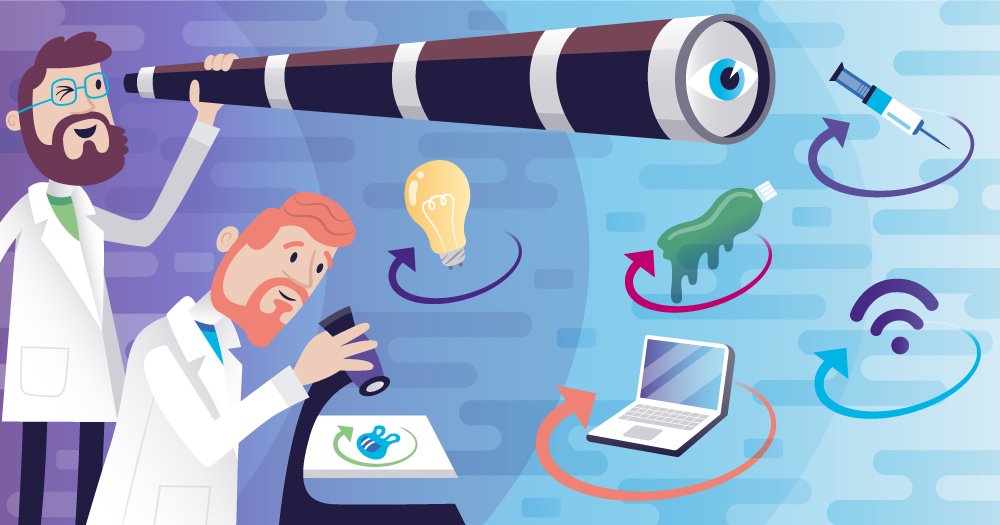
However, being circular in our choice of materials and components is often only one opportunity; bigger ones might exist if we are willing to look beyond the product as it is today. We opt for a telescope before a microscope – we’re interested in the detail, but we’re just as interested in the bigger picture, where the big innovations often lie. Applying systems thinking and looking beyond circular material usage could uncover a totally new way of delivering the benefits people currently derive from the existing product.

Some entrepreneurial businesses have had a eureka moment when their context is well placed to offer them the chance to do something radical and reimagine a product, system or service altogether. With the games industry booming, (in no small part due to the current pandemic), this year it’s set to reach a phenomenal $159.3 billion in sales¹. With many asking where the potential for growth is, innovation has pivoted away from games linked to hardware formats. Inspired by smartphone innovation and leveraging an expertise in cloud computing, Google Stadia and Amazon Luna have emerged as serious challengers to established players such as Xbox and Playstation. Hardware tomorrow will be so yesterday. Brands in this new gamer age look like the style of their landing pages and the quality of their games and content, not the console or the cartridges or discs that once ran on them. By 2021 video gaming sales are due to hit the $200 billion mark; one can only imagine how the absence of hardware will increase the profit margins within this behemoth entertainment industry.

By considering the wider context around a business, and how this might change in the future, it’s possible to identify opportunities that – like in the game-changing example – offer enhanced value to customers precisely because they are more circular and less reliant on consumption of materials. As the famous quote goes, “People don’t want to buy a quarter-inch drill. They want a quarter-inch hole”!

A partnership approach

We are known for working in close partnership with our clients (it’s in the name!), but also for offering an evidence-based, independent perspective when assessing circular options and the surrounding context using both a telescope and a microscope. We believe this approach can de-risk circular innovation strategies by identifying opportunities that fit the situation, and even reimagine the product or service entirely. Circularity is definitely not one-size-fits-all – but with careful consideration of context, we think there is a circular opportunity that’s right for everyone.

Connect with CDP

For more on how to apply circular design thinking in the right context for your business, products, and markets, contact Cambridge Design Partnership.
A future for food||
Share:
Find the authors
on LinkedIn:

A future for food; the need for innovation in agriculture

Currently agriculture is facing challenges from many directions. Modern hyper-intensive farming (demanding the highest crop yield from monocultured crops with less regard for long-term fertility or ecosystem metrics) is interrelated with the great environmental threats; destabilising climate change, biodiversity, oceanic dead zones and poor global soil health. In turn these issues are impacting agriculture.

Often it is trends in our society that influence business strategy and investment. CDP has an in-house team dedicated to tracking them and based on the mega-trends we see today, we think that agriculture is heading for a revolution.

CDP’s Year in Industry Students Charles Griffith and Isaac Blanc, give us a Gen Z view of the future.

The Big Picture

Agriculture has undergone three great revolutions. The first was ten thousand years ago, which saw humans first begin to cultivate seed crops and domesticate animals. The second was three centuries ago during the Industrial Revolution, which saw human and animal muscle power replaced by machinery. The third came about in the last half of the 20th century, which saw the start of modern intensive food production, and has supported an ongoing boom in the human population. This revolution was characterised by increased agrichemical use and highly specialised and lately GMO crops.

Perhaps today we are starting to see signs of a new agricultural revolution, with the emergence of a new technology called Controlled Environment Agriculture (CEA). As the name suggests, this involves producing crops for food or pharmaceutical products, using technology to control many or all growth parameters. Whilst typically referring to controlled indoor environments for plants, it also extends to animal agriculture. Here, factors like animal autonomy, reproduction and hormonal balance, as well as environmental conditions, may be controlled to maximise feed conversion ratios. Taking control of traditionally “natural” factors in this way is allowing CEA to offer significant gains in productivity, reliability and quality of produce. Currently, commercial CEA is chiefly producing leafy greens, while more complex crops like nuts, coffee or avocados are trickier and require the technology and market to mature further.

However, we can see four mega-trends that we think together will stimulate the innovation needed to create a fourth revolution in agriculture.

Health and Wellness

Consumers are increasingly becoming aware of how the food they eat can further their health and wellbeing. As an example, we’ve all heard that leafy greens are good for us (they are rich in many micronutrients) and so it’s resulted in an increased demand for them. However, leafy greens are highly perishable and, due to the logistical challenges in supplying these foods year-round with traditional farming methods, their prices are high for what is essentially just a leaf.

It makes sense that in its early days, most current commercial CEA crops are leafy produce as no pollination is required, the plants have a small form factor and offer fast ROI as their lifecycle is short. Consumers concerned with chemicals and pollutants in their food can seek solace in the bio-secure origins of controlled agriculture produce. Additionally, leafy greens from vertical farming or controlled greenhouse operations (like BrightFarms, which was born in New York) can boast higher mineral profiles compared to outdoor crops.

Premiumisation and Traceability

Mega-trends of ‘premiumisation’ and ‘traceability’ are also catered for by CEA. In terms of premiumisation, with affluent consumers becoming ever more interested in the quality and production of their food, some CEA warehouse operations market their produce as being more local, grown with minimal or no insecticides, herbicides or fungicides, and offering superior quality compared to outdoor plants, both in perceived freshness but also nutritionally.

In terms of traceability, there has been an increasing desire amongst consumers to buy locally, which has emerged from several factors including supporting the local economy, eating fresher food and reducing carbon emissions and pollution caused by transport. However, with an increasing proportion of the global population now living in urban areas the question is: how can you buy locally grown food when you live in a huge city?

CEA start-ups have a unique opportunity to capitalise on this dilemma, as the technology is ideal for urban agriculture. For instance, Gotham Greens, which run three high-tech greenhouses in NYC and one in Chicago, boast that their produce is “hyper-local” and even grow a type of rocket they call ‘Chicago Crisp’. Business seems strong for companies like this; BrightFarms have grown about 10x in crop capacity between 2015 and 2019.

Sustainability

Perhaps the trend with the widest impact is sustainability. The Earth has finite resources and it’s critical that we use these in a more efficient and circular manner. Taking water as an example, the global freshwater supply is under increasing strain and water prices are rising. Outdoor agriculture can consume an enormous amount of water whereas when using techniques like hydroponics, aeroponics, deep water culture or the nutrient film technique (NFT), CEA warehouse projects are able to make saving upwards of 90% when compared to similar crops grown outdoors.

There is also a huge strain on arable land. Industrial agriculture has led to degradation of much topsoil while deforestation and heavy tilling have rendered land unabsorbant and vulnerable to extreme weather (of course, more likely with progressing climate change). Heavy agrichemical use can decimate the soil microorganisms that play a crucial role in decomposing and upcycling nutrients (therefore more fertilisers are needed for the same growth, and the cycle continues). The reduction in agricultural capacity contrasts with the growing human population, not to mention the need to rewild and reforest in order to capture carbon and foster the recovery of our biodiversity.

Clearly, innovation is needed here and while single-story controlled agriculture can significantly boost productivity and reduce land use, there is another somewhat more hyped branch of CEA – ‘Vertical Farming’. This practice of producing food in vertically stacked layers increases the yield per square metre. However, the construction cost is high, and so is better suited to urban environments where the land use savings will counteract this. Artificial lighting, most often provided by LED lights, consumes power which may not come entirely from renewable energy sources. There is a great need for increased efficiency in vertical farming, in both building and running the systems.

Changing the demand side

Of course, while we all want to eat more greens, we can’t discuss food sustainability without mentioning the impact of animal agriculture. The most comprehensive study on agriculture to date, found meat and dairy provides 18% of global calories and 37% of protein, yet requires 83% of currently used farmland and produces 60% of agricultural greenhouse gas emissions, when all production factors are included. The UN has urged, for the sake of sustainable resource management, for humans to shift away from meat and dairy. The impact of animal agriculture is not bound to land either; for example, the fishing industry is responsible for a significant amount of plastic found in the ‘great pacific garbage patch’. Meanwhile, other studies have shown that such a shift would be better for public health too.

This has all led to our final mega-trend: the rise of flexi’s, veggies and vegans. Changing what we eat has the most potential of all to reduce the environmental impact of our food. Consumers would benefit from help to do so, one way to do this would be the introduction of environmental labelling on food. We have labelled household appliances in this way for years, and they have improved so much in response that we have had to create new energy efficiency categories. The top right image in this article’s illustration is an example of such a label, inspired by a proposal from Joseph Poore at the University of Oxford. Additionally, rapid advances in alternative meats mean this transition is looking increasingly attractive to those consumers who don’t want to change their diet.

Conclusion

Innovation in agriculture is not only being driven from evolving consumer preference, but also from the needs of our planet. We are living in an age of widespread intensive agriculture, for all its achievements, it has also brought about environmental challenges. Without wide reaching, transformational innovation to change our food system, there may not be enough capacity in the future to feed us all.

Fortunately, innovation is emerging, for example advances in CEA are facilitating new food systems that offer benefits on many fronts from increased freshness, locality and nutritional profiles to reduced environmental impact. However, many challenges remain to increase efficacy, reduce costs and upscale. Solving these will require inspirational engineering, new digital approaches, robotics, AI as well as biology and commercial innovation.

As young engineers at the start of our career, we are looking forward to addressing these challenges!

Share:

Is technology the recipe for cutting food waste?

Globally, about a third of all the food produced for human consumption every year is wasted – roughly 1.3 billion tonnes – according to the Food and Agriculture Organization of the United Nations. Consumers in richer countries waste almost as much food (222 million tonnes) each year as the entire net food production of sub-Saharan Africa (230 million tonnes). This equates to around 100kg per person, per year, wasted by consumers in Europe and North America.

The percentage of food directly wasted by consumers, as opposed to earlier in the production process, also increases in line with a country’s wealth – with North American consumers accounting for roughly 40% of the total wastage. This is particularly shocking, considering the wider environmental and socio-economic costs – with the increased financial cost to the consumer being the tip of the slowly melting iceberg.

This all makes for depressing reading. But when the numbers are this large, even incremental improvements have the potential to make a huge positive impact. For example, it is estimated that confusion arising from food labelling costs families up to $29 billion annually in the US. It is not surprising, therefore, that there are ongoing efforts by the Consumer Goods Forum, supported by global fast-moving consumer goods (FMCG) brands, to drive improvements in standardising food labelling to make use-by dates simpler for consumers to understand by 2020. This feels like a good place to start – but how do we take better control and management of our own food? Can technology save us from ourselves?

There are many available technologies to help address this problem and provide benefits to consumers, retailers and producers. But selecting the right technology is one of the key challenges. One potential solution is to provide a greater level of information on the status of food on the shelf and in the home through the use of smart, connected devices. Samsung has invested in this vision of the future of stock control with its camera-enabled Family Hub fridge – capturing information on its contents and uploading it to the cloud. It’s an expensive purchase for consumers right now –  but expect prices to drop over the next few years as competitors catch up. However, although a connected fridge is an interesting concept and a step towards a connected future, the embodiment is missing the link to the food producers, the ordering process and the grocery stores themselves.

In time, the tiny Amazon Dash button may be seen as an early data point on the revolution in shopping practices. But it is really just the beginning when it comes to convenient, frictionless reordering. Hopefully the future is far more expansive than a button that allows a family pack of toilet rolls to be ordered and arrive the following day. Technologies which can combine the reordering with the monitoring of in-home stock levels and usage profiles have the potential to provide a new dimension to convenience and time saving. This information can be employed in-store to improve shelf replenishment or help with warehouse restocking, and a combined system would be able to suggest when food appears to be selling too slowly – to allow a supermarket to dynamically price food and avoid wastage.

Perhaps another approach is to focus more on the broader requirement to monitor products not only in the home but also in-store. Consider a future where inventory management solutions extend beyond the visual, instead incorporating low-cost sensors that allow tracking of individual products as they are picked or restocked. In the home, with product awareness a future kitchen could suggest interesting new recipe ideas, based on its knowledge of the quantity (and best-before dates) of food on the shelves and in the fridge. This also opens up further opportunities in the connected health space – allowing meals to be tailored to dietary requirements and lifestyle.

Here at Cambridge Design Partnership we have a wealth of expertise in developing system architectures and smart packaging in the connected space. Coupled with our user insights and FMCG brand innovation teams, we’re able to help clients navigate the often complex journey that leads to being better connected with consumers.

If you’d like us to help unpack your inventory management challenges, get in touch via hello@cambridge-design.co.uk. Or talk to our user insights and inventory management experts at the Global Innovation Forum in London on 1-2 November. They will also be doing a keynote presentation with one of our global cosmetics clients at the Active and Intelligent Packaging Industry Association (AIPIA) Congress in Amsterdam on 2-3 November.