Why testing is vital to product sustainability|

Making it last: Why testing is vital to product sustainability

How long do we expect a product to last? Many sophisticated technology products, such as phones and tablets, are routinely replaced after a few years as specifications evolve rapidly. But what about a chair or a toaster? There are a huge range of products that we only replace when they wear out, but how long will this take, and how do we decide when minor changes add up to justify a replacement? When we prepare new product designs, how do we test to predict whether the lifetime will be months, years, or decades?

The challenges of biomaterials

Many consumer products contain large quantities of plastics derived from crude oil. But there’s increasing consumer interest in products made from bio-based materials derived from plant matter. While bio-based plastics are renewable, many are recent innovations. There may be a temptation for designers to make a direct substitution between a well-established plastic derived from crude oil and a bio-based plastic. Yet the two materials are unlikely to behave on a “like for like” basis. Because of limited service experience, there’s often a lack of data or understanding of how new types of plastics degrade and age over time. As a result, long-term testing and lifetime predictions of bio-based materials is a particularly relevant topic and can begin right at the start of a design project, while still in the materials selection phase.

Designing for the long term

We want newly designed products to have a long service life and to withstand normal rough handling. If we buy a shiny new phone, bike, or car, we expect it to start looking slightly rough and worn after a while, but we don’t want it to break or change color too soon. How do we check for this? We need to think about how the product will be used and how it might fail.

We can look at this challenge in terms of material selection. How do products age under different applications? What types of rough handling will a product need to withstand, and will the result be sudden failure or a gradual loss of properties? How will subtle changes in the appearance of the product over time affect its suitability for continued use? Does it matter if it becomes less glossy or even changes in color? Is it easy to keep clean? Do certain design elements require local reinforcement to prevent early failures at potential weak points? It’s easy to overlook these questions when an existing product is redesigned, particularly if a change in material is proposed.

Even when changing the grade of the same plastic material, such as polypropylene, small variations in the amount or type of fillers and other additives, or the length of the polymer chains, can modify its behavior. We can’t look up a single set of properties for polypropylene as there are a huge number of grades with different characteristics. The impact of even a small change may be to move a design from rugged to marginal, with a substantially increased chance of failure. It’s vital to select specific tests in order to evaluate the risks for a particular application.


Better, or just different?

There are many perfectly sensible drivers for changing materials, including cost or weight reduction, improvement in properties or sustainability. In each case we seek to improve, but have we unwittingly introduced a new way in which the product might fail? If the appearance or feel of the product has changed, might it be used differently? If it appears to be stiffer and more rugged, is it OK for me to push it harder? Have we considered how to test the product design to take all possible failure modes into account? If the customer could misunderstand how to use the product there’s an increased chance of unanticipated rough handling.

If we design a product to have a long lifetime, we also need to take customer preferences into account. Until recently, there were drivers to replace products simply because they look a little old and tired. But much greater awareness of environmental issues has encouraged customers to continue to use well-liked older products until they fail, and to consider repairing them to enhance their useful life. Whatever nature can create, nature can also degrade. So, if we consider replacing a synthetic plastic with a natural material, then it may be biodegradable under the conditions of use and so it may fail in new and unexpected ways.

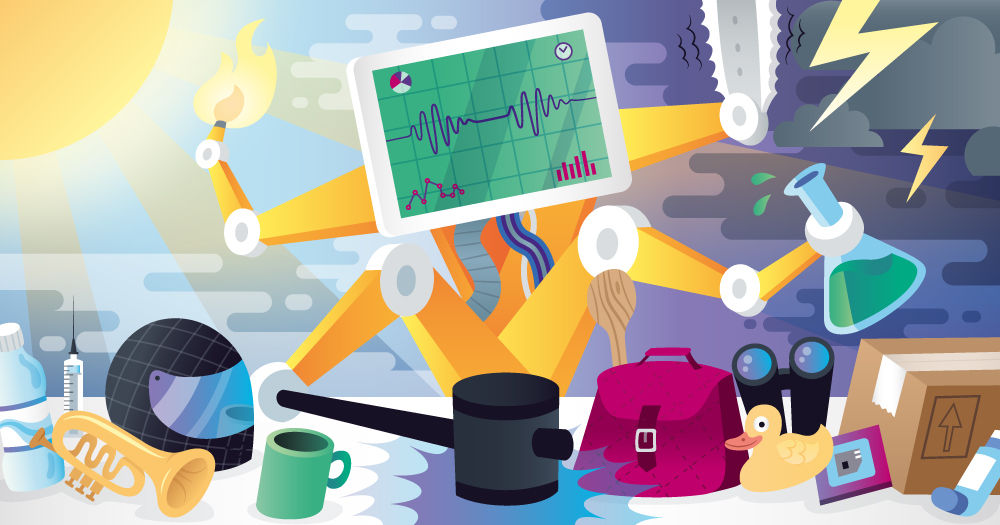
Mechanical performance testing is always a good place to start. As well as testing the finished product, additional trials on small pieces, or “coupons”, of the component materials will highlight any changes in properties after environmental aging. For many regulated applications, such as medical, food packaging or toys, there are specific mandatory tests, for example measuring levels of extractable or leachable materials. But in a novel design it’s often other, non-mandated tests that show up how a particular product might fail. It’s then the responsibility of the designer to investigate and mitigate the possible failure modes in a new product. Key tests will show up early signs of wear, damage or other aging and it may not be necessary to test the item to destruction.

Taking it outside

If a product is to be used outdoors or at high or low temperatures, the risk of failure must be checked over a wide range of conditions. Artificial weathering environments with water spray and UV light mean we can quickly predict the impact of many years of outdoor exposure. As well as possible changes in mechanical performance, the stability of color and other aspects of appearance can also be tested. For example, we expect the paint on a car to begin to degrade only after many years.

Specific environments will put additional stresses on some types of materials. The salt in a marine environment or the sand in a desert may cause wear much more quickly. Beneath the hood of a gas-powered vehicle, the components will be exposed to high temperatures and oil, fuel, and other fluids. Materials used in aircraft, high voltage systems and nuclear power stations also need to perform reliably in very specific ways.

Standing the test of time

Long-term subtle changes can be difficult to detect. For example, many plastics undergo creep when subjected to loads and specialized test regimes are needed to detect when substitution with a stiffer material is necessary. Exposure to fluids can also cause long-term changes, particularly when plastics slowly absorb the fluid and become softened and distorted.

If a product is designed to last for decades, for example if it’s installed within a building, then we need to carry out accelerated aging evaluation to test how its properties will perform over this period. One response is to apply the rule that the rates of chemical changes increase with temperature in a predictable, mathematical way.

By storing samples in ovens at a range of elevated temperatures and testing them periodically, we can build a picture of how the same material will perform over decades at room temperature. This methodology is often termed the Arrhenius approach. For example, it may allow us to predict behavior after 10 years at 20°C in only around six months, by accelerating the testing at 60°C. We can even immerse the accelerated test samples in fluids if we want to simulate use in wet conditions, for example in food or beverage applications.

A route through the maze

With appropriate experience in design, material selection and evaluation, it’s possible to devise a new product and to put together a suitable test plan. The data generated can be applied to provide confidence that a new design or a change of material will lead to a product with a long lifetime. After all, when we like a pair of shoes, we want them to wear out slowly, and there’s no reason why the same can’t apply to our favorite products.
The future is smaller

The future is smaller, faster, cheaper… and more energy efficient

Power electronics technology is enabling big advances in electric transportation and smart energy delivery, as well as playing an important role in meeting the ever-increasing demand for global connectivity and data storage. In this blog, we explore some of these opportunities and the up and coming technology solutions that are already revolutionizing the world.

Electric Vehicles are fast becoming mainstream. For example, Tesla has developed from a start-up to a company with significant production capability, and we can see dozens of new models entering the market helped by financial incentives and tax breaks aimed at reducing fossil fuel demand. Market analysis firm IHS Markit predicts over 300 electric car models will be available in the EU by 2025. Batteries, electronic drives and the charging infrastructure are the foundations of this revolution, facilitating a transition from energy delivered rapidly in liquid form, to the clean and convenient power conducted by copper wires. However, right now the UK electricity grid infrastructure, like many around the world, can’t cope with significant adoption of EVs. So it is likely that smarter grid solutions, enabled by power electronics will be needed to support this innovation.

Another major application of power electronics is renewable energy conversion, both in consumer and commercial applications. While cleaner energy is a longer-term play, governments around the world are investing and carbon emissions are being driven down; for example, the UK has pledged to become carbon neutral by 2050, and is poised to bring forward a ban on new fossil fuel vehicles to 2030 from 2040 as a way to help speed up adoption.

Other demands on energy are growing fast as well. For example, the number of devices connected to the Internet is exponentially increasing each year as our desire to consume data, such as online streaming services continues to grow. This in turn drives networks, storage, bandwidth, and ultimately an increasing requirement for the electrical energy that powers these systems.

These applications all depend on power conversion or moving the electricity from one format to the next as the energy travels from generation to storage to point of use. To support this revolution, the electronic building blocks needed must become smaller, cheaper and more reliable, and most importantly, more energy efficient.

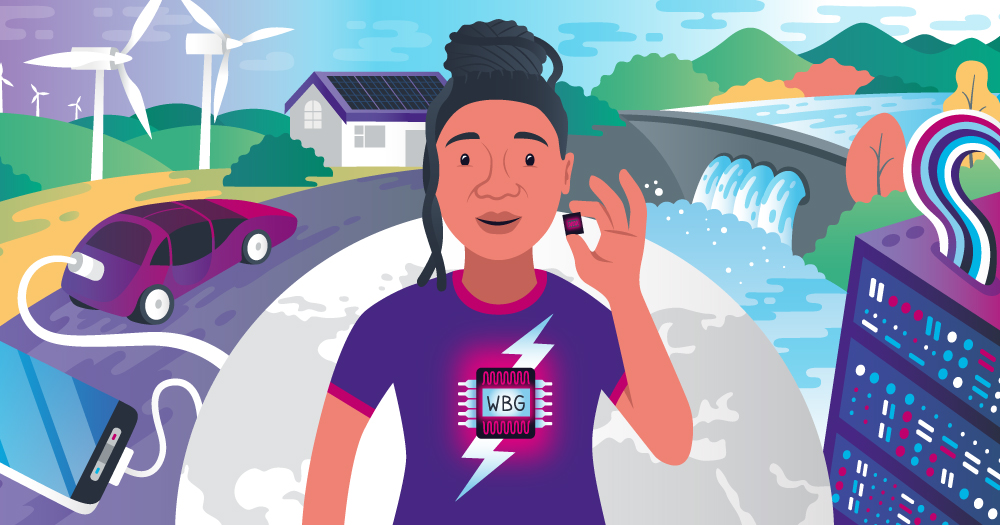
Advances in semiconductor technology such as new power switching devices based on Silicon Carbide (SiC) and Gallium Nitride (GaN) wafer materials offer faster and more energy efficient switching performance than ever before. These WBG devices are a crucial ingredient to achieving higher power densities and greater efficiency when compared to traditional Silicon-based power converters.

WBG devices can switch faster, run hotter, handle higher voltages, and are available in smaller foot-print packages. Cost is a critical factor at the moment, but for the right applications they can offer a step-change improvement in both overall system-level converter cost and efficiency; representing a significant breakthrough and enabling new and exciting end applications. In the longer term, as production volumes rise, WBG devices are expected to reach price parity with Silicon MOSFETs. For GaN on Silicon devices, perhaps cost parity will even be achieved with Silicon IGBTs, due to their common Silicon wafer processes and greater process simplicity for the GaN device. As an example, both Tesla and Toyota have already used Silicon Carbide semiconductors in the traction drive systems for their electric cars. These devices have also found application in the DC and AC power converters in both the off-board and on-board charging systems.

However, WBG devices are not a simple drop-in replacement for existing Silicon devices. They present significant implementation challenges, often resulting in performance that is far from optimal, or designs that prove unreliable and prone to failure. Engineers have passed through a learning curve with each new generation of Silicon switching device. WBG devices are a significant step in that evolutionary path and require even greater attention to circuit details; in particular, a good understanding of low inductance high current printed circuit board design.

Fully accessing the benefits of WBG devices requires significant detail engineering. What was once the realm of the power electronics engineer has now become a significant cross-functional challenge. The latest chip-scale packaging requires careful attention to thermal management that is a collaborative design between electrical and mechanical disciplines to create a multi-physics solution. Also, in these high-performance circuits, test and measurement present significant challenges as fast switching edges generate harmonic frequencies that are well into radio frequency engineering.

But the business opportunity is the potential to get a better product to the market and avoid getting left behind in an inevitably changing technology environment.

CDP has a specialist team of engineers who can create new products with energy conversion utilizing the latest WBG technologies, and get them to market rapidly. Using our core capabilities, technology building blocks and quality processes, we can help realize the promise of smaller, faster, cheaper…. and a more energy efficient future.

Circularity in context|

Circularity in context

Picture the scene: a room full of executives are watching a presentation on company strategy (actually, let’s move with the times… they’re all at home, watching on Zoom). A simple, elegant image of a circle dominates the screen. Will they support the adoption of circularity principles across the business? In unison, they nod. Not only is this the right thing to do, but it’s what the rest of the market is doing. Circularity is an essential component of a forward-looking business strategy.

But in each of their minds is a nagging question… How?

Why is circularity important?

“Circularity” is a word that has become ubiquitous in the sustainability strategies of many of the world’s biggest brands, from Apple (variations of the term ‘circular’ appear 27 times in their latest sustainability progress report) to AstraZeneca. Spearheaded by advocacy groups like the Ellen MacArthur Foundation, the concept has intuitive appeal: maintaining the value invested in materials and products for as long as possible seems like good sense, given the effort, skill and resources required to produce them. It should also be good news for a planet that is running out of capacity to supply us with raw materials and soak up our waste.
Behind the elegant concept of circularity, however, is an incredibly diverse range of steps with varying degrees of applicability – and environmental benefit – in a given situation. But the need to simplify this into marketing messages and calls to action has led to Circularity becoming a buzz word, applied so broadly that it risks becoming meaningless. Companies, keen to move into this green and pleasant new vision for the economy, are looking for simple, off-the-shelf ‘cricular’ measures that they can adopt quickly – sometimes at the expense of a proper assessment of whether the approach is appropriate and truly beneficial for them, their customers or indeed, the environment.

In this blog, we look at why Circularity in Context is of fundamental importance and the approach CDP takes, working in partnership to provide our clients with the best possible sustainable outcomes, instead of pushing a square peg into a circular hole…

Context is King
Take this as an example. An enthusiastic company want to generate a new beverage offering that is due to launch in an up and coming developing market – let’s call it ‘Circular Soda’… for now. They want something that has the kudos of being ‘Circular’, which seems an attractive USP for a marketing message. Time is spent identifying the right grade of rPET (recycled PET plastic); starting with a circular material in the first place seems like a great idea. But… when the brand launches with sustainable claims emblazoned on the label, it’s not long before journalists realize that this ‘recyclable’ rPET is not being recycled in practice, as there is no recovery or recycling infrastructure in this market! Context is king… had the company thought it through a ‘circular’ solution, based around recycling, is actually not the best fit for this market, even if it is perfect for other regions. Sadly, in some instances, this kind of example is not that far from the truth.

A great real-world example is our old ‘frenemy’ the plastic bag. Few are aware that this innovation in 1959 had sustainable circularity front and center in the mind of its Swedish designer, Sten Gustaf Thulin. Sten calculated that a plastic bag that could be reused time and time again was a far more durable and far less energy intensive product than the common 1950s cotton or paper bags. He always carried his beloved innovation in his pocket, just in case he found himself doing a spot of shopping… (70 years later we find ourselves reaching into our own pockets for Sten’s reusable bag, in a consumer culture that aspires to be more circular… if only we could remember not to leave them in the car!) Unfortunately, the context that became king in the 1950s and decades following was convenience. Bags were so cheap to produce and so desirable for consumers as a disposable convenience, that Sten’s planet-positive pack has become a slur on sustainable living. This is where the introduction of filters in the process of innovation is key. What are the factors that might pervert intended circularity, and how can the design counter this?

Back in the boardroom, chief execs are still looking at the circle on the screen and scratching their heads with a killer question in mind.

How do we put circularity in context?

At CDP, our Circularity in Context model enables client teams to look at a brief through a broader lens, with the ability to consider what’s happening now as well as what will influence innovation in future, via 4 key filters that will help drive our understanding of which circular opportunities are most applicable. These filters extend far beyond the business or product itself, looking at the wider ecosystem and emerging trends that are shaping it.

  • The societal filter looks at the ways in which governance and politics influence the markets our clients are operating in, and how society as a whole might embrace or reject certain opportunities due to attitudinal or legislative parameters for change. This can drive future regulation, infrastructure development, or R&D investment.
  • The economic filter helps us understand ‘viability for change’ from a commercial perspective; what commercial pressures occur in the context that their brand and product is operating in? What criteria are used to appraise investments? What is the existing asset base?
  • The user filter puts us in the shoes of the end users, either ‘consumers’ (B2C) or customers (B2B); how should a proposition meet their needs and does a move toward a more circular solution provide gains or create pains for them? How might their habits and behaviors have a positive or negative impact on the viability of a more circular solution?
  • The technological filter is an exceptionally important one that’s often overlooked. CDP rely on a broad group of experts with deep knowledge in science and technology to determine how a ‘circular idea’ can become a technically viable reality, as well as identifying emerging technologies that could enable new business models in the future.

As much as people want to be unfettered when pursuing creative thinking on how to adopt circular approaches, these filters constitute whether a circular concept could become a viable reality for our clients. So, developing a brief with our clients for a successful outcome with these filters underpinning innovation – aiming to be circular, but doing it in context – is the key to success.

Game-changing?

As a team of researchers, designers, engineers and innovators, we want to develop great sustainable products! Much of the focus of current efforts to embed circularity into products has focused on utilizing circular materials; the leaders in the field are extending their ambition to more resilient, returnable or repairable models. A great example of the adoption of ‘game changing’ circular thinking, at different levels, now exists within the Toy industry. The first level in improved circularity is moving from dispose to recycle; at the end of 2019 Mattel announced its goal to achieve 100% recycled or recyclable plastics in its products and packaging by 2030. New entrants to the toy market (such as Toy-Cycle and Whirli) have gone a step further and established a ‘recommerce’ platform, where outgrown toys are shipped directly to the company to be sorted, repaired, resold and returned into the system. This commercial model for a lending library – recycling parts, not materials – is perfectly in keeping with a new generation of consumers who don’t want to condemn their child’s personal plastic Toys “R” Us store to landfill, or even the recycling bin. The societal context is shifting!

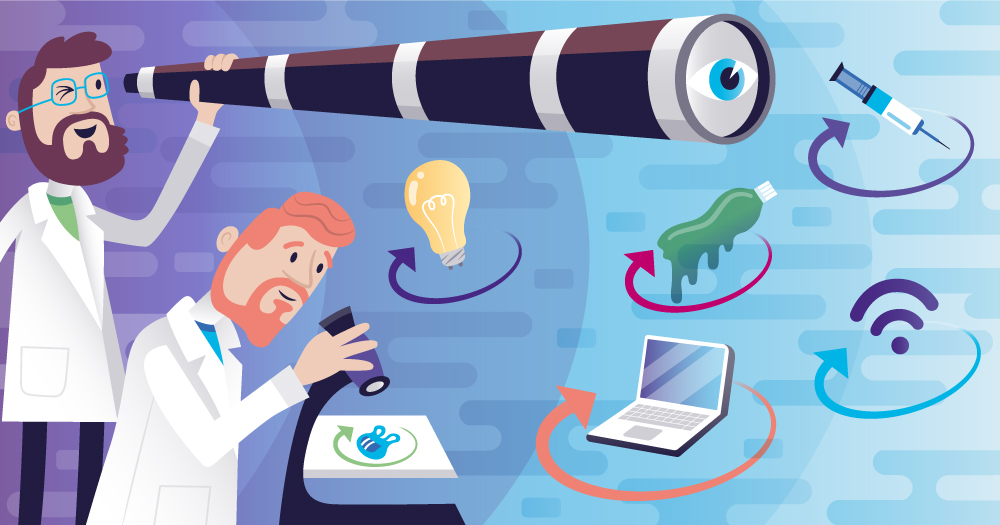
However, being circular in our choice of materials and components is often only one opportunity; bigger ones might exist if we are willing to look beyond the product as it is today. We opt for a telescope before a microscope – we’re interested in the detail, but we’re just as interested in the bigger picture, where the big innovations often lie. Applying systems thinking and looking beyond circular material usage could uncover a totally new way of delivering the benefits people currently derive from the existing product.

Some entrepreneurial businesses have had a eureka moment when their context is well placed to offer them the chance to do something radical and reimagine a product, system or service altogether. With the games industry booming, (in no small part due to the current pandemic), this year it’s set to reach a phenomenal $159.3 billion in sales¹. With many asking where the potential for growth is, innovation has pivoted away from games linked to hardware formats. Inspired by smartphone innovation and leveraging an expertise in cloud computing, Google Stadia and Amazon Luna have emerged as serious challengers to established players such as Xbox and Playstation. Hardware tomorrow will be so yesterday. Brands in this new gamer age look like the style of their landing pages and the quality of their games and content, not the console or the cartridges or discs that once ran on them. By 2021 video gaming sales are due to hit the $200 billion mark; one can only imagine how the absence of hardware will increase the profit margins within this behemoth entertainment industry.

By considering the wider context around a business, and how this might change in the future, it’s possible to identify opportunities that – like in the game-changing example – offer enhanced value to customers precisely because they are more circular and less reliant on consumption of materials. As the famous quote goes, “People don’t want to buy a quarter-inch drill. They want a quarter-inch hole”!

A partnership approach

We are known for working in close partnership with our clients (it’s in the name!), but also for offering an evidence-based, independent perspective when assessing circular options and the surrounding context using both a telescope and a microscope. We believe this approach can de-risk circular innovation strategies by identifying opportunities that fit the situation, and even reimagine the product or service entirely. Circularity is definitely not one-size-fits-all – but with careful consideration of context, we think there is a circular opportunity that’s right for everyone.

Connect with CDP

For more on how to apply circular design thinking in the right context for your business, products, and markets, contact Cambridge Design Partnership.

Innovation predications at CDP

The 2020s decade and the changing climate in innovation

It’s the start of both a new year and new decade. At this time, it’s traditional to try to predict the emerging challenges, innovation opportunities and technologies that will shape our work at CDP for the next ten years.

As I was thinking about writing this blog over the holiday break, I could not avoid remembering last year’s mass climate protests and in particular, Greta Thunberg’s extraordinary speech to UN leaders last September. Over just the last week we have watched the reports of extreme forest fires in Australia caused by unusually warm sea conditions, Norway reporting its hottest ever temperature in January and Moscow importing artificial snow for New Year celebrations. In the UK, the Met Office published an analysis of our weather over the last century that shows the last decade had the highest winter and summer temperatures ever recorded.

I am sure the implications of climate change will impact every family and business significantly in the ’20s but it’s such an incredibly big and multifaceted subject it’s hard to comprehend; so I wondered what the day to day impact might be on an average family.

Reducing the CO2 emissions from our energy consumption will be one of the main targets for the ‘20s. For most of us, it is spread between domestic uses, food, transport and the energy needed to manufacture and supply the consumer products we buy, use and throw away.

As an individual consumer it’s very difficult to find out how big an environmental impact we make, what to do first and where the biggest opportunities for savings lie. This information is available, but it’s fragmented and difficult to interpret. There are many competing rationales for change that are all too often in tension with one another. Should consumers be rejecting plastic food packaging that extends shelf life? Should local councils be looking to bury rather than incinerate low-grade plastics with no recycling value at end-of-life? These choices only get more complex when groups, governments and ultimately consumers (albeit indirectly) try to consider all the UN’s 17 sustainability development goals globally.

Assuming we can work through this complexity, any major change in society faces resistance, it’s simply human instinct to be wary. The Ross-Kubler model describes the emotional responses to major changes in our lives, the initial shock and denial we experience before curiosity, enthusiasm and commitment to a new solution kick in. So reliable, understandable information on the implications of our choices is the key to get us all to commit to change the way we live.

Reducing energy use in our homes will be a major challenge. In the UK our electricity supply from renewables exceeded that from fossil fuels for the first time in the third quarter of 2019, but gas and oil remain the largest domestic energy sources. It is clear in the next decade we will become more focused on insulation, exploiting local renewable energy sources and smart energy management. The technology we have today can create carbon neutral homes, but at a cost that is not always worthwhile on a personal level with today’s economics, principally because energy is relatively cheap. So, we will need a switch from the short-term economic logic to seeking benefits over longer time horizons, perhaps those measured in human generations.

As is common in the UK, most household’s transport needs are dominated by car usage. At CDP the number of electric vehicles in our car park is rising because these can be fuelled from renewable electricity, if available. However, the embodied energy in electric vehicles is higher than you might expect, and their longevity is yet to become the important issue it should be to maximise their effectiveness. Manufacturers make their profit when they sell a new car, but if they were responsible for the total energy used in manufacture, operation and recycling they might follow a different design strategy and business model. A move from selling products to providing integrated services is an approach that could facilitate a more logical strategy for emissions reduction across many markets.

In any case we are destined to travel less in the next decade, by necessity living closer to our work and relying more on low power technologies to communicate. One of my colleagues recently wrote a blog on how we are doing this at CDP; A practical approach to multinational innovation.

Finally, in the ‘20s we need to leave behind our unconstrained consumption of food and new things. The embodied energy, and natural resources in the products we buy is the hidden part of the iceberg. For example, the energy needed to manufacture a smart phone is many times the energy it will ever use during its life. This change means products that are designed to be upgraded and avoid technology obsolescence will become more highly valued. I think functional simplicity, reliability and effectiveness will become increasingly important, we will ask ourselves what we really need, and choose products that just meet that with elegance and style.

However, it’s an obvious statement that the biggest barrier to more sustainable energy use and reducing CO2 emissions will be the cost of doing so. Ironically, consuming less will cost more because of the investment needed in new infrastructure and business structures, so we are likely as a society to resist this change. While the wealthiest will be able to afford this challenge, the poorest will experience the highest impact and this will have a severe political impact on western democracies. Groups will say it’s not fair that I should change before others do. You can see this happening now at local, national and international levels already. Perhaps that is why Greta has had such a cultural impact at the UN in this debate, because children have the least invested in our institutions and the status quo, but the most to lose from the likely effects of global warming.

At CDP we have brought together a team of experts to help our clients navigate the challenges of creating sustainable strategies, new products and services in the next decade. If you would like to discuss the opportunities for innovation in this area, please call Matt Morris or George Bostock.

Optimising material in design innovation

Optimising material in design innovation

The interplay between choice of materials and product design provides unique opportunities for innovation. The criteria for selecting materials for an application are constantly evolving. A holistic approach where materials, process and form are all part of the design provides the best route to maximise potential.

A key question repeatedly encountered in product design is ‘what materials will work in this application?’ A good starting point is to consider the purpose. How is function created by the interplay between the shape and composition of the product? Is it important what it looks like? Should it let the light in or keep it out? What about electrical properties? Does it need to insulate to protect the user from mains voltage inside, or conduct electricity to prevent build-up of charge? Should it be very strong, or break in a controlled way in extreme conditions to fail safely? If it gets very hot or wet, do we expect it to continue to function in the same way, or should it undergo a recognisable change to indicate that it is no longer safe to use?

First Impressions

In many markets, first impressions of a new product design are very important and different materials can convey distinct messages. Does it feel cold or warm, grippy or slippery, rigid or flexible? Does the surface texture give an impression of a quality product that will last? Should it be a particular colour to stand out or blend in?

Is It Safe?

We want our products to be safe, but choice of appropriate materials will depend on the application. Medical devices and products used by children or in contact with food need to be tested to the appropriate standards to check that no harmful ingredients might leach out during use. But inside a nuclear power station, the ability to continue to operate unaffected by radiation will be crucial.

Will It Last?

For many materials, properties will change with time, and this may affect the period of usability of a product. Predicting lifetime will depend on the temperature range over which articles are used. Accelerated ageing at a range of elevated temperatures can be carried out to model the expected life of products at room temperature. If use at low temperatures is envisaged, it is also important to check that materials which are flexible at room temperature do not become brittle when very cold.

For repeated or extended use, materials need to be chosen which retain their properties over time. Ease and comfort of handling may be very important, for example fit and grip, or the ability to stay clean and free of microbes. Items subject to repeated deformation may tend to change shape. For high voltage applications, the ability to retain safe insulating properties is important.

What About Costs?

We often focus on the opportunity for cost reduction by material substitution, but in many applications the cost of the materials is only a small fraction of the end price of a product. There may also be some scope to include small amounts of expensive materials in the formulation to provide additional functions. For example, ‘smart’ materials may be included to modify optical, magnetic, thermal or electrical properties.

Material substitution can often reduce overall costs by providing a route to reduction in process time or temperature. Choosing a more expensive material that can be handled in a simpler type of fabrication process is another option. Manufacturing methods are continually evolving; hence the choice of process needs to be regularly reviewed. When rapid delivery of prototypes is crucial, additive manufacturing may offer a route to fulfil this need. However, when moving to a different process for larger volume production, it is important to verify that the material will perform in the same way.

One Material or Many?

In the area of composite materials, thermoset systems have proved difficult to recycle, but the recent increased use of high temperature engineering thermoplastics in composites provides more possibilities.

Many material problems can be solved by understanding the interface between different items e.g. how implants interact with the human skeleton in the long term or careful process control of co-moulded plastic and rubber parts to ensure good adhesion between them. Often the simplest solution is to store newly manufactured parts under controlled conditions for a set time before exposing them to customer use.

Planning for the Future

The availability, price and customer acceptability of many materials continues to change, and consumers and manufacturers are increasingly looking to choose more sustainable alternatives. Be this through materials that facilitate recycling or repair, use of sustainable raw materials such as a move from oil based to plant based raw materials, or through a reduction in the energy embodied in the material manufacture, processing and recycling at the end of life.

New information about the safety of existing materials may also emerge. For example animal fur and asbestos insulation are no longer available and plastics are now often called resins. Which materials will become unpopular or unavailable next?

How Does Material Choice Integrate into the Overall Design?

The CDP team has very broad knowledge in a variety of areas of consumer, industrial and medical applications from materials for printed electronics through adhesives and hydrogels to pesticides for rodent control. We have not just a materials expertise but an expert interface with engineering and manufacturing disciplines to offer a range of product design solutions.

We have specialist experience in materials for energy generation and storage, from batteries to supercapacitors and fuel cells, enabling us to identify opportunities to generate intellectual property in both materials and applications.

In particular, the CDP skillset includes a detailed understanding of materials in healthcare applications. This is of particular importance for drug delivery devices, where this capability provides a vital insight into the possible chemical interactions between a medical device and the drug being delivered. Manufacturing processes such as sterilisation methods, coupled with formulation characteristics including viscosity, surface tension or particle size will all have an impact on the selection of materials.

In a Nutshell

When we consider materials, product form and manufacturing process separately, we can go a long way towards achieving a good design. But it is only when we look at the choice of appropriate materials as part of the overall design and manufacturing process that we can achieve so much more.

We use so many different products in our everyday lives and they all need to be made from the most appropriate materials so that they will continue to perform well for many years.

2020: Decade of the drones|

2020: Decade of the drones

Unmanned aerial vehicles (UAVs) or drones are increasingly part of our everyday lives. Here, Adam Turner, Consultant Mechanical Engineer and drone expert at Cambridge Design Partnership, considers the future potential of this remarkable technology.

Here at CDP, we love innovation and disruptive technologies. It’s what we do. So, needless to say, I find myself hugely intrigued by the uses offered by drone technology. Where will drones go from here?

The drive to design an unmanned aircraft initially came from the military, for airborne missions that were too risky for humans. In recent times, however, drones have found peaceful uses in everything from wedding photography to rounding up sheep. As designers, here at CDP we’re pretty sure this is just the beginning.

Automated so they are easy to control, powered by (potentially) clean electricity with battery and motor technology progressing quickly, and with the opportunity to include artificial intelligence to allow fully autonomous operation, the scope for drones is enormous. Here are some applications we are excited about.

Drone taxis. There are plenty of big names like Boeing, and start-ups like Volocopter, working in this sector. For example, global taxi firm Uber is also creating a small, vertically launched drone like aircraft to offer transport within and between cities. For how long will there be a pilot on board? With the benefit of an app, you could order a drone to take you to work or out for dinner. Drone taxis potentially avoid city congestion and the noise and disruption of conventional helicopters. It’s simply a case of up, up and away…

Drone agriculture. Already, farmers use drones to check crops and livestock. In the future, I’m sure crops spraying drones, such as John Deer’s recent development will enter use.  Food productivity will surely rise, drones programmed to take a series of photos using different light spectrums will enable a farmer to track crop growth and spot any issues, leading to better yields and less agri-chemical usage.

Drone environmentalism. Already, an initiative by British firm Biocarbon Engineering to fight deforestation in mangrove forests using drones is proving much more efficient than human labour. The drone surveys and tests the soil, then drops pods containing tree seeds and vital nutrients. Beyond this, the environmental potential of drone technology is enormous. From preventing poaching of rare animals, tracking populations to tracking glacial ice, a drone can play a crucial role.

Drone cranes. The construction industry has already trialled drones to lift bricks and roof tiles into place on a building site.  Going further, drones that can lift hundreds of kgs are in development. If drones become ever larger, which we at CDP anticipate, could they then one day replace cranes as the go-to method of lifting building materials?

Drone inspection. Inspecting high rise buildings, industrial plant and infrastructure like electricity pylons and bridges, is already a cost-effective drone application. Be it using cameras or more specialist sensors.  We expect this to develop further as drone automation, and AI to detect faults, makes this even more attractive.

Drone shipping. Containers revolutionised the shipping industry in the 1960’s. Will drones be the next big thing in the transportation world? While they will always be significantly less energy efficient compared to ships and trucks, giant drones could deliver high value imports quickly from ports to distribution hubs, especially in areas where other transport infrastructure does not exist. Then at a micro level, drones might bring our packages to the door and solve that tricky ‘last mile’ delivery conundrum for companies like Amazon and UPS, who are developing systems at present. As well as the multi-rotor quadcopter, we are already seeing hybrid fixed-wing drones with longer flight-times and higher energy efficiency. Some are solar-powered, to partially re-charge as they fly, or powered from renewable fuels like hydrogen.

Drone fireworks. Human beings love a light show in times of celebration, whether it’s Guy Fawkes night in the UK or an awe-inspiring Olympic opening ceremony. For an eco-friendly, reusable alternative to fireworks, hundreds (or even thousands) of light-emitting drones can perform truly astonishing displays. US tech firm Intel has already put on some truly stunning drone displays at the Superbowl and at the Winter Olympics.

Drone rescue. On a more serious note, drones can literally save lives. In search-and-rescue situations, we already see crews using drones to spot survivors. Taking this even further, a drone could drop life jackets and rafts to people at sea, or food and medicine to inaccessible disaster sites. Rescue crews in Alabama used heat-seeking drones to search for survivors after a tornado in March 2019. Ambulance drones could deliver, say, defibrillators or EpiPen’s in cases where every second counts towards a patient’s survival.  Researchers are also looking at creating swarms of micro, autonomous drones whose group behaviour is designed to automatically search inaccessible spaces like burning buildings.

Drone crime. Anyone who has seen footage of drones delivering drugs into prisons knows that this technology has its dark side. Already, there have been reports of drones surveying neighbourhoods before a burglary. In terms of terrorism, disruption and smuggling goods or even people, drone tech presents the justice system with a serious headache. Just consider the disruption to Gatwick Airport in the UK by drones in December 2018 – the runway was closed for 30 hours, 1,000 flights were cancelled and 140,000 passengers stranded.

More recently, environmental protest group Extinction Rebellion tried to use drones to close Heathrow Airport but were foiled by signal-jamming technology. Terrorist or rogue state attacks using drones as weapons is another threat. I foresee that anti-drone technology will be an important field in the coming years and that the regulation of drones will become ever more important. In the UK, the Civil Aviation Authority have brought in compulsory drone registration for drones over 250g in weight. Will drones, like cars today, have number plates, insurance and MOT tests in the future?

Drone police.  As an antidote to drone crime, law enforcement use drone surveillance in place of expensive helicopters, where their ability to search large areas quickly can be vital to ensure public safety and to catch criminals.

Drone shopping. Need a loaf of bread? New shoes? A Venti Double-Iced Toffee Almond Nut Latte with extra cream? We may one day soon team up our internet shopping habit with sending our own personal drone to fetch our purchases from the retailer. Your supermarket shopping could be dropped off on your doorstep or in a code-secured locker outside your house. Forget a drive-in Macdonald’s, could there be a drone-in Macdonald’s?

Drone communications. Bringing comms networks to regions which lack the infrastructure for internet and cellular services could well be a next step for drone technology. The Zephyr programme from Airbus is already exploring this possibility, with a solar-powered high-altitude pseudo satellite (HAPS). Zephyr, a fixed-wing drone, can stay in flight in the stratosphere without refuelling for months at a time. Among its many possible applications is the capacity to bring connectivity to the remote communities worldwide. Let’s not forget that 4 billion people on the planet are still without the internet.

Drone sports. Already drone-racing leagues are springing up. Competitors wear headsets, so they feel as though they are sitting on the nose of a drone. It’s exhilarating stuff when the drone is flying at 80mph through tight, LED lit, 3D courses. The footage can be streamed too, in HD, making this a spectator sport. In another development, drone fans have been meeting up for air battles, adding paintball guns, lasers and even a flame thrower to their drones. Even in the most traditional sports drones are proving to be disruptive. In fishing for example, a drone is used to position the bait in locations previously impossible to access from dry land. What’s next? The sky really is the limit.

Drone exploration. A popular activity is to use HD camera equipped drones to expand your experience when exploring the great outdoors.  They provide a new perspective on famous landmarks, some amazing selfies and allow the user to go to places and explore where it is otherwise impossible.

Drone photography. It has become difficult to find a TV program with an outdoor theme that does not include a drone shot to set the scene or provide fantastic images of landscapes or wildlife.  Fast paced action and sci-fi scenes are filmed by drones to allow the viewer to get close to the action.  Drone photography categories in photographic competitions are testament to the opportunities this technology provides for seeing the world in new and creative ways.

Conclusion. It’s easy to fear that drones could shape a dystopian future.  This blog has steered away from drone applications that include weapons. The shocking, dramatized viral video created in 2017 by the Future of Life Institute made this point strongly, and generated a debate about the risks of combining drone technology with AI.  But here at CDP, we are optimistic and see drones as a powerful potential force for good. It is up to humanity to ensure that this is used wisely, and that is a question we all need to consider in the coming years. How things will turn out, of course, only time will tell.

secret to designing great digital services|

What’s the secret to designing great digital services?

Earlier this month, the Service Design Global Conference in Toronto really illustrated how design – as a way to integrate the needs of people, technology possibilities and business requirements to create products and services – is becoming part of mainstream business mentality. However, as the pace of new technology quickens and companies feel like they just need to keep up, considerations of what people actually need and how it makes them feel can get left behind. This leaves many organisations suffering with unrealised value or rejected digital services. 

At CDP we have an expanded approach to innovation we call Potential Realised. In particular it embraces the diversity of human experience and emotion within a design lead process; building services for people, by people. In this blog, I explain how.

The theme at this year’s conference was ‘Building Bridges’, which provided a platform for a truly inspiring array of case studies where design, and it’s inclusion of people-centricity, co-creation and systems-thinking, has enabled inclusivity and shared outcomes across diverse groups. A quote that resonated for me throughout the two days was that of the late John Heskett who said: “Design is the human capacity to shape and make our environments in ways that satisfy our needs and give meaning to our lives.” This reminds us that design is essentially a human task which aims to do more than satisfy purely functional ambitions. And by doing so has the potential to realise unique experiences and value.

Phrases such as user-led, human-factors and customer-focused design are now firmly fixed in the lexicon of innovation and business. While this is generally a positive shift from business-centric thinking, it can place a simplistic lens on the individual; functional jobs-to-be-done; customer-needs; the user. If we are to really design for humans, the complexity of emotions, to provide meaning we need to raise our thinking to social and emotional levels. Of course, empathetic thinking and behavioural science lends much to this endeavour but what I am suggesting, and is included in Potential Realised, is a more concentrated and forensic application of these concepts.

Speakers at the conference had some great examples of how this can play out when thinking about how certain technologies are adopted in services:

  • AI: The buzz word and cloak for a plethora of different technologies, comes with connotations of a robotic apocalypse. Perhaps because it is seen as faceless, logic-driven or perhaps even too human-like. But if we design in emotional ‘best-practice’ we can create a much healthier relationship with AI technology. For instance, what qualities do we value in a work colleague? Communication, adaptability, transparency? So let’s explicitly build these qualities into AI solutions so we can understand decisions, question logic and retain control; ultimately maintaining the social norms which we expect.
  • Wearables: Initial offerings in the fitness sphere have expanded into an array of health, wellness and lifestyle devices and apps. The proposition of a personal trainer on your wrist is pretty sound logic and for many is helping them live healthier lives. However, as a recent study shows for others it may have adverse effects with reduced activity levels and possibly raised anxiety caused by the ever-present reminder of their unachieved goals or data-overload. The lure of technical possibility can sometimes mean we fail to anticipate and design for such responses. iPhone ‘screen time’ is a good example of this done well. Perhaps others could go further to embrace these anxieties such as actively enabling people to go on a ‘digital detox’.
  • Chatbots: The rise of the chatbot has been helping point of need customer service and operational productivity across markets. However, the focus on efficiency benefits often means they can be more ‘bot’ than ‘chat’. However, Capital One’s Eno service is a great example of where a chatbot has been purposefully designed to learn about and respond to the patchwork of human emotion – using language and offering support in a way that engenders personality, fun and trust.

In all these cases, we can see different paths to implementing new technologies. Broadly speaking, one which builds on a technology that appears to offer value but which after time reveals some barriers to adoption and can lead to unintended consequences. On the other, the path favoured in our organisation similarly embraces technology opportunities but consciously puts human emotion at the core of design, which not only caters for human needs but discovers new areas of differentiating value.

Taking this path requires a deep understanding of people’s behaviour, the context in which they engage with a service and how they perceive value in it. Here are some ways you can start building this into a service design:

  1. Be diverse. Design is a great tool because it embraces multiple views and is built to pivot solutions based on learning. But it is only as strong as those involved in the process and the information they have to work with. By opening the net and including as many diverse viewpoints as possible, and where feasible seeking quantitative evidence, more of the diversity of need and emotion can be captured accurately.
  2. Get real. The sooner you can get concepts into the complexity of the real world the better. This often requires early tech input and creative prototyping methods such as Wizard of Oz, ( https://www.cambridge-design.com/news-and-articles/blog/prototyping-of-digital-concepts ) which are low cost but still provide the insights you need. It’s also crucial to have a clear set of success measures, for example, as well as utility measures what emotions do you want to generate – feelings of trust, excitement, reassurance?
  3. Be a storyteller. Stories are what make us human. They have the power to convey specific viewpoints in the context of societies and structures. From them we can learn about the complexity of our interactions. Through them, we can paint multiple visions of the future, converge on what we’d like to see and what is needed to realise it. Either through speech, text, art or even Lego, we can use stories in the design process to work through different versions of stakeholder viewpoints and needs.
  4. Beware the icebergs. Observation and experiences are important elements of design discovery, but these visible elements are underpinned by structures and social norms that may not be so visible. For instance, asking a team to work in a more agile way may prove fruitless if they are dependent on other parts of an organisation who aren’t. Things like structure, language and rules may need to be broken or reformed in order to deliver a desired experience.
  5. Be local. Even if you have done good work in understanding your broad customer base, there is a risk in applying a solution uniformly, particularly if you operate globally. Trying to wrap-up generalised services and messages for local audiences will be seen through and the authenticity of your offer will be undermined. For instance, Unilever have addressed this risk head on by establishing nimble regional teams who gather and apply local audience data to deliver targeted messaging at pace, thus combining the scale of a global company with the agility and relevance of a local provider.

At CDP, our multidisciplinary teams follow these principles through our Potential Realised approach, translating deep insights into digital and physical concepts that we test as early as possible using creative prototyping. This reduced cost and risk management approach allows us to evaluate and refine services that integrate the complexity of human experience and maximise the value for organisations, individuals and society. By providing an end-to-end service of research through to build and launch we ensure initial ambitions don’t get lost or compromised along the way; resulting in live services which delight you, your customers and your bottom line.

If you’d like to find out more about how we can help you, please get in touch.

||

Can sleep tech become ubiquitous?

A good night’s sleep is increasingly considered to be just as important for our health and well-being as eating healthy food and exercising regularly. Unfortunately, today’s 24/7 high-stimulus, digital world is renowned for disrupting our natural sleep patterns. The average 21st century human is now sleeping significantly less than in the past. In 2017, McKinsey reported that more than one in three Americans does not get enough sleep – roughly the same number who are obese.

What is more, our sleep quality – as well as quantity – has decreased as well.

This emerging need has created an ecosystem of manufacturers, retailers and health service providers as well as pharmaceutical companies that has formed around sleep health. The McKinsey study reported the US sleep-health industry is currently worth between $30 billion to $40 billion and has historically grown by more than 8 percent per year, with few signs of slowing down.

In addition to the traditional categories of clinics, pharmaceuticals and bedroom furniture and bedding, a new wave of sleep gadgets has emerged.  Crowd funding sites are full of novel sleep devices from masks to robots. Many are connected, continuing the trend of measuring and connecting our lives.  Some even aim to stimulate the brain to create therapeutic effects.

Certainly sleep is becoming better understood, but scientific knowledge is still at a relatively early stage and this equates to a general lack of understanding through the population, government and mainstream industry.

“It’s an exciting time for the emerging sleep-ware industry”, says Clare Beddoes of Cambridge Design Partnership: “Here at CDP, we believe that sleep-tech is an exciting area that is evolving rapidly, following closely on the heels of the developments in the fitness and wellness sphere, which has seen an explosion of innovation in recent years”.

“We’re already working with companies assisting them in defining opportunities to innovate and we expect many interesting and successful advances in the area of sleep technology in the near future.”

With this in mind, here are five basic questions we think you need to ask if you are planning to bring a new sleep-tech product to market. If you have the answers to these then, with any luck, you won’t be losing sleep over your product development!

1. Can you show that your customers actually need your proposed product?

It’s great to have an idea for a product that you think might be the answer to an insomniac’s prayers. But are you sure it’s what the market really wants, needs and will pay for? Our approach is to start with the user and to identify the unmet needs where solutions will be really valued. This makes sure you’re heading in the right direction before you spend a lot of time and money pursuing a new idea.

2. What is the existing competitive landscape for similar products?

We’re fascinated by the plethora of sleep devices on the market and although it is increasingly crowded, we believe that the market is in an early phase and there are most definitely spaces for products that address the needs of broad market groups. So take the time to find out what the competition is and where the spaces are for innovation for the majority of mainstream consumers.

3. Where do market unmet needs align with technical solutions that can improve sleep?

The aim must be to create the must-have sleep-tech product. Just recently, here at CDP we worked on a technology to monitor REM sleep. We discovered that not only did users want to know how much REM sleep they had every night, they wanted to know whether it was enough and, then, crucially, they wanted to know what to do if it wasn’t. Successful products need to close this loop and not leave customers stranded.

4. What is the best revenue model for your concept?

This is crucial in the digital world. Will your product work if sold for a one-off payment or would it be a better proposition as the start of a relationship with your customer? Will customers pay for every night they sleep better, or will they not notice the difference?  In the AI enabled world consumers are beginning to expect customised solutions, continuous updates and evidence- based feedback.

5. Who are the most impactful sleep professionals for you to work with?

To develop and launch your product successfully, you’re going to need clinical and scientific back-up. So, do you need to work with doctors, psychologists, clinical researchers or YouTube sleep experts? Should you be turning to the peer consumer community, personal trainers or artificial intelligence? It’s all about finding the best development support route and final endorsement.

That way, your innovation journey will stand the best chance of seeing those sweet dreams of success become a reality.

Virtual innovation|

Virtual innovation?

Earlier this year Cambridge Design Partnership went global with the launch of a new East Coast engineering center in Raleigh, North Carolina, allowing us to better address the needs of our growing North American customer base. The obvious challenge however, is the 3,868 miles between our creative teams.

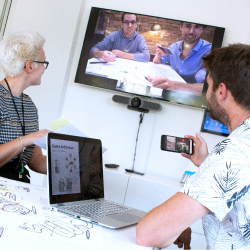
CDP’s essentially holistic design process requires close collaboration. Take brainstorming for example, a fundamental step in the design process, where team members with different skills and experiences come together to discuss problems and generate new solutions. During these sessions new ideas are sparked, shared and built upon. Without the major carbon impact of engineers and designers leaping on a plane, the challenge was to replicate the brainstorm experience virtually by exploiting different tools and technologies. We needed the teams to feel as though multiple locations had been merged together with everyone feeling relaxed and engaged so that they could fully contribute. It’s crucial that the team can see and hear one another as well as look at what’s being created whether it be sketches, models, prototypes, videos or other simulations.

Yes, there are well known high-end, off the shelf solutions for this from the big video conference providers, but we wanted to create a flexible and scalable solution by leveraging the desktop and mobile video conference tools that are becoming ubiquitous in international commerce.

Firstly, we needed to get the right technology in place and secondly, we needed to get the team feeling comfortable and confident using the technology. Here’s how we did it:

Minimum requirements

First of all we kitted out specific meeting rooms in each location with the audio and video equipment needed to reach a minimum level of fidelity. Essentially each room needs to have enough cameras and screens for all team members to see and be seen. This makes the team feel connected rather than just having one camera focused on the whiteboard. We link these cameras and screens to the Zoom platform that we use across CDP.

A key tool we use is the smartphone. This provides the flexibility for individual members to communicate very quickly. For instance, if there is a sketch or prototype they want to show, they can grab their smartphone, activate the camera and immediately share it.

Having good audio is essential. We’ve all had bad experiences with dropped calls and delays, which won’t do any favours for successful group dynamics. There are some great plug and play teleconference devices on the market and, together with high speed, low latency internet you’re well on your way to stutter-free conversations.

To integrate the rooms further, you need high-definition video so participants can clearly see each other’s facial expressions and body language, which is surprisingly important.

Tips from lessons learned

Firstly, we always set up the meeting rooms in advance because there is often a technology ‘moment’ that needs resolution, and you don’t want to lose that creative vibe fiddling with IT issues. So our engineers can walk into the room, open the meeting and we’re up and running.

Secondly, we make it as easy as possible for participants to dial-in and we ensure we have back up options. You can easily email a link to join a meeting and with one click and the participant is in.

Thirdly, don’t forget the conventional brainstorm best practices apply as normal, with a facilitator who takes charge of the session with a clear plan and issuing briefing documents well ahead of time.

Benefits

With a number of virtual brainstorming sessions now under our belt, we’ve found that the technology can actually enhance the brainstorming experience. For instance, instead of those in the same room huddling around an A4 drawing, by using smartphone cameras that drawing can immediately be shared with everyone on a screen regardless of their location.

Working across time zones can actually work to your advantage as team members can effectively work on a creative brainstorm for an extended day. The team in the first office can prepare for the session and then after the event, the team in the second office can collate the output and develop and visualise the best ideas after their colleagues have gone home.

Also with a virtual brainstorm it’s easier and quicker to organise and assemble the right people, whether that be one large group or smaller separate groups. It also scales beyond CDP, as clients and key partners are able to join virtual brainstorms effortlessly. A key benefit is that it enables privacy at the touch of a button. In other words, if during the session the client team would like a quick breakout to discuss strategy or sensitive information, they can simply mute their video, have a chat between themselves and then unmute to join the session again.

Another key benefit is that sessions can be easily recorded. This can be useful in helping to decipher exactly what concepts were shared during the session. It’s also potentially useful for IP and communication with lawyers when drafting patents.

Let the miles disappear

Having done a number of virtual brainstorming sessions between our Raleigh and Cambridge sites, and having ironed out the kinks by getting everyone comfortable and confident with the technologies, we’ve found that although we may be 3,868 miles apart those miles disappear as the two rooms merge in the heat of creativity.

Now, with an effective process and with the various technologies in place, we look forward to many more exciting brainstorms amongst our team and our customers, wherever they are in the world.

Sustainable music festivals

Why are music festivals leading the sustainability agenda?

In 2019 the music festival industry experienced a sea change in their attitude to single-use plastic, with many large live events making the decision to ban it altogether. As the festival season draws to a close, CDP’s Matt Morris, mechanical engineer, sustainability expert and live music fan, looks at what product designers can learn from festival greening in 2019.

Matt says: The big change in the world of festivals this year was the move away from single-use plastics, all part of a general shift towards sustainability and better environmental practices at live music events.

In February 2019 the UK’s biggest festival, Glastonbury, announced it was banning single-use plastic bottles – saving the production of a million plastic bottles. Then many others followed, pledging to stop single use plastics by 2021.

Here at Cambridge Design Partnership, our aim is always to design out unnecessary waste so our clients are as sustainable as possible. So having attended several festivals myself this summer, and having seen the changes taking place first-hand, I am struck by what we can learn from these temporary communities as they strive to go plastic-free.

Join us to address some of the greatest environmental challenges of our era

We’re currently recruiting for a Sustainable Design Consultant, Life Cycle Assessment Engineer and a Head of Sustainability.

Starting with a closed system

Cutting out single-use plastic and greening your market is easier in a small enclosed community where the same organisation controls both the input of products and output of waste. This is, of course, the case at a music festival, where the sale, distribution and disposal of plastic is all within the remit of the same festival organisers.

It is far more straightforward, for example, for Emily Eavis to announce that Glastonbury is banning plastic bottles given that all the drink sales points and backstage hospitality facilities are licensed by Glastonbury Festival itself. The festival also organises the collection and recycling of waste after use, which means they are heavily invested in getting the recycling and disposal right.

However, in the wider world, communities and nations are faced with a far more challenging and fragmented proposition. Traditionally supply chains are one way, from manufacturers to consumers, and are motivated by maximising sales and minimising costs. Consumers are not encouraged by manufacturers to see any value in packaging, they often believe it is somehow free so don’t value the materials and energy encapsulated within it. In addition, waste systems are there to collect and dispose of packaging in isolation of its use and production. This means there is little incentive to coordinate the cycle of production, use and recycling. Although some forward thinking communities are now aiming to change this, for example via the plastic-free towns movement.

Here at CDP, we have been working with food service providers to create plastic-free packaging for closed environments such as transport systems, schools and hospitals. This allows those in charge of these institutions the choice to remove single-use plastic, and can act as a test bed for new solutions prior to more widespread adoption.

Considering the alternatives

Many festivals in 2019 chose to replace disposable plastic cups with sturdier ones that could be reused at any bar within the grounds. However, I was intrigued to see that plastic pint glasses were replaced at Glastonbury this year by stainless steel tumblers. These cost £5 each to buy and festivalgoers could either keep them or return them for a full refund on departure. It seems that the backlash against plastic has extended beyond just single-use plastics, prompting designers to consider materials that would not have been on the table just a few years ago.

However, material selection needs careful consideration. In terms of its impact on the planet, a steel cup may need to be reused many more times than a re-useable plastic one to offer a net benefit. Good design can help with this conundrum, by creating things that are a joy to use again and again. Judging by the fact that the Glastonbury 2019 stainless steel cups are now selling for £12 on eBay, leveraging the Glasto brand seems to have worked in this case!

It helps to engage with cultural influencers

Changing consumer habits takes significant effort. But at Glastonbury this year, I lost count of the performers who lent their approval to the plastic-free initiative. From rappers to rockers, many of the artists (who could only drink canned water on stage) spoke out during their sets in favour of the plastics ban, helping it to gain traction with a captive and approving audience.

What’s more, within the festival setting, there are dozens of ways to keep the initiative in the crucial ‘top of mind’ spot for peak consumer awareness. With kiosks everywhere offering free water and selling reusable cups, a festival is a great place to pioneer sustainable practices and encourage early adopters.

To replicate this in the wider economy is less immediate but not impossible. Frequent positive reinforcement through influencers, marketing and advertising does eventually have an impact.

Taking a holistic view

One of the ways in which CDP designs genuinely more sustainable products is by analysing the impact of the product through its entire life cycle. At festivals, it can be all too easy to take the feelgood option while the real environmental implications are more complex.

For example, the widespread switch at festivals this year to disposable cardboard or wood food packaging instead of plastic may create that positive vibe – but does it have less conspicuous drawbacks? It certainly reduces plastic waste, which is a very visible problem, but equally crushing a tree down into small fibres, mixing the wood pulp into a slurry and then passing it through huge rollers takes lots of energy and water. By contrast, plastic is light, durable and its manufacture is generally not particularly energy intensive. So we may be trading a plastic waste problem for an energy and water problem.

And if we rolled out this transition globally, could our forests (which, frankly, are in need of some TLC right now) support the demand for wood and pulp? It’s important to factor this into your environmental calculations before making a knee-jerk decision to switch materials or abandon plastic packaging. As designers, we have an obligation to weigh up these impacts, because it’s not fair to expect every consumer to have the necessary expertise.

At CDP we work with major beauty product manufacturers to develop packaging and products. Often, it’s important to look at the way the product is used, as well as its constituent parts, before making changes. For example, there can be as much benefit to the planet from encouraging consumers to switch off a running tap when brushing their teeth (wasting potable water and its processing and distribution energy) as there would be from asking them to switch to a bamboo toothbrush. At CDP we look at the entire lifecycle of a product, and the context in which it is used, to get a clear view of all the impacts on the planet.

This holistic view is also the key to creating genuinely innovative sustainable products and services. As consumers grow ever more discerning and the environmental movement becomes the mainstream, this approach will be critical to successful and sustainable product innovation.