Unmanned aerial vehicles (UAVs) or drones are increasingly part of our everyday lives. Here, Adam Turner, Consultant Mechanical Engineer and drone expert at Cambridge Design Partnership, considers the future potential of this remarkable technology.
Here at CDP, we love innovation and disruptive technologies. It’s what we do. So, needless to say, I find myself hugely intrigued by the uses offered by drone technology. Where will drones go from here?
The drive to design an unmanned aircraft initially came from the military, for airborne missions that were too risky for humans. In recent times, however, drones have found peaceful uses in everything from wedding photography to rounding up sheep. As designers, here at CDP we’re pretty sure this is just the beginning.
Automated so they are easy to control, powered by (potentially) clean electricity with battery and motor technology progressing quickly, and with the opportunity to include artificial intelligence to allow fully autonomous operation, the scope for drones is enormous. Here are some applications we are excited about.
Drone taxis. There are plenty of big names like Boeing, and start-ups like Volocopter, working in this sector. For example, global taxi firm Uber is also creating a small, vertically launched drone like aircraft to offer transport within and between cities. For how long will there be a pilot on board? With the benefit of an app, you could order a drone to take you to work or out for dinner. Drone taxis potentially avoid city congestion and the noise and disruption of conventional helicopters. It’s simply a case of up, up and away…
Drone agriculture. Already, farmers use drones to check crops and livestock. In the future, I’m sure crops spraying drones, such as John Deer’s recent development will enter use. Food productivity will surely rise, drones programmed to take a series of photos using different light spectrums will enable a farmer to track crop growth and spot any issues, leading to better yields and less agri-chemical usage.
Drone environmentalism. Already, an initiative by British firm Biocarbon Engineering to fight deforestation in mangrove forests using drones is proving much more efficient than human labour. The drone surveys and tests the soil, then drops pods containing tree seeds and vital nutrients. Beyond this, the environmental potential of drone technology is enormous. From preventing poaching of rare animals, tracking populations to tracking glacial ice, a drone can play a crucial role.
Drone cranes. The construction industry has already trialled drones to lift bricks and roof tiles into place on a building site. Going further, drones that can lift hundreds of kgs are in development. If drones become ever larger, which we at CDP anticipate, could they then one day replace cranes as the go-to method of lifting building materials?
Drone inspection. Inspecting high rise buildings, industrial plant and infrastructure like electricity pylons and bridges, is already a cost-effective drone application. Be it using cameras or more specialist sensors. We expect this to develop further as drone automation, and AI to detect faults, makes this even more attractive.
Drone shipping. Containers revolutionised the shipping industry in the 1960’s. Will drones be the next big thing in the transportation world? While they will always be significantly less energy efficient compared to ships and trucks, giant drones could deliver high value imports quickly from ports to distribution hubs, especially in areas where other transport infrastructure does not exist. Then at a micro level, drones might bring our packages to the door and solve that tricky ‘last mile’ delivery conundrum for companies like Amazon and UPS, who are developing systems at present. As well as the multi-rotor quadcopter, we are already seeing hybrid fixed-wing drones with longer flight-times and higher energy efficiency. Some are solar-powered, to partially re-charge as they fly, or powered from renewable fuels like hydrogen.
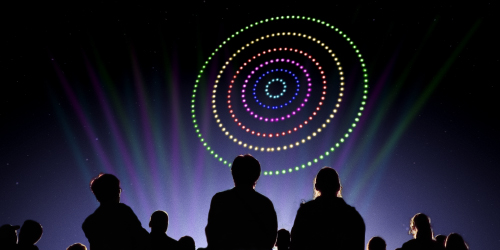
Drone fireworks. Human beings love a light show in times of celebration, whether it’s Guy Fawkes night in the UK or an awe-inspiring Olympic opening ceremony. For an eco-friendly, reusable alternative to fireworks, hundreds (or even thousands) of light-emitting drones can perform truly astonishing displays. US tech firm Intel has already put on some truly stunning drone displays at the Superbowl and at the Winter Olympics.
Drone rescue. On a more serious note, drones can literally save lives. In search-and-rescue situations, we already see crews using drones to spot survivors. Taking this even further, a drone could drop life jackets and rafts to people at sea, or food and medicine to inaccessible disaster sites. Rescue crews in Alabama used heat-seeking drones to search for survivors after a tornado in March 2019. Ambulance drones could deliver, say, defibrillators or EpiPen’s in cases where every second counts towards a patient’s survival. Researchers are also looking at creating swarms of micro, autonomous drones whose group behaviour is designed to automatically search inaccessible spaces like burning buildings.
Drone crime. Anyone who has seen footage of drones delivering drugs into prisons knows that this technology has its dark side. Already, there have been reports of drones surveying neighbourhoods before a burglary. In terms of terrorism, disruption and smuggling goods or even people, drone tech presents the justice system with a serious headache. Just consider the disruption to Gatwick Airport in the UK by drones in December 2018 – the runway was closed for 30 hours, 1,000 flights were cancelled and 140,000 passengers stranded.
More recently, environmental protest group Extinction Rebellion tried to use drones to close Heathrow Airport but were foiled by signal-jamming technology. Terrorist or rogue state attacks using drones as weapons is another threat. I foresee that anti-drone technology will be an important field in the coming years and that the regulation of drones will become ever more important. In the UK, the Civil Aviation Authority have brought in compulsory drone registration for drones over 250g in weight. Will drones, like cars today, have number plates, insurance and MOT tests in the future?
Drone police. As an antidote to drone crime, law enforcement use drone surveillance in place of expensive helicopters, where their ability to search large areas quickly can be vital to ensure public safety and to catch criminals.
Drone shopping. Need a loaf of bread? New shoes? A Venti Double-Iced Toffee Almond Nut Latte with extra cream? We may one day soon team up our internet shopping habit with sending our own personal drone to fetch our purchases from the retailer. Your supermarket shopping could be dropped off on your doorstep or in a code-secured locker outside your house. Forget a drive-in Macdonald’s, could there be a drone-in Macdonald’s?
Drone communications. Bringing comms networks to regions which lack the infrastructure for internet and cellular services could well be a next step for drone technology. The Zephyr programme from Airbus is already exploring this possibility, with a solar-powered high-altitude pseudo satellite (HAPS). Zephyr, a fixed-wing drone, can stay in flight in the stratosphere without refuelling for months at a time. Among its many possible applications is the capacity to bring connectivity to the remote communities worldwide. Let’s not forget that 4 billion people on the planet are still without the internet.
Drone sports. Already drone-racing leagues are springing up. Competitors wear headsets, so they feel as though they are sitting on the nose of a drone. It’s exhilarating stuff when the drone is flying at 80mph through tight, LED lit, 3D courses. The footage can be streamed too, in HD, making this a spectator sport. In another development, drone fans have been meeting up for air battles, adding paintball guns, lasers and even a flame thrower to their drones. Even in the most traditional sports drones are proving to be disruptive. In fishing for example, a drone is used to position the bait in locations previously impossible to access from dry land. What’s next? The sky really is the limit.
Drone exploration. A popular activity is to use HD camera equipped drones to expand your experience when exploring the great outdoors. They provide a new perspective on famous landmarks, some amazing selfies and allow the user to go to places and explore where it is otherwise impossible.
Drone photography. It has become difficult to find a TV program with an outdoor theme that does not include a drone shot to set the scene or provide fantastic images of landscapes or wildlife. Fast paced action and sci-fi scenes are filmed by drones to allow the viewer to get close to the action. Drone photography categories in photographic competitions are testament to the opportunities this technology provides for seeing the world in new and creative ways.
Conclusion. It’s easy to fear that drones could shape a dystopian future. This blog has steered away from drone applications that include weapons. The shocking, dramatized viral video created in 2017 by the Future of Life Institute made this point strongly, and generated a debate about the risks of combining drone technology with AI. But here at CDP, we are optimistic and see drones as a powerful potential force for good. It is up to humanity to ensure that this is used wisely, and that is a question we all need to consider in the coming years. How things will turn out, of course, only time will tell.