The Challenge

Cryoablation is a minimally invasive procedure that uses extremely cold temperatures to freeze tumours and diseased tissue in situ, thereby destroying it and preventing regrowth.

Our client asked us to help them develop a new technology in this crowded IP space, to allow them to own and manufacture a unique, office based treatment for breast cancer.

Our Approach

Our science team investigated the IP landscape and reviewed the physics behind the leading systems.  They spotted that they operated at high pressure to avoid vapour locks, meaning that their engineering became complex and expensive to manufacture, and required heavy, industrial gas cylinders to be brought into the clinic.

So we brainstormed a different approach, using liquid nitrogen at low pressure to replace a stainless steel system with polymers, significantly impacting complexity and production costs.  Vapour locks were eliminated by inventing a miniaturised cyclone evaporator that fitted right inside the treatment needle.

Sanarus-Visica-Cryosurgery-Prototype
visica_probe
SANARUS-027-crop

The proof of concept system allowed all operational parameters to be adjusted.

SANARUS-022-crop

The proof of concept system included multiple sensors to monitor performance.

15-crop

Test probe demonstrating the system’s ability to deliver high power cooling.

With iterative development over several prototypes, our scientists and design engineers proved that the new approach matched the performance anticipated by mathematical modelling and provided reliable, powerful freezing.  Importantly the physicians preferred the use of liquid nitrogen because it was easily available and was conveniently handled in the office environment

The value we created

A patent portfolio was created around our new technology and after clinical trials, the FDA cleared new Visica 2™ Treatment System for use. Today over 4,000 procedures have been performed successfully in physician’s offices.

By starting with fundamental science and customer needs, and adding savvy engineering and materials science, we were able to innovate around the established solutions and create a new system that outshone competitors

Bringing breast cancer treatment into the physician’s office

Connect with CDP

Accelerate your product innovation with CDP’s multidisciplinary expertise. We support product development at critical stages, helping you navigate complex technical, regulatory, and manufacturing challenges. From mechanical, manufacturing and electronic engineering to science-led innovation, human factors and digital systems. Our teams provide the insight and execution needed to move your product forward with confidence, from concept to commercialization.

Capabilities

The Challenge

Catheter ablation is widely used to treat a range of abnormal heart rhythms. It involves passing a thin, flexible catheter through the blood vessels to the heart, where it pinpoints the arrhythmia and uses ablation to block the abnormal electrical signals. A more dexterous catheter increases success rates for patients and retains greater cardiac function.

King’s College London invented a technology that enabled ‘three degrees of freedom’ steerability to improve the precision of treatments and facilitated robotic augmentation. They asked us to develop their intellectual property to demonstrate commercial viability.

CAD-Assembly-3

Our approach

We first engaged with cardiologists to identify user needs, which led us to improve the catheters capacity for therapy delivery. The technology is based around unique flexible segments so we integrated these into an overall catheter design that was practical to use and mitigated any major risks. In addition, we designed for manufacturing and assembly and selected new materials for strength, flexibility, biocompatibility and sterilization.

Our mechanical engineering team then designed, built using micro molding, and finally tested integrated prototypes that demonstrated advanced performance and reliability.

FullSizeRender-r-crop

Micro injection moulding is used extensively in the new desig

Micromould-channel-original-cross-sec-0_5N-crop

Computer aided engineering helps predict the performance of system components.

2015-01-08-15.32.34-R-crop

Precision engineering ensures high performance.

Catheter_case_slider_2

The value we created

In just nine months, ten full-length catheters were manufactured and tested. Their performance exceeded the key regulatory requirements of ISO 10555 and we proved key manufacturing and assembly steps. Our work enabled King’s College London to plan clinical trials and showcase their catheter technology to potential acquirers.

ablation-catheter-technology-cardiology-surgeon-operating-theatre

“We have been delighted with the results of Cambridge Design Partnership’s work on this project, their engineering approach and the practical improvements they managed to incorporate. They delivered fully moulded parts, and specified other components and the assembly route which fully met our aspirations for the project”

Professor Kawal Rhode, Professor of Biomedical Engineering, King’s College London

Connect with CDP

Accelerate your product innovation with CDP’s multidisciplinary expertise. We support product development at critical stages, helping you navigate complex technical, regulatory, and manufacturing challenges. From mechanical, manufacturing and electronic engineering to science-led innovation, human factors and digital systems. Our teams provide the insight and execution needed to move your product forward with confidence, from concept to commercialization.
Capabilities

The Challenge

We spend much of our lives in buildings, so they need to be safe, stimulating, and sustainable places to live. There is a trend toward Smart Buildings that use data from sensors to control the building infrastructure to maximize comfort while minimizing their environmental impact.

We were asked by an innovative West Coast tech start-up to help them launch a new approach to energy management in large buildings. Their cloud-based system would be enabled by an IoT network of smart double outlet sockets, connected through a bespoke communications backbone. The data collected would be used by an AI system to optimize the building’s energy use over time, while adapting quickly to different use scenarios.

Hub-white-lres
Biscuit-graphic

Our Approach

We were asked to design the system hardware and communications backbone, and to organize its manufacture in Asia. Our digital experts created a bespoke system architecture so our mechanical, electronics, and software engineers could develop the smart sockets and communications hub. We built and tested prototypes, confirmed regulatory compliance and selected and managed the subcontract manufacturer in Asia for volume production.

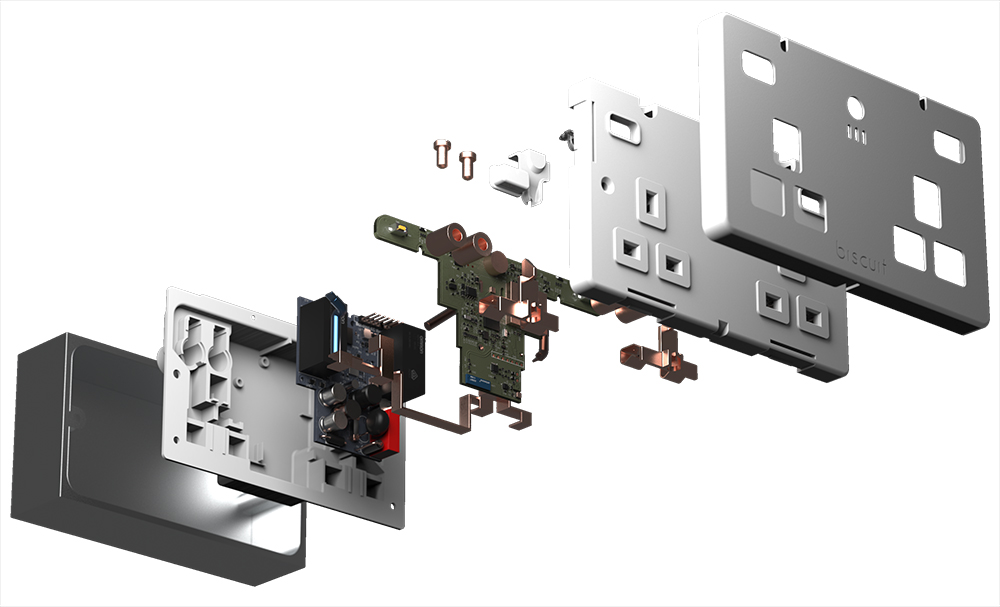
The smart double socket outlet includes electronics to monitor and report seven key parameters that provide rich data on building usage. These include energy consumption, temperature, humidity, air pressure, sound pressure, motion, and light levels.

Socket_exploded-lres
CDP-170118-0028-crop

Test fixtures facilitate the automated testing of PCBs for field trial devices

CDP-160118-0089-crop

Schematics and PCB designs developed under our ‘zero defect’ quality control process

CDP-160118-0069-crop

Multiple sensors create rich data to describe building usage

The value we created

Our client was able to contract the end-to-end development of their system hardware and communications backbone to us so their team could focus on developing user-facing software. We successfully designed the connected monitoring system and implemented a trial in 300 apartments in just 12 months.

We helped our client realize a novel AI-powered Smart Building system featuring sensing, control, and even a micro-grid system that enables local power generation.

Case_study_bisuit_4

Connect with CDP

Accelerate your product innovation with CDP’s multidisciplinary expertise. We support product development at critical stages, helping you navigate complex technical, regulatory, and manufacturing challenges. From mechanical, manufacturing and electronic engineering to science-led innovation, human factors and digital systems. Our teams provide the insight and execution needed to move your product forward with confidence, from concept to commercialization.

Capabilities

Avon_white-1

The Challenge

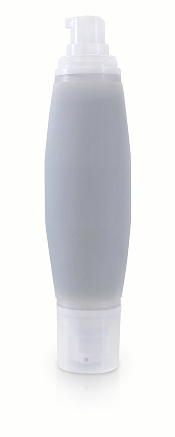
Global beauty brand Avon wanted to maximize the potential of a critical new product launch. ANEW Reversalist Infinite Effects Night Treatment Cream is a ground-breaking skincare product. The product combines two different night creams that need to be rotated every seven days to prevent the user’s skin adapting to the skincare regime.

Key to optimizing the anti-aging benefits was that users needed to remember to rotate the double-ended dispenser each week. Avon sought reassurance that consumers would continue to follow the usage instructions over time – so turned to CDP’s unique user insight service diialog™ for a new perspective. The diialog™ service uses miniature sensing technology discreetly fitted to products or packaging to capture quantitative data during user tests. The result is a conclusive analysis enabling companies to develop a deeper understanding of consumer behavior.

Our approach

The first task was to define ‘normal’ use. We set up an internal trial to ensure our algorithm was robust enough to translate inertial sensing data from the dispenser into accurate user insights.

We then ensured our diialog™ technology could be incorporated into the dispenser without adversely affecting its performance or appearance, while also ensuring there was sufficient battery life to cover Avon’s month-long consumer trial requirements.

Working alongside Avon’s packaging team, our human factors experts were able to ensure our diialog™ technology was a seamless part of the product’s ergonomics.

avon case study - our approach
IMG_0059-crop

An internal trial ensured our algorithm reliably translated the inertial sensing data from the dispenser into accurate user insights

Use behavior tracking sensors

Our diialog™ technology was seamlessly incorporated into the dispenser, eliminating any potential impact on users’ behavior

IMG_0613-Crop-square

Our diialog™ technology was seamlessly incorporated into the dispenser, eliminating any potential impact on users’ behavior

IMG_0536-crop

The value we created

The results of the diialog™ trial revealed that users were able to correctly follow the regimen of rotating the dispenser each week, while there were very few cases of triallists forgetting which end of the device to use.

But we went above and beyond. After successfully assessing and evaluating the original challenge, the trial uncovered further opportunities for packaging innovation to maximize adherence to the unusual usage regimen – insights that were not revealed by the feedback questionnaire completed by trial participants.

Avon_alt_2_case_slider

“The unique insights from the diialog™ trial will help us continue to innovate and offer high-performance, high-quality, great-value products that meet the needs of consumers worldwide.”

Paul Davies, executive director of global skincare R&D, Avon

Connect with CDP

Accelerate your product innovation with CDP’s multidisciplinary expertise. We support product development at critical stages, helping you navigate complex technical, regulatory, and manufacturing challenges. From mechanical, manufacturing and electronic engineering to science-led innovation, human factors and digital systems. Our teams provide the insight and execution needed to move your product forward with confidence, from concept to commercialization.

Capabilities

The Challenge

Water damage is the largest cause of home insurance claims. This Internet of Things (IoT) Leak Sensor can spot if there is an unusual flow of water into your home which could indicate a potentially serious water leak. It sends a notification via your home automation system to your phone, and even helps you find a plumber.

Start-up company FlowGem created an ingenious concept for a novel water detection technology and asked us to design and build a demonstration system for home trials. The device had to be very sensitive to detect a slow leak, yet slim enough to mail out to customers and simple and robust enough for DIY installation.  Of course, it also had to be cost effective, data secure and have a long service life when connected to a Wi-Fi network when powered by just two AA batteries.

Gush-9-Lres-1
IMG_0285-crop

3D printed parts were developed to ensure caseworks met all functional requirements

Gush-34-crop

A clip was developed to maintain a reliable contact to the customer’s water pipe over time

WP_20161012_007-crop

Testing and finite element analysis ensured reliable performance through the product’s life

Case_study_flowgem_2

Our Approach

We quickly deployed a multidisciplinary team led by an experienced project manager together with mechanical, electronics and software engineers. We started by addressing several design challenges that were needed to turn the core technology into a practical and reliable product in the hands of customers. Having solved these, we moved on to design and build the sensors and software infrastructure needed for a 100-user home trial, in just six months.

We designed the sensor to simply clip onto your incoming water pipe. Data is collected and analysed in the sensor using smart algorithms to save power and is transmitted periodically to the cloud to build up a picture of water usage. You are alerted by text message to problems ranging from a burst pipe to a slow drip.

Gush-10-lres-1
Case_study_flowgem_3

The value we created

Our work enabled start-up FlowGem to demonstrate the potential of their technology to the big players in the home automation market. This led to a successful acquisition and integration of the sensor into one of the leading Connected Home ecosystems.

The unrivalled performance and ease of use of the new connected water sensor, together with positive results from their large home trial led FlowGem to successfully implement their business plan.

Connect with CDP

Accelerate your product innovation with CDP’s multidisciplinary expertise. We support product development at critical stages, helping you navigate complex technical, regulatory, and manufacturing challenges. From mechanical, manufacturing and electronic engineering to science-led innovation, human factors and digital systems. Our teams provide the insight and execution needed to move your product forward with confidence, from concept to commercialization.
Capabilities

The Challenge

Gmax Technology asked us to help develop an innovative heart monitor to help vets and trainers accurately monitor their sport horses. Up until now they usually adapted human heart monitors, but they often gave false results and could not spot anomalies that could indicate future heart problems.  They also did not hold up well in the demanding commercial equine training environment.

Vetcheck_2_white
Maydan-Mirage-70-crop

Prototype development ensured a high level of performance and reliability

Maydan-Mirage-16-crop

Testing a heart beat trace visualisation in the lab

Concept-3-rear-crop

Wirelessly connectivity enables measurements to automatically be stored alongside other training data

Case_study_vetcheck_2

Our Approach

The device ergonomics and user interface were created to allow the vet to see the heart beat trace, a visualisation that allows anomalies to be quickly identified.  The monitor is also wirelessly connected to a Smartphone allowing measurements to be automatically recorded in a database, alongside other training data.

CDP-240517-078-lres
Vetcheck_white

The value we created

The Gmax VetCheck system is in use by equine professionals  all over the world.  It is the easiest and most accurate way to make measurements of your horse’s heart and is used both in training and international competitions to ensure that high standards of welfare are maintained.

Connect with CDP

Accelerate your product innovation with CDP’s multidisciplinary expertise. We support product development at critical stages, helping you navigate complex technical, regulatory, and manufacturing challenges. From mechanical, manufacturing and electronic engineering to science-led innovation, human factors and digital systems. Our teams provide the insight and execution needed to move your product forward with confidence, from concept to commercialization.
Capabilities

The Challenge

Whilst others have shown 3D printing of injection mold tooling is feasible for simple parts, we wanted to mold real world, complex components.

So we developed a fresh approach using industry standard polymer 3D printers to create complex mold tools in hours. Realizing that making the tool is only part of the time required, we also made sure to fast track tool design and verification.

screen-grab-2-crop
Tooling-sketch

First the design is sketched to develop the geometry of the major components.

IMG_9852-crop

The printed tool insert splits to allow the molding to be removed.

IMG_9687-crop

Precision 3D scanning is used to verify the accuracy of the finished part.

Case_study_tooling_3

Our Approach

We developed a new tooling strategy that mitigates material limitations and maximizes the benefits of digital processes. The tool is quick to design and exploits modular tool plates, so 3D printing of the mold tool can start within hours of the part design being completed.

The in-house digital work flow moves from 3D CAD to 3D printer and finally 3D scanner to verify accuracy.  The tool is then set up on our BOY 22 injection molding machine to produce the parts needed. Final part inspection is repeated on the 3D scanner as well.

This technique gives us the capability to move from part design to verified molding in just a few hours, even for the most complex components.

render-1-crop
CDP-220719-0038-R-lres

The value we created

We developed a new tooling strategy that mitigates material limitations and maximizes the benefits of digital processes. The tool is quick to design and exploits modular tool plates, so 3D printing of the mold tool can start within hours of the part design being completed.

The in-house digital work flow moves from 3D CAD to 3D printer and finally 3D scanner to verify accuracy.  The tool is then set up on our BOY 22 injection molding machine to produce the parts needed. Final part inspection is repeated on the 3D scanner as well.

This technique gives us the capability to move from part design to verified molding in just a few hours, even for the most complex components.

CDP-161018-0019-lres
WHITE PAPER

Breaking the mold: Digital tooling to reduce time to market

Getting new products to market efficiently is crucial to maximizing your return on investment.

Connect with CDP

Accelerate your product innovation with CDP’s multidisciplinary expertise. We support product development at critical stages, helping you navigate complex technical, regulatory, and manufacturing challenges. From mechanical, manufacturing and electronic engineering to science-led innovation, human factors and digital systems. Our teams provide the insight and execution needed to move your product forward with confidence, from concept to commercialization.
Capabilities

The Challenge

Billions of dollars are invested each year in clinical studies for new respiratory therapies. If the data collected turns out to be of poor quality or inconclusive then the study can fail. The unfortunate result is that potentially life saving therapies may never make it into the hands of patients.

Inhalers, for example are notoriously tricky to use and their performance is typically dependent on how the patient inhales. Even in monitored studies only a qualitative assessment of technique is possible. In Phase III studies, which are often unsupervised, the only opportunity to explain any unexpected or outlying data has been to rely on Case Report Forms.

quantii-inhaler-connected-data-sensor-platform-product
Case_study_header_quantii_C

Our approach

We created the quantii sensor platform to improve data quality in product trials, by improving training and providing rich data on patient interactions.

We incorporated discreet, miniature sensor technology into the test device together with data storage and wireless communications. Firstly, user training is enhanced as quantii provides real-time feedback so users can quickly understand what is needed of them and practice the correct technique. During the trial each operation of the device is monitored and translated into a wealth of quantified user insights, such as air flow and capsule discharge rates throughout each inhalation cycle.

Case_study_header_quantii_B
Quantii provides a wealth of insight, including accurate measurement of the inspiratory flowrate profile, ramp-up rate, total inhaled volume and the spin rate of the capsule

The value we created

Quantii enables high-quality, data-driven clinical studies and, for the first time, use error can be distinguished from drug efficacy. This allows you to direct remediation investment to the right places and accelerate your journey to market.

Connect with CDP

Accelerate your product innovation with CDP’s multidisciplinary expertise. We support product development at critical stages, helping you navigate complex technical, regulatory, and manufacturing challenges. From mechanical, manufacturing and electronic engineering to science-led innovation, human factors and digital systems. Our teams provide the insight and execution needed to move your product forward with confidence, from concept to commercialization.

Capabilities

Instant Detect 2.0 wildlife monitoring and threat detection system


The Living Planet Report 2020 revealed a catastrophic 68% decline in global wildlife populations due to environmental destruction and the illegal wildlife trade. The Zoological Society of London (ZSL) asked us to implement the first market-ready generation of its wildlife monitoring and threat detection system, Instant Detect 2.0.

Instant Detect 2.0 is a satellite connected system aimed at monitoring wildlife and detecting poachers in the most remote and unconnected landscapes. The system is battery powered and backpack portable so it can be deployed anywhere.   

Our approach

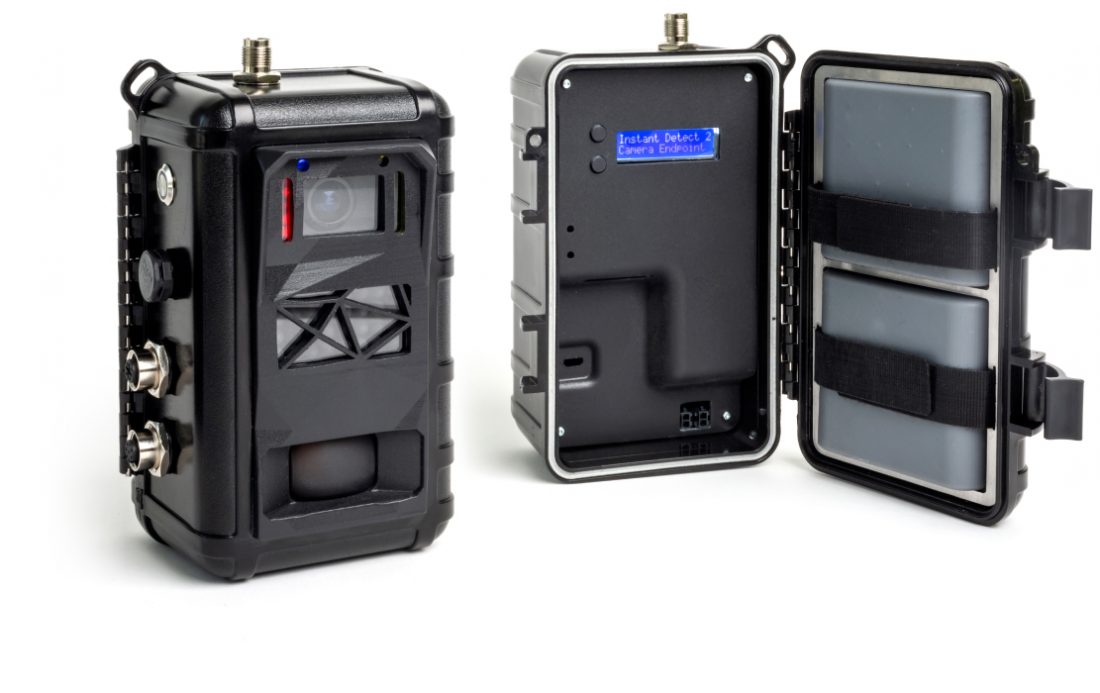
Instant Detect 2.0 gathers data from many locations at one time using sensors, including a high resolution camera that can be triggered by infra-red motion detection, timed triggers or a metal detector sensor. The entire system is built to military standards of robustness so it can withstand a long service life in the harshest of conditions. 

Digital connectivity

Data is transmitted from the sensors using a low power, long-range radio network (LoRa) to a base station, from there it is uploaded to the Iridium satellite network and then to the cloud. A single base station connects 10 cameras and more than 100 sensors, allowing large areas to be monitored by a single system.

Image sensors optimise performance in low light conditions.

Circuit schematics and PCB designs are developed under our zero-defect quality control process.

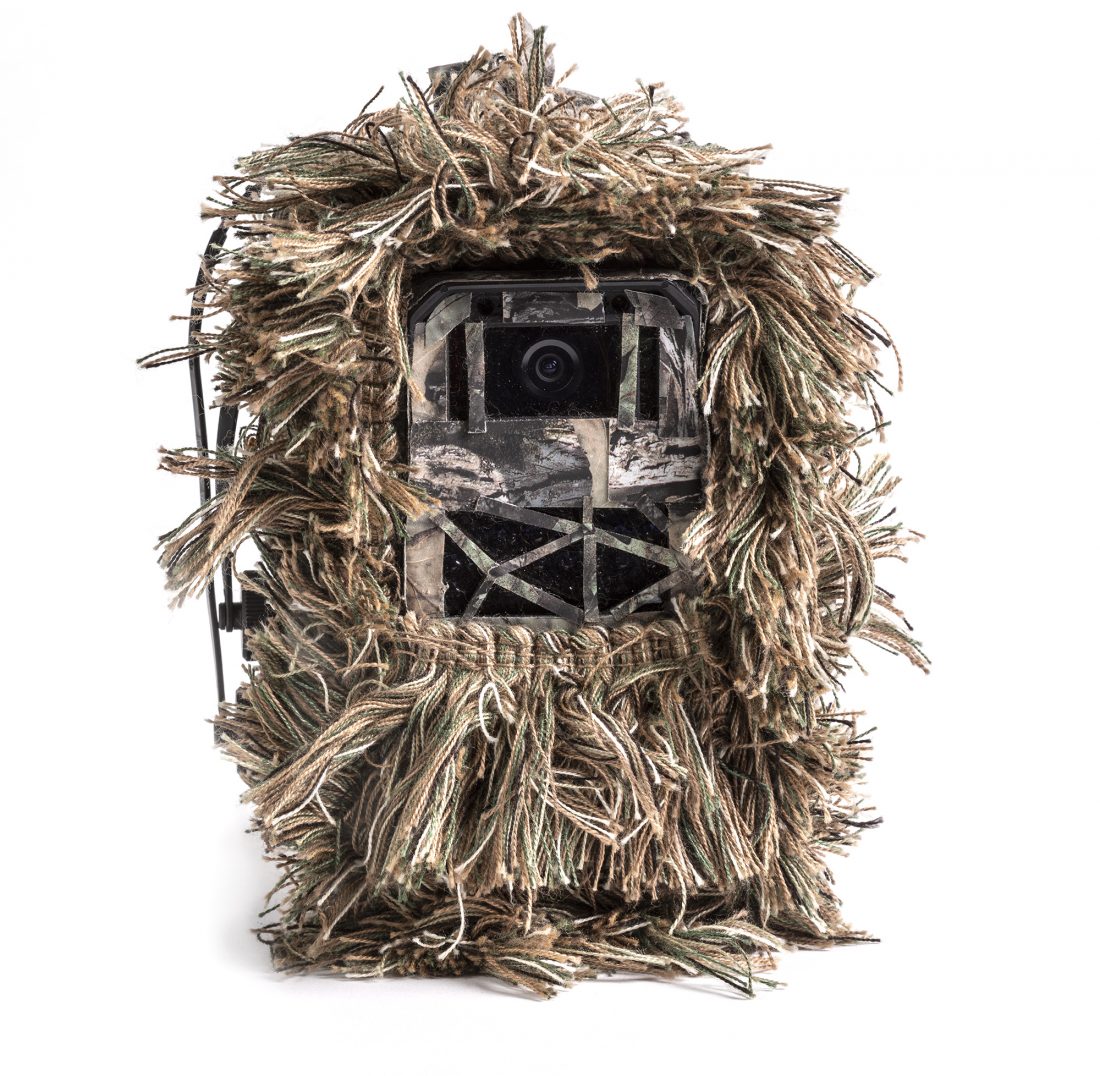
Military specification caseworks are camouflaged to hide them from poachers.

wildlife monitoring and threat detection system
Instant Detect 2.0 Image sensors
Image sensors optimise performance in low light conditions.
Instant Detect 2.0 Circuit schematics and PCB designs
Circuit schematics and PCB designs are developed under our zero defect quality control process.
Instant Detect 2.0 caseworks decorated to hide them from poachers
Military specification caseworks are decorated to hide them from poachers.


The value we created

Within 18 months the Instant Detect 2.0 system was developed, prototyped and initially tested in Kenya and a remote uninhabited island in the Pacific Ocean. Currently in beta testing in several real-world conservation field sites, the system is set to have enormous conservation potential with a wide range of potential applications, including protecting endangered species from poachers, monitoring wildlife health, managing human/wildlife conflict and enabling scientific research like monitoring the impacts of ocean plastics and climate change on uninhabited archipelagos. 


Connect with CDP

Accelerate your product innovation with CDP’s multidisciplinary expertise. We support product development at critical stages, helping you navigate complex technical, regulatory, and manufacturing challenges. From mechanical, manufacturing and electronic engineering to science-led innovation, human factors and digital systems. Our teams provide the insight and execution needed to move your product forward with confidence, from concept to commercialization.

Capabilities

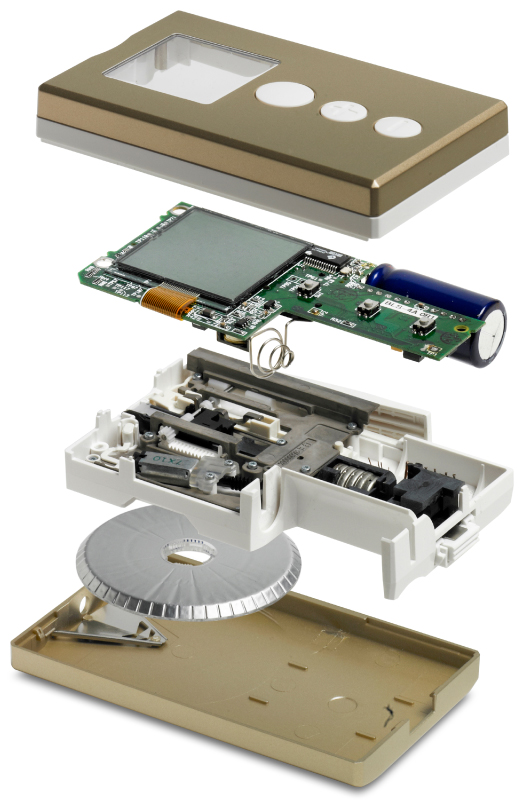
Diabetes is a chronic disease that causes high blood sugar and afflicts over 400m people worldwide. Measuring blood sugar is a part of a patient’s regular routine to control their condition.

Pelikan Technologies aimed to disrupt the diagnostic market with a painless blood lancing system that would significantly improve a patient’s experience. We were selected to work with Pelikan’s R&D team to commercialise their lancing technology and bring their first medical device to market within two years.

Our approach

Implementing their technology in an approved medical device provided several challenges, the sector is highly patented and the low pain technology needed a very high performance drive system, well beyond what was commercially available. In addition, the lancet consumable had to be manufactured automatically in very high volume with an ultra low cost of goods.

In partnership with the Pelikan team we developed a low cost linear motor based lancet drive system with a high dynamic response and precision.  We designed a disposable lancet cassette and manufacturing process that included a novel 3-dimensional foil sealing technology.  Finally, we integrated these elements with a mechanical system to automatically load a fresh lancet into the electronic engine, and after use return it to avoid needle stick injury.  

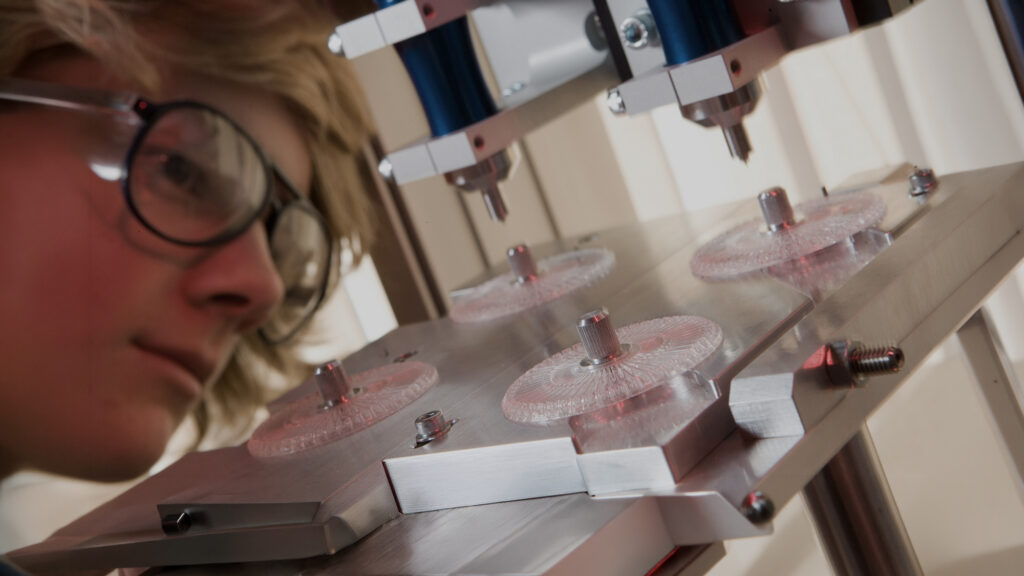
Manufacturing lancet cartridges in high volume required automated inspection systems.
The launcher mechanism stores used lancets and presents a fresh one ready for use.
The device electronics precisely controls the lancing profile.

The value we created

Implementing their technology in an approved medical device provided several challenges, the sector is highly patented and the low pain technology needed a very high performance drive system, well beyond what was commercially available. In addition, the lancet consumable had to be manufactured automatically in very high volume with an ultra low cost of goods.

In partnership with the Pelikan team we developed a low cost linear motor based lancet drive system with a high dynamic response and precision.  We designed a disposable lancet cassette and manufacturing process that included a novel 3-dimensional foil sealing technology.  Finally, we integrated these elements with a mechanical system to automatically load a fresh lancet into the electronic engine, and after use return it to avoid needle stick injury.  

Connect with CDP

Accelerate your product innovation with CDP’s multidisciplinary expertise. We support product development at critical stages, helping you navigate complex technical, regulatory, and manufacturing challenges. From mechanical, manufacturing and electronic engineering to science-led innovation, human factors and digital systems. Our teams provide the insight and execution needed to move your product forward with confidence, from concept to commercialization.

Capabilities