In packaged products

In packaged products, context is king

Chris Houghton leads Brand Innovation & Packaging at Cambridge Design Partnership, he has worked on an array of successful insight, design and strategic innovation projects with top consumer goods names including Arla, Carlsberg, Coca-Cola, Diageo, Nestle, PepsiCo, Procter & Gamble and Unilever.

Following his ‘Context is King’ keynote speeches at PACE in Amsterdam and AIPIA in New Jersey, he summarises five key questions brands need to answer when building an innovation pipeline.

Bill Gates famously wrote, Content is King back in 1996. His forecast…“Content is where I expect much of the real money will be made on the Internet”…

How right he was as we’ve seen the digital revolution establish over the past decade. On demand streaming services have overtaken traditional audio and video formats with gaming next on the horizon. Coupled with new business models, the likes of Uber and Airbnb have tapped into consumer demands making brands sit up and think what should we do to take advantage of this fertile digital landscape?

Context #1. Who?

Who are you designing for? Do you understand their cultural sensitivities, their customs and established rituals? Do you know their values? Their gender or generation? Their mental and physical abilities? Are they tech-savvy – do they need to be? The better you understand specific population cohorts the better your chance of successfully meeting their expectations.

Each culture and country has its own technology trajectory and utilisation levels. The worldwide average for time spent on the internet is now 6hrs 42mins which is just above USA’s average but some way short of chart toppers the Philippines clocking in at over 10hrs per day (source Digital 2019, wearesocial.com users aged 16-64).

Some categories like beauty and cosmetics are ahead of the curve with high digital engagement. L’Oreal was one of the first brands to realise this with their Makeup Genius app which allows users to compare before/after make-up and hair effects on-screen. This pre-purchase, augmented reality tool enables fast navigation of product choices to help consumers decide what to buy – within two years L’Oreal said it had 20 million users worldwide.

For decades, beauty brands have been heavily reliant on celebrity endorsements or experts in lab coats to target and assure consumers but today that paradigm is changing. Millennials increasingly seek individuals that they can relate to, building seemingly intimate relationships with those they follow on Instagram and YouTube channels, who ultimately steer their lifestyle decisions. This mix of opinions, edited evidence, facts and ‘fake news’ can confuse many consumers, so building trust is more important than ever.

Context #2. What?

What category does your brand belong? Beverages, confectionery, personal care? The answer to this is obvious, of course and you’ll invest great effort closely tracking the activities of your competitors. But that is just the start. Innovations don’t always come from your direct competitors. Instead, brands are often blindsided from an unassuming left field competitor, arriving at speed with disruptive and transformational innovations. For instance toothpaste brands didn’t expect their category to be impacted by confectionary companies making chewing gum with teeth whitening claims.

We look at the ‘what’ in a solution agnostic way using the ‘jobs-to-be-done’ methodology. In a nutshell this approach states that when consumers become aware of a job they need to get done, they look around for a product or service that they can hire to do so.

Procter & Gamble’s Tide is a good example of a brand that have extended their portfolio to cater for changing contexts. The core range is unsurprisingly traditional powder, liquid and convenient pod packaging, but more recently Eco-Box was introduced to address e-commerce shipment and improved sustainability stats. The brand has even stretched beyond products solutions with the test market launch of Tide Cleaners. A direct to consumer, digitally enabled, subscription service that targets ‘generation rent’ to simply drop/collect dirty/clean laundry. This cleverly allows the brand to reach new consumers whilst experimenting with new business models, partnerships and logistical infrastructures in a low risk way.

Context #3. Where?

Where is your product used? At home, at work or on the go? Each location may present a different hierarchy of jobs. In fragrance, for example perfumes have clearly defined packaging conventions. Consumers expect a thick-walled glass bottle, an elegant closure with a precise dispensing atomiser. This objet d’art is entirely appropriate to adorn a home dressing table. However, if on the go,  this format no longer seems so practical for a handbag.

In 2017 British parfumier Jo Malone launched Fragrance Paintbrush under the brand Jo Loves. A compact perfume gel applicator that is crucially handbag friendly. This delivers an entirely different application ritual, delicately brushing quick drying fragrance onto the skin rather than the traditional perfume spritz.

In a digital, augmented world understanding the ‘where’ is crucial to enable or enhance the experience, especially when leveraging the surrounding environment. Whilst outside the packaged goods world, I find EuroStar Odyssey an insightful and charming experience to entertain children during a long train journey. Instead of uninspiring views inside a concrete tunnel beneath the English Channel, the carriage is virtually transformed into an underwater viewing gallery with dolphins and whales swimming besides you to help families kick start their vacation.

Context #4. When?

When is your product used? This can have a crucial bearing on consumer engagement levels especially regarding available time and tolerance levels. For example, a parent making up baby formula has very different functional, emotional and social ‘jobs’ depending on the time of day. Sterilizing equipment, measuring and mixing powder at 3pm is very different to 12 hours later for the 3am feed in the dark whilst you’re still half asleep, was that 4 scoops or 5?

When is a crucial dimension for digital interaction too. Many successful smart packaging examples have come from high engagement categories like alcoholic beverages and beauty where consumers make extra time for interaction and brand owners see sufficient ‘value’ to deploy cost sensitive technologies and/or content.

Context #5. Why?

Why should we choose your brand? What motivates us? What jobs are we trying to achieve? ‘Why’ ties together all of the other contextual considerations and forms the heart of any value proposition and reason to believe.

Take PepsiCo’s Gatorade brand for instance with their emotive message of #WinFromWithin. They understand people are motivated to ‘win’ especially in a sporting context. This reinforces how the brand was created in 1965 by scientists to provide athletes competitive advantage through superior hydration. Fast forward 50 years and the brand found themselves losing share with an influx of competitors big and small. To reverse this trend they identified contextual consumer jobs to cater for their needs more comprehensively. This prompted the launch of G Series, primarily a ‘When’ based product range to help athletes before (Prime), during (Perform) and after (Recover) sporting efforts. This triggered their portfolio to grow beyond solely sports drinks into food to create an ecosystem of sports fuels, from chews, bars, powders, drinks etc. More recently we’ve seen the launch of the Gx Bottle, a smart hydration system that helps individuals to customise their own products, with connected sweat tracking and variable carbs and electrolyte pods, the Nike ID of the hydration world.

So ask yourself, is your brand prepared for this revolution? Do you cater for those consumers that don’t accept one-size-fits all? Whilst Content may be King in the purely virtual, service-based world, Context is King for physical, packaged offerings where content can augment and enhance the physical experience rather than be able to entirely replace it.


How much does sleep cost|

How much does sleep cost?

Margaret Thatcher famously said ‘sleep is for wimps’. Sadly, that’s not good advice, but also, it seems, it is exceedingly bad for the economy. Even though we spend around a third of our lives asleep, society it seems, has been mis-sold the value of a full night’s sleep.

RAND Europe, a Cambridge based not-for-profit policy research organisation undertook a study into the impact of sleep on the world’s economies. Marco Hafner, a senior economist says: “Our study shows that the effects from a lack of sleep are massive. Sleep deprivation not only influences an individual’s health and wellbeing but has a significant impact on a nation’s economy, with lower productivity levels and higher mortality risk among workers.” RAND found that employees who sleep less than 6 hours per night report on average about a 2.4% productivity loss due to not being at work or employees being at work but working at a sub-optimal level, compared to workers sleeping between seven to nine hours per day. (RAND, 2016). Scale that up to the UK’s workforce and it equates to a cost of $50bn each year.

Evidence also shows sleep suppression is a predictor of ‘all-cause’ mortality, including fatal car accidents, cardiovascular disease, strokes and even cancer. A recent study by the Foundation for Traffic Safety reported that, compared to drivers who had slept for at least 7 hours in the past 24 hours, drivers who reported they had slept less than 4 hours had 11.5 times the crash rate.

Based on empirical evidence, the number of individuals receiving less than the recommended 8 hours of sleep is increasing. This is due to several lifestyle influences connected with a modern 24/7 society, such as psychosocial stress, unbalanced diet, lack of physical activity and phone, tablet, and computer use, among others.  (Roenneberg, 2013)

So how can we address this challenge?

According to sleep scientists there are simple measures we can take, the most important thing you can do is to self-impose a rigid sleep and wake up time each day, even at weekends. It seems there is no such thing as catching up on sleep, in fact, it only serves to aggravate the problem. Having a lie-in cranks your natural body clock (circadian rhythm) forward in time so when Monday rolls around and you must wake up early, it’s like having 3 hours or so of jet lag. Not the best way to start the week!

Two things to avoid in the evenings are caffeine and alcohol. Caffeine has a half-life of about 6 hours, so a post-lunchtime coffee would be equivalent to drinking a 1/3 of a cup of coffee right before bed. Conversely, alcohol can be a powerful sedative but is also one of the most influential suppressors of REM sleep, arguably the most important stage of sleep.
Health education often does not teach the importance of sleep. Every parent knows from experience that sleep is of fundamental importance to their child’s development and can dramatically affect the child’s ability to learn new skills.

It is also important for employers to recognise the importance of sleep and tiredness. Creating brighter workspaces, having outside eating areas and encouraging staff to take lunchtime walks all help to promote the natural melatonin hormones which regulate the sleep/wake cycles.

One such company that has embraced a positive sleep culture is Google. Google has implemented a flexible working arrangement with employees so they can match their hours to their circadian rhythm and have installed ‘sleep pods’ in their facilities to encourage naps, thereby germinating creativity and productivity, and reducing health problems and sick leave. It is also reported that the insurance giant Aetna pays a $300 a year bonus to staff that get at least seven hours of sleep per night recorded and verified using a sleep tracker such as a FitBit.

A big challenge is shift work. Many industries that have to provide essential 24/7 services need this capability and worryingly the World Health Organisation has listed night shift work as a ‘probable carcinogen’. Clearly more work is needed to develop strategies to protect those who have to work at night.

In a second blog, coming out next month we will be looking at how the emerging sleep tech industry, estimated to be worth over $30bn a year in the US, is addressing these challenges. Do they fulfil our unmet needs or are they creating more unnecessary gadgets?

manufacturing – we bridge the chasm

Bridging the design transfer chasm

The challenges of bridging the ‘design transfer chasm’ are well known in the medical device industry. If your approach to design and innovation has not fully anticipated the intricacies of volume production in a regulated environment, then difficulties will arise when it is sent to your manufacturing partner to be made at scale.

Developing high volume medical devices is a complex challenge, there are many issues beyond the design itself to consider such as usability, component cost, part variability and suitability for high-speed assembly and inspection.  Product designers creating new products from a clean sheet often rely on manufacturing engineers to rectify issues later down the line.

Unfortunately, rectification can be a tortuous process as each design change can have many unintended knock-on effects. When manufacturing delays impact the launch of a product, the direct costs and financial damage can be significant. The window of opportunity in which to sell a new product while it is still under a patent is limited, causing unforeseen harm to income potential.

Some contract manufacturers address this concern by offering a design and manufacture package, however this strategy can leave the manufacturer’s intellectual property and know-how embedded in the product. This ties in the manufacturer and restricts your ability to control supply chain profit margins in the long term by competitive second sourcing, adding risk in the future.

To address these challenges, Cambridge Design Partnership has created a product innovation model called Potential Realised. We find it offers a better solution by developing the new product within an environment where a holistic team of product development and manufacturing engineers work in parallel. The benefit of having the design and manufacturing teams working closely together is that production problems are foreseen, and issues fixed quickly, by either design or manufacturing changes.

The key step that leads to the success of this approach is a robust phase of short-run manufacturing organised by an extended design team towards the end of product development. The manufacturing team develops a comprehensive pilot manufacturing process which includes tooling and process qualification. This run provides both regulated product for clinical trials and verifies the capability of the design and manufacturing process.

The result is a detailed and tested package of manufacturing documentation alongside the completed technical file and clinical trial data. The designs are handed over with a quality control plan, standard operating procedures, jigs, and validated test methods. This means that all the intellectual property including the know-how relating to both the design and manufacturing process is transferred, enabling a competitive tender process to identify the most cost-effective volume manufacturing partner.

A key advantage of Potential Realised is revealed when conducting clinical trials. Trials normally start between design and full manufacture, so there is a danger that if design transfer requires alterations to the product, elements of the controlled clinical trial may need to be repeated. There are countless examples of pharmaceutical companies needing to repeat or extend clinical trials due to delivery device design changes during design transfer, or to take extra time to perform bridging studies to demonstrate to regulators that changes have not impacted clinical performance.  Instead, with the Potential Realised approach, a short manufacturing run for clinical trials is integrated into the development process and is conducted in a manner representative of how the product will be made once it goes into volume manufacture, thus significantly reducing these risks.

In the field of medical device innovation, Potential Realised integrates short-run manufacture into product development bringing a raft of advantages, not only saving both time and money in commercialisation but bringing forward product launch and vital product revenues.


To find out more, explore Transfer to Manufacturing.

S.M.A.R.T. innovations for the food industry

Last month, I had the honour of speaking at the annual NSF International conference, held at the British Library in London. This year’s conference theme was focused on ‘Addressing New Realities’, looking at how mainstream food producers can take advantage of technology innovation to compete effectively and survive in today’s rapidly changing world. 

Alongside industry experts, academics and futurists, examples of what we mean by ‘smart’ technology and how it is influencing the food industry were explored. These included drones that assess harvest maturity, artificial meat cultured in labs and new packaging materials and waste infrastructures that are helping reduce plastic waste. The main message throughout the day was clear – as digital technology and other applied sciences are transforming the future, we need to ensure the future remains people centered! Future proof organisations will be those who clearly understand what their consumers really want.

My keynote centered on the belief that innovation happens where consumer insight, technology enablers and business opportunities coincide. While technology plays a vital role in enabling opportunities, innovation requires all three ‘stakeholders’ and, the most fundamental starting point is having a clear understanding of the consumer. Building on this belief, I was delighted to address the conference delegates and share with them a S.M.A.R.T approach to innovation:

S

Solve a problem that customers really care about: often human behaviour is driven by a desire to solve problems, which can be functional, emotional or social in nature. We adopt Jobs-to-be-Done (JTBD) to define and understand the ‘jobs’ consumers are trying to solve. Done properly it provides a clear, solution-agnostic understanding of customer needs and desires across complex markets. The advantage over conventional market research methods is that jobs tend to stay the same over the long term, while technologies come and go and enable different point-in-time solutions that may become quickly obsolete.

M

Measure your success: Generally, consumers seek the best solution that enables them to solve their problem, and by understanding their needs we can create a multi-dimensional analysis of how well this has been done. We monitor eight mega trends which also help us understand how consumers make choices and measure how successfully the solutions have solved their problem. For example, personalisation is driving consumers growing desire for new experiences, while provenance is driving consumers transparency and traceability expectations.

A

Attitudes to Innovation: We seek evidence to understand and adapt to different consumers innovation attitudes and bring them on a compelling journey. Often organisations try to innovate by starting with a technology, this can result in new products and services that appear to be ‘tech for tech sake’. In order to make innovation meaningful to consumers you can begin by understanding their established behaviours and rituals. Be mindful of who your audience is here, for instance Millennials are the ‘Instagrammable’ generation and I love the expression ‘if a millennial eats a meal but didn’t Instagram (or ‘gram’) it first, did it really happen?’ Think about what makes something meaningful and attractive to your target audience.

R

Right to Play: when exploring innovation opportunities, be sure not to lose site of the baseline expectations and requirements that exist in your industry. These may be regulatory constraints that should always be addressed first. Consumers also have a set of baseline expectations within the food industry, both tangible (e.g. premium food ‘codes’) and perceived (e.g. attitudes and expectations around single-use plastic). These expectations can create tensions for organisations to innovate around, and we are seeing brands (even those competing with each other) adopting innovative new ways to try and solve such problems.

T

Transferable learning: innovation usually isn’t unique, meaning you can learn a lot from adjacent markets, in terms of technology enabled innovations that work…and those that don’t! For the Food industry, boundaries are blurring with both Beauty and Health making these industries highly attractive to learn from. We can already see examples where simple NFC technology is making both Beauty and Food more convenient, and how DNA science is enabling tailored Health and Food solutions. By exploring adjacent industries, we can see how business models could empower new social economies within the Food industry, as well as new material innovations which can inspire us to start experimenting with single-use plastic alternatives, for example.

Technology set in the context of consumer needs can unlock innovation and by implementing a S.M.A.R.T. mindset, it will help ensure you make the right technology investments for your business: By truly understanding your consumers’ problems, giving consumers measurable proof points to show that you have solved their problem making your innovation both attractive and meaningful to your target audience, ensuring you deliver against the baseline expectations first and foremost, and looking beyond your direct competitors to learn about both what to do, and what not to do, when it comes to successful technology-enabled innovation.


For highlights of the NSF International conference, featuring comments from Martha, please watch the following video.


Reporting back from CES 2019

Neil Campbell, CDP’s consumer technology business development leader, is freshly back from the Consumer Electronics Show 2019 in Las Vegas. Here, he reflects on the healthcare innovations there that caught his eye, from malaria-defying lightbulbs to DIY ultrasound scanners

The Consumer Electronics Show (CES) 2019 is a vast, raucous collection of the very latest in gadgetry and innovation. It’s an event at which, over the four days of America’s biggest technology show, you can sift for nuggets of gold amid a sea of clamouring sales staff. This year, I did all the legwork so that you don’t have to. Here are my top five take-away healthcare gems from CES 2019:

1 The pill-dispenser you can talk to and through

Amid the myriad of gadgets on display, it was a product from Pillo Health licenced to Stanley Ventures that really caught my eye. Called Pria, this piece of kit is an elegant answer to the problem of making sure that patients – the elderly in particular – comply with their medication without feeling like you are being “nannied”.

About the size of a large alarm clock, you can load a Pria with up to a month’s worth of tablets. Its round interactive screen has two friendly eyes and it uses facial recognition to dispense daily (or even hourly) meds correctly. As well as reminding a patient using speech to take their medication, the Pria can send alerts such as “Your Dad missed his 8am dose” through to a relative’s smartphone. The Pria also allows family and carers to facetime the elderly person through its screen. It’s beautifully designed and a truly practical use of connective tech.

At CES, I saw a lot of energy going into creating lifestyle products in the hopes of them becoming the “must-haves” that people simply can’t live without. The Pria for me was a stand-out winner. Anyone with an elderly relative would see this and say: “We need this, now.”

igg.me/at/pillohealth

2 The sticking-plaster solution to infant fever

At the other end of the age spectrum to elderly care, having worked in innovation for many years in this space I was fascinated by the many parenting tech products on offer. My favourite was an intelligent sticking plaster, called TempTraq, which is a wireless thermometer for digitally monitoring body temperature.
Each plaster is single-use and, when stuck on a child’s body just under the armpit, will continuously record body temperature with versions ranging from 24 to 72 hours, sending its results instantly via Bluetooth to smartphones. It is already on sale and prices start at just $14.99.

As the parent of a four-year-old myself, I can see this becoming an essential addition to any family medicine cabinet. With a TempTraq plaster, you can not only spot a dangerously high fever spike in a sick child and treat it immediately but can gather and analyse the data as well. This product also has huge potential for high-volume use within healthcare systems to improve the care and safety of poorly children as temperature is one of the few important diagnostic metrics that is not constantly measured in hospitals. Brilliant.
www.temptraq.healthcare

3 Home diagnosis, made simple

Another winner in my eyes was a home diagnosis kit called Tyto. This consists of a handheld touchscreen device that records and sends medical data from a patient to a doctor. Working via an app which requests a doctor consultation, the device has a range of add-ons such as a tongue depressor, stethoscope, otoscope (for ear examinations) and thermometer which can send your doctor data. Costing around $300, Tyto is made by a small company but already complies with the tough FDA (Food and Drink Administration) regulations in the US and is being offered Stateside by certain healthcare providers as a service to patients. innovation right now.
www.tytocare.com/

On the subject of home diagnostic testing, I was amused – but perhaps should not have been surprised – to see that for $60 you can get an over-the-counter sperm fertility optic imaging diagnostic testing kits that were also on offer at CES by YO. It’s clear that self-help health diagnosis is a key area for innovation with a theme of bringing the clinic and lab into the privacy of your own home.
www.yospermtest.com/

4 How’s the baby? Well, take a look…

Any parent will remember the excitement of seeing their unborn child on a screen during an ultrasound examination at hospital. Imagine if you could have access to your very own ultrasound scanner at home? Well, for around $2,000 you now can, thanks to a company called Butterfly iQ, which showcased its tiny scanner (about the size of an electric razor) at CES.
Billed as a lifesaver and gamechanger, it’s aimed at patients in remote rural areas with, say heart conditions or problem pregnancies. It comes with an app that allows the ultrasound imaging to be sent live to a doctor and has settings to allow you to cover a range of medical conditions. There is also AI (Artificial Intelligence) within the gadget to guide users to take the images correctly.
www.butterflynetwork.com/

Another similar scanner technology but aimed purely for pregnancy scanning was on show by a company form the Netherlands called Baby-scan. Although they have yet to launch to the market, I expect, due to the lower number of functionalities, the price is likely to be significantly lower than the Butterfly IQ. But a unique feature that in my opinion puts it in the high consumer value proposition for a product is that it does both 2D and 3D scan images of the foetus thereby capturing images of those precious moments to share with the family. So I can imagine parents-to-be scanning their bumps daily, just for the fun of seeing them.
www.baby-scan.nl/Home/BabyScan

5 Truly a lightbulb moment

Finally, my attention was also snagged by something very left field: Having worked in the innovation and product development space for pest control and insect borne disease prevention it tickled me to find this lightbulb. The FlyLight by Cleanrth Products LLC is a simple-looking doughnut shaped bulb that attracts insects. Once attracted there’s a fan inside that suck’s up the pests. Combining the two traditional trap techniques of an attracting light and suction capture it fits in a normal light socket and has a sliding door so you can easily clean out the dead insects.
It could be that the FlyLight has the potential to be a truly life-saving product in the developed world in the fight against Zika, and other flying insect borne diseases.
http://www.cleanrth.com/

How is digital technology maturing in healthcare?

The recent Digital Health World Congress 2018, which was held in London at the end of November, covered aspects of medical and mobile technology. It certainly presented an interesting and diverse line-up of speakers and exhibitors.

A key learning we took from the event is that digital health (the intersection of digital technology and healthcare) is maturing. In recent years, digital health has experienced a strong ‘hype cycle’ but, as the event illustrated, we are beginning to see real-world roll outs that address true user needs and have measurable business success.

Keynote speaker, Adrian Byrne, CIO at University Hospital Southampton NHS Foundation Trust, presented a fascinating maturity model of patient information systems delivered by Healthcare Information and Management Systems Society (HIMSS). He explained that the adoption of electronic medical records is a key building block that serves as a foundation for new digital services and associated technical innovations that can improve healthcare. But the creation of systems for electronic medical records is only the start of the journey – to succeed it needs the willingness of end users to adopt it and continued championing to maintain momentum.

A key takeaway from the event was that where deployments have succeeded, they provide quantifiable gains for patients and other stakeholders. An example that Adrian described is a simple patient ID barcode solution, which enables the patient to be scanned prior to any medication being given to them. Already it has prevented over 300 patients from being given the wrong dose.

Another real-world example, which is being rolled out in Kent, is a simple App called WaitFree. It recommends which A&E facility the patient should attend in order to help minimise waiting time. Using the information of current waiting times at each A&E facility in conjunction with an estimation of the user’s travel time to each facility, it recommends which facility they should attend in order to be seen quickest – which may not necessarily be the closest one! This has a clear benefit for the patient but also benefits the healthcare system as load on the system is distributed more evenly, maximising utilisation of scarce resource.

A major theme from the event was leveraging smartphones to provide new diagnostics. For example, healthy.io is turning a smartphone into a regulatory-approved urinalysis device. Its first product, dip.io, uses the phone’s camera to assess various urine test results. This means that a subset of the 42 million tests conducted each year in hospital can now potentially be moved into the home, increasing convenience to the patient but also reducing costs on healthcare incurred through hospital visits.

An example of the convergence of medical and consumer diagnostics is Nimasensor, a connected gluten and peanut sensor device. Whilst gluten and peanut allergies are increasingly recognised and catered for, the creator identified the significant challenge to sufferers who would commonly be ill after meals out even if they had been careful to select food without allergens. The Nimasensor enables users to conduct an on-the-go analysis of foodstuff, thereby enabling restaurant visits with more confidence that illness or even fatal consequences will not occur.

All of this is reflective of a trend that is increasingly seeing consumers take ownership of their own wellbeing and healthcare. It’s moving away from the traditional model of sick care provided at a surgery or hospital. With this traditional model users have no real means of determining how sick they actually are before accessing services and creating an ever-increasing demand with health services stretched to the limit. However, companies like Doctorlink are trying to simplify user access by triaging and facilitating efficient access only when required. This enables practitioners and providers to be utilised more efficiently.

Whilst at the event there were many examples of services being built into Apps to help HCP’s during their day-to-day jobs.  There was also a healthy mix of companies embarking on a product and service deployment. For example, Qardio is providing a wide range of health wearables like blood pressure monitors, and Tytocare has developed a camera-based toolkit for home diagnosis that feeds data straight to the clinician.

Augmented Reality/Virtual Reality (AR/VR) was also demonstrated at the event. Proximie is conducting some very compelling remote surgery assistance where the experts no longer need to travel the globe to assist in theatre. Instead, they can be virtually ‘there’ via the latest webcams, and so enhancing the level of support they can provide to a wider audience.

Equally compelling was Oxford VR who demonstrated dramatic behavioral improvements with people fearful of heights. With the use of VR tools they are quickly able to quash people’s fears and within a few hours empower them to tackle heights, escalators etc.

Overall, at Digital Health World Congress 2018 we saw many passionate and insightful enterprises pitching into the healthcare market, sometimes with a boost of funding, and then growing organically to deliver increasing levels of benefit around a specific need. Whilst this is exciting there exists the inevitable potential for fragmented and competing services, which is already one of the biggest problems in healthcare.

Here, at CDP, we start by examining a new healthcare challenge from all angles. This enables us to focus innovation on a sound foundation rather than taking new technology and looking for a home for it. This involves researching and thinking around users and how their needs can be best addressed, as well as the business imperative to create a profit. So when we finally deploy technology it efficiently addresses both user and business needs, with the foundation for scale built in.

How to get serious about sleep – for you, your customers and your bottom line

There is growing scientific evidence, media coverage and public awareness of the impact of sleep on our health. Not just how you feel today, but for your long-term health and productivity. Reduced quality or duration of sleep, even in those without a “chronic” sleep complaint such as insomnia or sleep apnoea, has been linked to increased risk of many medical conditions such as hypertension, diabetes, depression, obesity, cancer1, damage to the immune system, reduced tolerance to pain and reduced ability to cope with stress. In fact the US Centers for Disease Control and Prevention has described insufficient sleep as a ‘public health epidemic’2.

But this is much much bigger than just a lifestyle or healthcare concern, this ‘epidemic’ of poor sleep has far-reaching economic consequences3. A recent study by the Rand Corporation put the cost of poor sleep to the U.S. economy at $411 billion/yr. So as Professor Matthew Walker (author of ‘Why we sleep’) argues, there seem to be pretty compelling reasons for all of us to “reclaim the right to a full night’s sleep”.

So, what are the implications of this sleep issue for your customers, and for your business?

As this interest in sleep grows, we are seeing a change in behaviours and spend. For some it is a return to “old tech” e.g. paper books for reading, less TV before bed, alarm clocks separate to smartphones. We may see a return to “old routines” such as earlier or healthier meal times, which in turn changes grocery shopping habits. It may even encourage adoption of “low tech” spaces (e.g. keeping phones and computers out of the bedroom), or “sleep spaces” such as Casper’s “Dreamery”. But while there are 100’s of products claiming to improve one’s sleep experience – from mattresses, pillows, sleep trackers, lights, apps and nasal strips, through to medical products to treat serious conditions … there remains considerable need for products that can translate the growing scientific evidence into tangible and effective sleep solutions. We see significant opportunities for new entrants that can address these needs in a way that doesn’t pitch “tomorrow’s health” against “today’s fun” and that can help consumers to build positive habits and relationships with their own sleep.

And let’s not forget the cost of poor sleep to companies and economies, should we also be reassessing the way we work? Is it really good to provide that free coffee and caffeinated soft drink? Are our travel schedules and policies appropriate given our improving understanding of sleep. Are there ways that employers (and those organisations that serve companies and workers) can address this?  Should we leave it to employees, or as employers, should we be “nudging” people, given the huge benefits to our businesses and society of better sleep? We’d love to know what do you think.

At CDP we’re passionate about improving lives through innovation, we provide solutions to everyday life affecting issues like sleep and its effect on health, happiness, creativity and productivity.  You can read more about one example of our recent work to improve sleep outcomes with ICON Health & Fitness here.

If you are interested in improving how people sleep, or how a fresh perspective on opportunities in sleep can help you and your company – please do get in touch.

https://www.aaas.org/news/sleep-deprivation-described-serious-public-health-problem
https://www.ncbi.nlm.nih.gov/pmc/articles/PMC5627640/

image 1

MAKING A SPLASH Time-critical CDP software development helps Speedo make waves in swim tracking

18 June 2018 – Swimmers across the globe have a new level of activity tracking at their fingertips following a collaboration between digital technology and product design firm Cambridge Design Partnership (CDP) and leading international swimwear brand Speedo. CDP has created a swim tracking algorithm for a new generation of tracking app, called Speedo On, which can capture a range of key swim metrics via a water-resistant fitness band so that they can be incorporated into personal fitness goals.

The connected Speedo On app is featured on Samsung’s new Gear Fit2 Pro activity tracker. Sophisticated algorithms translate data from the accelerometer and gyroscope in the ergonomic wrist-worn device into measurements of lap count, lap time, stroke type and stroke count. The interactive swim tracking platform acts as a comprehensive training partner, offering analysis of swims and tracking progress against fitness goals. It also includes additional training programmes, tips and tailored advice, developed by some of the world’s best coaches and athletes.

As part of a worldwide team that worked around the clock to produce the app and its accompanying service for swimmers, the CDP team had a tight timescale of just two months for the development of the software in time for the launch of the Gear Fit2 Pro. So it deployed a mixture of analysis techniques – using both classical and machine learning algorithms to identify the relevant swimming characteristics. “One of the key challenges was understanding which stroke was being used as we had to classify the data taking into account wide variations in swim technique,” said Roberto Basile, a software engineer at CDP. “Lap counting was also complex as we were simply using measurements of hand movements – yet needed to differentiate between normal swimming and the movements during a turn.”

The development was completed in time for launch, with the Speedo On swim tracking app pre-installed on the Gear Fit2 Pro. The data is seamlessly transferred on to the Speedo On web-based platform. The app also has a social dimension – enabling users to follow other swimmers, take part in challenges and share achievements. And swimmers can complete time trials and get their SWOLF score – a swim efficiency measure.

“Speedo is committed to inspiring more people to get into the pool to achieve their fitness goals,” said Tim Sharpe, innovation director at Speedo owner Pentland. “The combination of CDP’s unique software skills and Speedo’s swim expertise has provided fitness-focused swimmers with a completely new level of tracking.

Notes for editors

Cambridge Design Partnership is a technology and product design partner focused on helping clients grow their businesses. Some of the world’s largest companies trust CDP to develop their most important innovations. Located in both Cambridge (UK) and in Palo Alto, California (US), CDP specialises in the consumer products, healthcare, energy and industrial equipment markets. Its multidisciplinary staff have the expert knowledge to identify opportunities and tackle the challenges its clients face. For more information, visit: www.cambridge-design.co.uk

The world’s leading swimwear brand, Speedo is passionate about life in and around the water, creating revolutionary new technologies, designs and innovations and supporting swimming from grass-roots through to elite level. In the 1920s Speedo made history with the Racerback: the world’s first non-wool suit. In 2008 Speedo redefined swimwear again with Fastskin LZR RACER – the fastest and most technologically advanced swimsuit ever created. 2011 saw Speedo unveil another world first with the Fastskin Racing System – a cap, goggle and suit designed to work together as one. Speedo is owned by Speedo Holdings B.V. and distributed in over 170 countries around the world. For more information, visit: www.speedo.com

For further information, contact the marketing team:
+44 (0)1223 264428
marketing@cambridge-design.co.uk

|

Innovating disruptive products within all health and wellness

Most of us don’t take action often enough when it comes to improving our health. For many, the standard of care is bare bones: we find the time to schedule a visit to the doctor, listen attentively for the few minutes the doctor is speaking, and then implement the one or two ‘must haves’ to keep our bodies going. Unfortunately, the still-dominant culture in healthcare is: I’m the patient, you’re the provider. Fix it.

Health and wellness includes how we interact with our healthcare providers as well as proactively manage our wellbeing. Almost every decision we make (what we eat, when we exercise, how much we sleep, etc.) can be linked to our health. The personal challenge to keep up is daunting and therein lies the massive opportunity of consumer health – helping consumers seamlessly and credibly engage with their health.

There are many organisations rising to the challenge. However, innovation in this sector is no small task. Given the complexities of regulatory affairs and quality systems, many consumer teams struggle with the health aspect. Given the fast pace and seductive necessity of everyday products, many health teams struggle with the consumer aspect. The right innovation capabilities can help fill the gaps.

There are four key elements when it comes to successful innovation in the health and wellness space:

A multidisciplinary team spanning all phases of product development from ideation to pilot manufacturing
Experience of both the consumer and medical space
The engineering diversity and scientific depth to understand the technical complexities of a product strategy
A method of evaluating the commercial potential of new opportunities

The healthcare industry is changing and patients are becoming consumers. Businesses that understand this and have the right innovation capabilities to develop compelling products and services will reap huge rewards.

LinkedIn

Breathing new life into clinical outcomes

The rise of connected devices and the variety of information they can generate is set to drive an increase in patient adherence to therapies. Our trials have shown that remote and hidden sensing of actual user behaviour can uncover unexpected and significant opportunities to improve the patient experience.

So how can connected technology help in the development stages of a new product, especially in a clinical environment? A recent study – Non-adherence: a direct influence on clinical trial duration and cost – by Moe Alsumidaie highlights the significant costs of non-adherence during pharmaceutical development. The study reported a 40% increase in patient enrolment to allow for non-adherence – adding an estimated $12m to the cost of a Phase 3 study.

We are also starting to see many medical device approvals in the connected space. MobileHealth reported 51 approvals in 2017 alone – the focus being on app-based patient management of disease, especially in the cardiac and diabetes sectors. There were only two respiratory-based systems reported – namely the connected spirometer GoSpiro and a new inhaler monitoring device for AstraZeneca’s Symbicort aerosol inhaler, dubbed the SmartTouch.

These solutions are enabling remarkable new capabilities for patients – and also for payers as we move towards outcomes-based healthcare. But are there steps that can be taken earlier in medical device development that can disrupt the whole process for the benefit of everyone?

What if we took a little bit of time to insert technology into products in either the clinical stage of drug development or early device design phases to understand how patients interact with the device and dosing regime? Two of the main methods to understand what has happened in a clinical investigation is to get patients to fill in a diary during their study and, on return, count the number of doses taken from the inhaler or capsule pack. Not quite 21st century.

Maybe, in the near future, clinical plans will include more advanced technology to enable a more accurate understanding of the efficacy of a new drug in development – was that poor resultant FEV1 clinical endpoint really due to the drug or was it because the patient simply forgot to prime the device and inhaled nothing but fresh air? Being able to unpick the actual usage data, so that these distinctions can be accurately made, could potentially help all stakeholders to better understand what the patient actually did and hence clarify where the subsequent opportunity to improve patient outcome actually lies – be it drug, device or training/education. In essence, it’s about using technology to guide design and development so that the appropriate solution is selected.

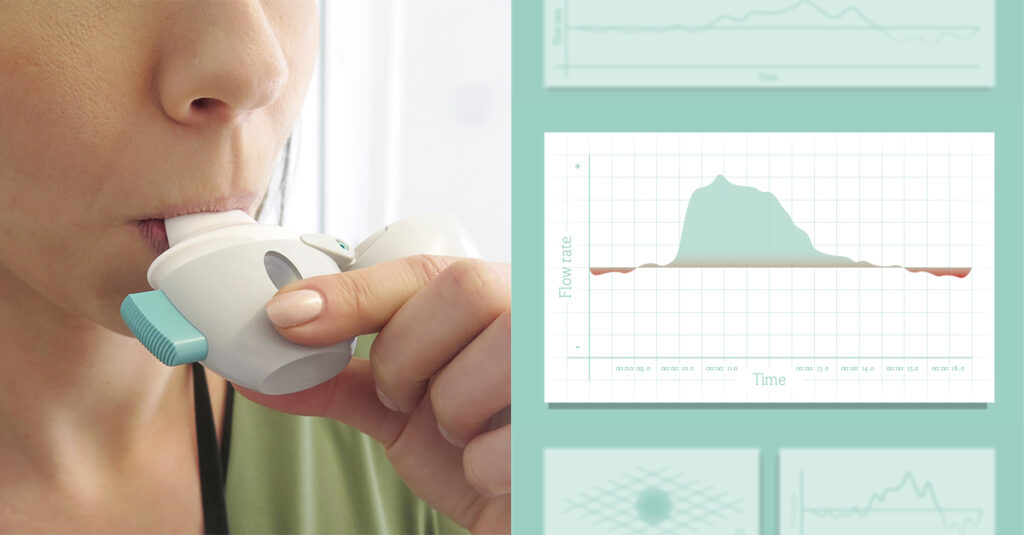
Here at CDP we wanted to go further and challenge ourselves to capture some very specific usage data for inhalation, whilst avoiding the Hawthorne effect and without changing the external form factor, thereby minimising any influence on user behaviour. It is common knowledge that all inhalers have associated use errors, so we took a commercially available one that has documented use errors and inserted miniature sensors that would enable both real-time indication and post-usage remote assessment of those use errors – namely priming action, orientation of use and inhalation/exhalation profile. We enabled the data to be time stamped and communicated to an appropriate output, in this case on-screen graphical readouts.

Behind this is the need to understand the volume of specific use data that gets logged and learn how to translate and classify the events represented as peaks and troughs on a graph. At CDP we have a wealth of experience of doing this across several sectors including sports and packaging systems.

If you’re looking for a breath of fresh air in your next respiratory drug delivery development, get in touch via hello@cambridge-design.co.uk or visit us at the RDD 2018 event in Arizona, 22-26 April on exhibit table 6.