|CDP - Featured in The Times
Share:

Bringing Innovation to Life

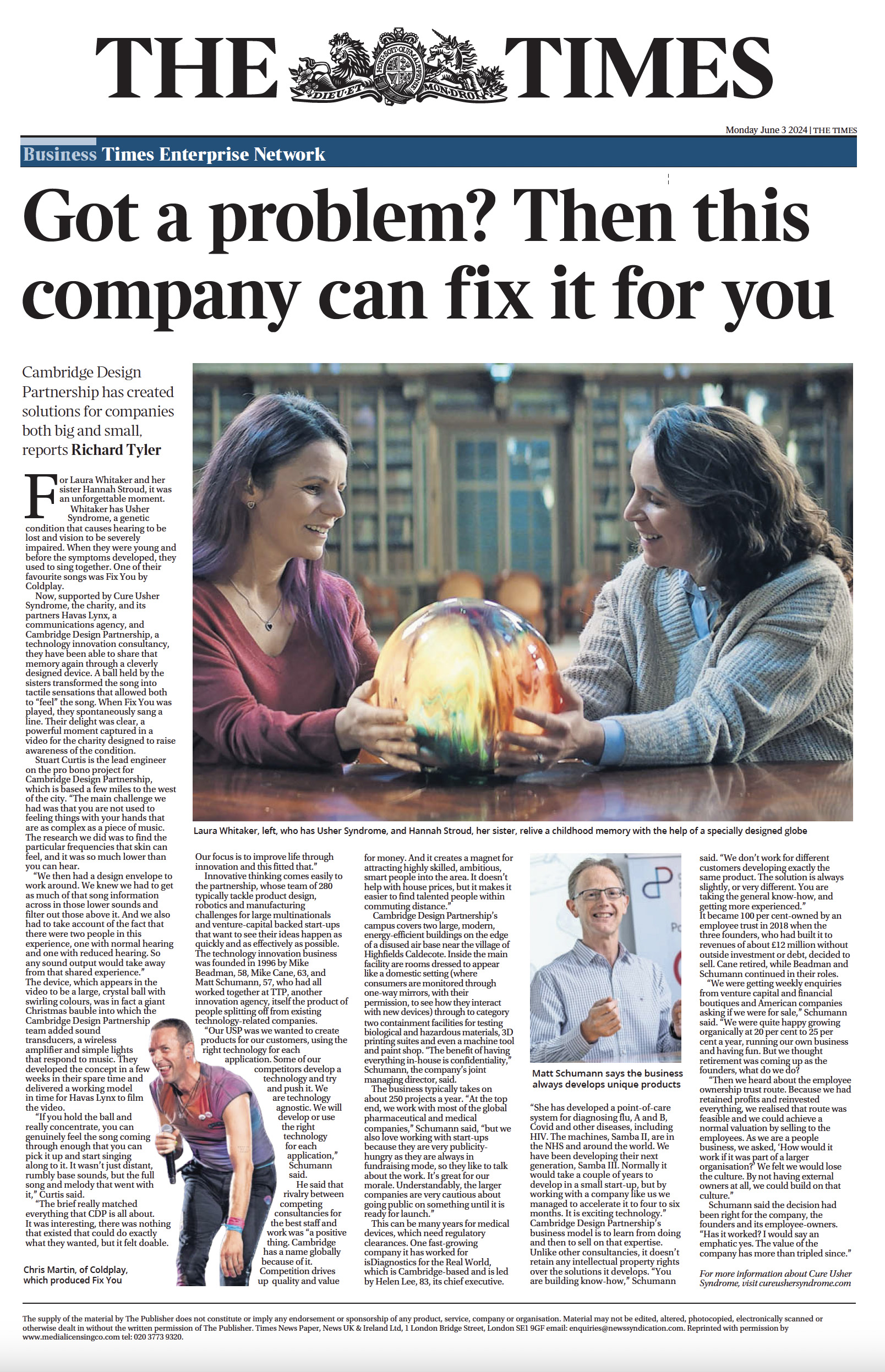
Cambridge Design Partnership was recently featured in The Times with our Co-Founder Matt Schumann and Head of Mechanical Engineering Stuart Curtis discussing how our innovative solutions are helping clients speed up time to market and enhance the lives of those they serve.

CDP - Featured in The Times


LEARN MORE

The World’s First Touchable Memory.

A Device Shining a Light on Usher Syndrome

Learn more about our involvement in the remarkable Usher syndrome awareness campaign.

|CDP - Featured in The Times
Share:

Introducing the World’s First ‘Touchable Memory’: A Device Shining a Light on Usher Syndrome

We are honored to announce our involvement in a remarkable awareness campaign with Cure Usher, Havas Lynx, and Push Films: the world’s first ‘touchable memory’ device.

This awareness campaign seeks to shed light on Usher syndrome, a genetic condition that causes varying degrees of hearing and sight loss from an early age. Despite its significant impact, Usher syndrome remains underrecognized, with a misdiagnosis rate of 40%, underscoring the critical need for heightened awareness and understanding.

Our collaboration on this project perfectly encapsulates our commitment to improving lives through innovation.

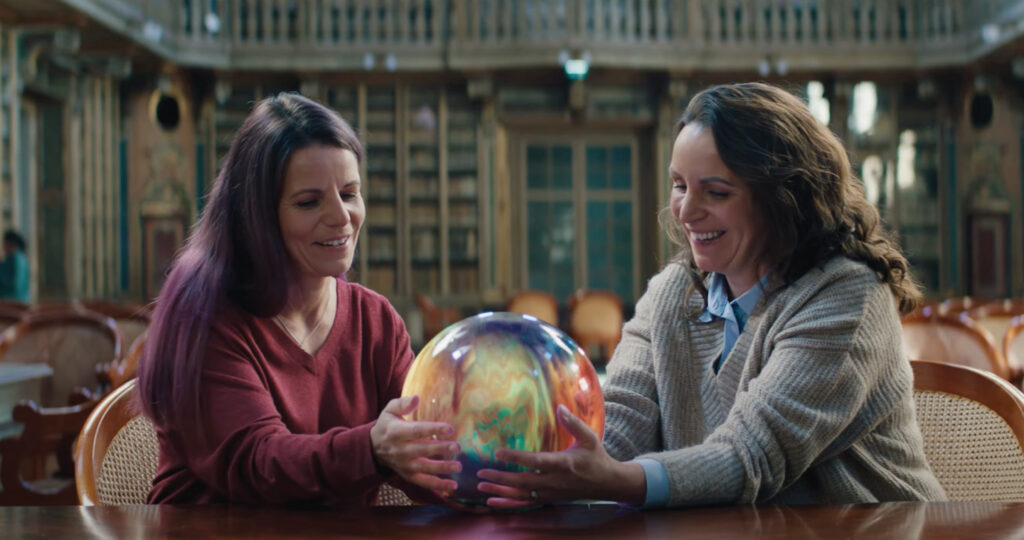
By developing a device to appear in the campaign film that converts sounds into tactile sensations, we enabled the campaign’s real-life sisters – Laura, who has Usher syndrome, and Hannah – to reconnect with a memory in a uniquely inclusive manner.

We invite you to watch the emotional film and explore the press release below.

https://youtu.be/SQXHR3sfoZw?feature=shared


The World’s First Touchable Memory. A Device Created To Raise Awareness About This Impairing Genetic Condition

  • Usher syndrome is a genetic condition that develop in children and young adults causing the loss of hearing and sight in different degrees.
  • Awareness of Usher is low with doctors misdiagnosing 40% of the time leading to uncertainty for families. In the UK around 11,000 people have been diagnosed with Usher, with an estimated 400,000 people worldwide.

Cure Usher Syndrome, a patient-led charity dedicated to raising awareness of Usher Syndrome, has launched its new brand awareness initiative, kicking off with an emotional short film which shows two sisters experiencing the world’s first touchable memory.

Conceived by leading global healthcare communications agency, Havas Lynx, and transformed into a real device by tech-experts, Cambridge Design Partnership, the device transforms stimuli such as sound or music, into tactile sensations. The frequency of these vibrations is adjusted for the hand’s receptors, which research shows can detect almost nothing over 1,000Hz.

The emotional short film features Laura Whitaker, a woman who has lived with Usher syndrome since a young age and her sister Hannah Stroud. It shows the real-life sisters interacting with the ‘Touchable Memory’, which allows them to experience a moment in time the same way despite Laura’s hearing and sight limitations.

In preparation for the film, Laura and Hannah undertook a series of interviews which allowed the Havas Lynx team to collate information to select a memory to hide in the device.

Not only does the device translate sounds into vibrations, but it was also designed with a specific shape, light, and colour for people with limited concentric sight.

Stuart Curtis, Engineer at Cambridge Design Partnership, said: “Results showed that skin receptors on the hands respond best to low-frequency sound and can detect almost nothing over 1,000Hz compared to our hearing which can detect 20,000Hz. With the use of surface transducers, we translated a synthetic baseline from a MIDI track, into a sensorial experience. These frequencies became physical and allowed Laura and Hannah to feel the music rather than hear it.”

Alex Okada, Chief Creative Officer at Havas Lynx, said: “Since this condition is still incurable, we had to be very careful how to raise awareness without spreading fear. The device was a way to grab attention but the emotional connection between the sisters was what made it meaningful.”

Mark Jordon and Laura Norton are Patrons at Cure Usher Syndrome, they have two young children who both have the condition. Talking about the campaign, both said: “We are proud and privileged to be joint patrons of Cure Usher, and to support this charity in raising awareness of Usher syndrome.

“The film is unbelievably powerful, I think it is going to have a huge impact in raising awareness of usher syndrome and what it means to find a cure. The human element of Laura and Hannah’s story is invaluable, and I can’t thank them enough for sharing their memories and the power that their story holds.

“A huge thanks also to Havas Lynx, Cambridge Design Partnership, and Push Films, all bringing the magical elements to make this emotional film.”

Cure Usher Syndrome is working to raise awareness, support families and raise money for vital medical research. It currently has an agreement with University College London (UCL) where donations directly fund research as part of the Institute of Ophthalmology.

You can donate to Cure Usher Syndrome via its website: https://cureushersyndrome.com/donate-support/

For more information contact: robyn.houghton@havas.com

Femography and Cambridge Design Partnership
Share:
Find the authors
on LinkedIn:

Collaborating to improve lives through innovation

Over the last few years, Cambridge Design Partnership (CDP) has developed a strategic partnership with MAS Holdings, South Asia’s largest apparel tech company.

Our most recent collaboration has been with Femography, the FemTech division of MAS Holdings, which started out as a small team with diverse expertise, and has evolved into the FemTech arm of the Company. Femography leverages 35 years of apparel tech expertise and works with some of the world’s biggest brands to create innovative apparel solutions that focus on addressing the unseen and unmet needs of women. These innovative solutions are breaking taboos through their textile technology and mission-led practices. The partnership between CDP and Femography combines ingenuity and cross-disciplinary approaches to rapidly create and expand access to impactful women’s health solutions.

Our partnership with Femography was focused on the identification of white space opportunities within menstruation. This leveraged our combined passion and commitment to innovation within the women’s health space. The outcome resulted in a creative solution pipeline which has extended and elevated Femography’s product pipeline.

In this article, Abby Scheer, an Industrial Designer and FemTech Lead at CDP, reflects on the importance of strategic partnerships with Femography’s Tehani Renganathan and Ginnymarie Mendis, and shares exciting key learnings for successful innovation across the FemTech space.

The role of strategic partnerships in successful FemTech innovation

Strategic partnerships provide multi-faceted value, especially in driving innovation that helps transform lives. The partnership between CDP and Femography includes a shared vision that challenges taboos and pre-existing social norms surrounding the female body and increases the discovery and development of impactful solutions.

“We partnered with companies and consultants who really shared that vision, they were vested in this journey with us – and it is that success that we see the fruit of today.” – Tehani Renganathan, Chief of Strategy, Marketing and New Ventures, Femography

Backed by science and approved by women, Femography designs everyday lifestyle solutions across all phases of the feminine journey – from menarche to menopause and everything in-between. Femography’s solutions are created to help women live confidently in their bodies, but many taboos continue surrounding feminine health and well-being.

“Our efforts aren’t focused on creating just a regular clothing/apparel solution, but to also look at solving unmet and undermet needs of our consumers. We have understood the many pain points they journey through, and we are continuously working towards giving them a passive or active solution that can restore normalcy for them.” — Ginnymarie Mendis, Chief of Consumer and Product Innovation, Femography.

Strategic collaborations with insightful partners increase the breadth and depth of discovery and development of impactful solutions – this is especially important in the FemTech space where research and funding is often lacking. Femography approached CDP for expertise in the consumer health and technology space, and together we met this menstrual health challenge head-on.

Building a successful strategic partnership

Drawing on her firsthand experience, Ginny shared how a successful partnership should have “…mutual trust, respect, and a shared vision and commitment to the journey”. When it comes to innovation, it is also important to have a creative partner who can help bring early ideas and concepts to life as fast as possible. CDP’s innovation, efficiency, and approach were a foundational aspect of the partnership formed between CDP and Femography.

“We wanted to bridge our strengths with your [CDP’s] strengths and come up with even greater solutions and innovations that could really have an incremental impact on our planet” – Ginnymarie Mendis.

Femography also recognizes that strategic partnerships are key to successfully expanding its existing portfolio into everyday periodwear and even period swimwear in a meaningful way. When looking to expand into new customer markets across, for example, US, EU, Australia, and Asia, fine-tuning product categories is key.

The FemTech knowledge, cross-cutting sector expertise, and user-centered design approaches which CDP brings to their strategic partnerships has helped to unlock how existing solutions can meet users’ needs and support the rapid discovery of transformative solutions for growing women’s health issues.

New innovation opportunities in FemTech apparel

Reflecting on our recent collaboration, Tehani highlighted the exciting and anticipated new opportunities which can be created and unlocked due to our partnership.

“The CDP and Femography partnership will help create and unlock access to non-medical alternatives to help women better manage their health. An important objective includes exploring a broad product landscape, creating a pipeline of global solutions mapped to symptoms and other pain points women struggle with.” -Tehani Renganathan.

Equally, Tehani reflected on a fantastic launch that the Femography team is exceptionally proud of. Become, the consumer-facing menopause brand of Femography that was launched in the UK almost 7 years ago, was transformational in helping to get the menopause conversation started. Become frequently partners with other brands and organizations to lead change, providing another great example of the importance of innovation collaborations. This year Femography has expanded the Become footprint to the US market to leverage American women’s vocal conversations on menopause, increase awareness of the topic, and provide a solution to women who need it.

What next?

Much more work is still needed to address the health needs of women in the UK and US, and even more so in many developing and underprivileged communities. The collaboration between CDP and Femography continues to help innovate and expand the reach of unique solutions in women’s health across each sub-sector market. Together, CDP and Femography will strive to collaboratively innovate meaningful products, to help bring greater health, dignity, and confidence to all feminine bodies.

Consumer Healthcare
Share:
Find the authors
on LinkedIn:

Demystifying FemTech innovation: your questions answered

In an exciting first half of 2022, our FemTech team attended and presented at conferences, including the Reproductive Health Innovation Summit in Boston and the Women’s Health Innovation Summit in Basel. We’ve enjoyed fascinating conversations at events like these, covering everything from whether ‘FemTech’ is a useful term to how FemTech can manage the gender data gap. In this article, we share our responses to some of those questions which stood out to us.

Is ‘FemTech’ the right term to use to discuss this space?

Yes – and no. The term ‘FemTech’ has been a valuable tool since Ida Tin coined it in 2016, but it can narrow the field of focus. FemTech gives investors a framework and ‘safe’ vocabulary to discuss women’s health issues – some people find “I’m investing in FemTech” easier to say than “I’m investing in a period tracker.” A Google search on the term shows that it has evolved into a rallying point for like-minded people in the industry to find each other and drive innovation. At CDP, we view FemTech as a design philosophy underpinned by inclusivity, experience-led design, and the smart integration of tech (or intentional absence of tech), which we overlay on wide-ranging areas of innovation.

How important is it that FemTech designs for the planet?

We can look at how FemTech has grown due to an increasing consumer focus on sustainability. Menstrual cups, for example, have been around for a long time but only recently become a mainstream product. In 2018, the global menstrual cups market amounted to an estimated US$1.2 billion – it’s expected to reach US$1.89 billion by 2026. This increase reflects a massive shift in consumer attitude towards prioritizing sustainability over the last few years. But it also shows the success of products that meet user needs. Menstrual cups generally need to be changed less frequently than conventional tampons, so they meet user needs and offer a sustainable alternative. [1] At CDP, our user-centered design approach means we design for people, first understanding what they are trying to achieve, before translating contextual insight into solutions.

How is FemTech managing the gender data gap?

Historically, medical studies have often assumed the male body as the default, ignoring that women have different physiologies and responses to disease. This has resulted in a lack of data focusing on women’s needs, which puts FemTech innovators at a disadvantage. On the other hand, it also presents an opportunity for the industry to create valuable proprietary data which can be shared to further the understanding of women’s health. Take the vastly under-researched area of female sexual pleasure – the first comprehensive anatomical study of the clitoris was only published in 1998. [2] For Goodness Sake is the parent company of OMGYes, an education app focused on female sexual pleasure. In partnership with Indiana University and Kinsey Institute researchers, it researches people’s most intimate and vulnerable experiences. The results are published in peer-reviewed journals and (to quote their literature) “turned into honest and friendly online products” – the best of both worlds.

What are some best practices when it comes to developing FemTech products?

The most important thing is not to treat each stage in the innovation journey as a discrete process but to communicate between disciplines and, critically, with consumers and patients – put them at the heart of the innovation process, and validating the new product or service experience. This will ensure that, for example, manufacturing decisions won’t negatively impact user requirements. Our advice is to apply our FemTech philosophy of inclusivity, user-centered design, and the smart integration of tech to a robust end-to-end innovation process, such as CDP’s Potential Realized. This comprises six steps: opportunity definition, concept creation, concept realization, product realization, manufacturing realization, and life-cycle management.

How should emerging FemTech companies approach regulation?

Many FemTech products sit with one foot in healthcare and the other in consumer. Knowing which category your product falls into is key to avoiding unexpected regulation (our white paper on FemTech regulation has more information on this). Consider regulation early, as compliance is complex and expensive to retro-engineer. Negative PR following a regulatory oversight could be catastrophic for a new company or brand, which might otherwise have been successful. And even if you find your product is exempt from regulation, it’s good practice to take a risk-based approach to design to ensure your product remains safe and enjoyable for its end users.

What have we missed?

As passionate advocates of inclusive design, we’re always happy to talk about FemTech. Please drop us an email if you have any further questions: womenshealth@cambridge-design.com

REFERENCES

  1. Menstrual cups: global market value 2018-2026 | Statista [Internet]. Statista. 2022 [cited 13 June 2022]. Available from: https://www.statista.com/statistics/920669/global-market-value-of-menstrual-cups/
  2. O’Connell H, Hutson J, Anderson C, Plenter R. Anatomical relationship between urethra and clitoris [Internet]. https://www.researchgate.net/. 1998 [cited 13 June 2022]. Available from: https://www.researchgate.net/publication/13684666_Anatomical_relationship_between_urethra_and_clitoris


Mastering fluid flow to enhance user experience|
Share:

Mastering fluid flow to enhance user experience

Ice cream and blood are two things you probably don’t want to think about simultaneously. But both are full of organic proteins and fats and behave differently from a fluid like water when they’re pumped through tubes. Innovators sometimes think about these similarities when creating, for example, a novel ice cream dispenser or device that filters out platelets from donor blood .

How a substance flows is a vitally important consideration for many products, from foods to skincare to medical devices to household paints. Development teams need to keep in mind a wide range of flow behaviors (for example, flow through nozzles, non-Newtonian flow, and foaming) to hit the sweet spot: a positive user experience that makes a product stand out in a crowded market. This means thinking about the science of how liquids and gases behave (fluid dynamics), as well as how the product responds to user interaction.

Look at how the squeezable plastic ketchup bottle differs from the glass bottles that were standard before 1983. The new design completely changed the user experience – no more digging down into the bottle with a knife to get the ketchup flowing again. Things became even easier for ketchup lovers with the debut of the upside-down squeezable bottle – no more awkwardly storing ‘regular’ bottles upside down in the fridge.

Or think about how the experience of washing your hands changed after the arrival of the liquid soap dispenser. Instead of having to share the same bar of soap with others, people can now wash “without the soapy mess”, as Robert R Taylor, who introduced SoftSoap liquid soap, put it, and can take only as much soap as they need.

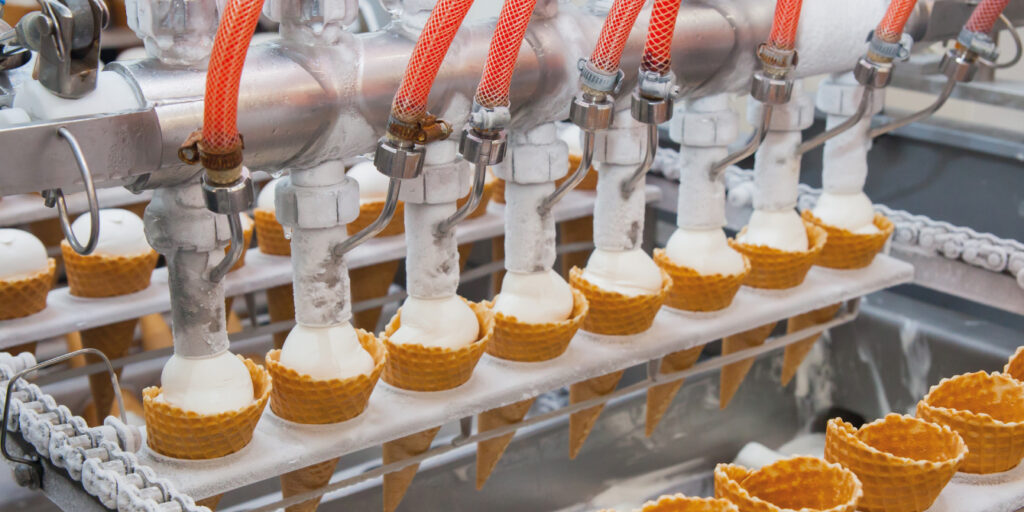
While the flow of some liquids is analogous to water, whose behavior is well understood, other substances behave in much more complicated ways, requiring in-depth analysis work to understand when designing new products. For example, the air bubbles in ice cream make it behave as a liquid foam. Ice cream’s flow will change depending on how you’re dispensing it: Push it at high pressure through a narrow channel or nozzle, and the air bubbles will be compressed, allowing more ice cream to flow through the nozzle at once. When the ice cream is returned to normal pressure, the air bubbles re-expand, and the ice cream returns to its original size. Because of this complex and variable behavior, designing a product to dispense ice cream relies on hands-on experiments… which can mean going through gallons of ice cream before you can create a design that works as intended. Only by conducting these experiments to understand ice cream’s behavior can you build the mathematical model required to effectively develop a high-performance machine.

While it’s a shame to use gallons of ice cream in the quest for a better product, it’s not an environmental disaster. But shipping water-based products around the world does contribute to fossil fuel consumption and climate change. Removing water from laundry detergent helps cut shipping emissions by reducing bulk and making shipping more efficient. But it also dramatically changes how detergent flows and gets used by consumers. For example, measuring out 10 ml more detergent than recommended likely wouldn’t have an impact if you’re using a product that’s mostly water. But being off by 10 ml when detergent is concentrated could make a big difference for your laundry. So, it’s vital to ensure that dispensing is accurate, which requires an understanding of flow.

There are so many flow behaviors that can affect a product’s design. For example, should a container for insecticide include a mechanism to avoid skin contact and spillage? How could a medical device for freezing tumors be redesigned to eliminate vapor locks without the use of heavy and bulky high-pressure gas cylinders? Is there a way to dispense foaming hand soap in a decorative pattern for a premium experience?

Getting the design right for a flowing substance can differentiate between a product that fails and one that creates an experience that shifts category norms and delivers breakthrough consumer delight.


References

FemTech : #2 Experience-led design
Share:

The three pillars of FemTech success: #2 Experience-led design

In the first of a series of articles covering the three pillars of our FemTech philosophy, we discussed inclusivity. Here, we move on to experience-led design, before ending with the smart use of technology.

Product innovation is shifting focus – from making things to designing seamless experiences. An experience-led design process leads to simple, intuitive, and enjoyable solutions, increasing customer satisfaction and retention.

How a user feels when using a product or service is becoming as important (if not more so) than the solution itself. More than ever, themes such as brand ethical position, purpose, and sustainability credentials are influencing where consumers place their cash and their loyalties. To address this, FemTech innovators must do three things:  

  • Understand external influences
  • Focus on the end-to-end user experience
  • Leverage multi-disciplinary perspectives

Understand external influences

Understanding what drives change in the consumer and healthcare space is vital. The challenge for FemTech innovators is to understand how these factors will affect user expectations and behavior.

Take environmental factors: ‘flushability’ has long been a selling point for hygiene products, such as wipes and sanitaryware. However, some manufacturers have drawn historical criticism for stretching the technical definition of flushable to what may be sent on its way with the press of a lever. ‘Solubility’ is a more meaningful definition in the context of the environment and related consumer aspirations. These criteria are determined by industry standards such as Water Industry Specification (WIS) 4-02-06, ‘Fine to Flush’, and other standards with similar objectives across different international legislative jurisdictions.

Sanitary disposal bag firm Fab Little Bags is banking on consumer sentiment changing amid increasing awareness of water pollution. By providing a way to dispose of a tampon in a way that aligns with changing environmental beliefs – binning is better than flushing – it removes eco-guilt and improves the end-user experience.

Regulation is another factor that could affect user experience. If users know that a product, such as a fertility monitor, has been medically approved, they may feel more confident when entrusting it with a potentially life-changing task.

Focus on the end-to-end user experience

User experience isn’t limited to using a product or service but encompasses the whole consumer journey, including product research, purchase, delivery, unboxing, and after-life.

Consumers have ‘Moments of Truth’ during this journey – key points when they form an impression of a brand – and emotional and social drivers can have equal, if not overriding influence, over functional ones. The Zero Moment of Truth occurs during pre-purchase research. The intimate wellbeing e-commerce platform, Bloomi, which screens every product against a checklist of banned ingredients to ensure they meet its clean standards, recognizes the importance of this stage. The attention to the customer experience is continued with the promise of delivery in discreet packaging. Bloomi has designed a customer experience free of anxiety about harmful ingredients and privacy by considering elements of the user journey beyond use.

Leverage multi-disciplinary perspectives

User experience isn’t the remit of front-end innovation alone. Harnessing a multi-disciplinary team allows for a wealth of experience, perceptions, and viewpoints to be incorporated into the end-to-end design process. For example, our designers and engineers accompanied our research team to hear first-hand the frustrations women have when undertaking a breast cancer biopsy. This ensured that we could design an accurate medical tool and an empathetic user experience.

Certain environments, such as innovation sprint programs and start-up incubators, foster multi-disciplinary design. FemTech Labs, the first FemTech accelerator in Europe, is one example. It brings together experts, investors, and business coaches to kickstart FemTech businesses. The FemTech Lab accelerator program is short and intense, supplying opportunities for participants to grow quickly and sustainably by drawing on the expertise of its comprehensive interdisciplinary network.

As we’ve seen from the above examples, many FemTech companies are already prioritizing experience-led design as part of their development process. One of the mentioned case studies, Fab Little Bags, doesn’t ostensibly have any tech in it, which brings us to our upcoming article: the smart use of technology.

To continue the conversation, get in touch: womenshealth@cambridge-design.com


References

||
Share:

The three pillars of FemTech success: #1 Inclusivity

Welcome to the first in a series of articles outlining the three pillars of our FemTech philosophy: inclusion, experience-led design, and the smart integration of technology. Here, we start with inclusion, a crucial topic for success in innovation.  

While there are initiatives to ensure gender diversity in the boardroom, there’s rarely the same in product development. This need for equilibrium has historically often been overlooked in market research and product testing, resulting in design that misses a proportion of end-users. For example, it wasn’t until 2011 that female crash test dummies were introduced in the US.

There are three steps to achieving inclusivity in end-to-end innovation:

  • Understand the problem 
  • Understand the context
  • Understand the ecosystem

Understand the problem

We use an Insights for Innovation approach underpinned by the ‘jobs to be done’ perspective. This focuses on understanding a task or ‘job’ independently of any existing solutions used to achieve it. This means we start with the problem rather than the solution. For example, our starting question is: ‘What needs might a couple have when trying for a baby?’ (the jobs), rather than ‘How can we design a biometrics tracker to gauge fertility?’ (a solution).

This solution-agnostic approach involves defining a ‘job’ in terms of the user’s functional, emotional, and social needs, for example:

  • ­The functional need to ‘know when I’m ovulating’
  • ­The emotional need to ‘feel like conception is a natural process’

An excellent example of a solution that has fulfilled these needs is Inne. This fertility monitoring system uses saliva to detect ovulation. Saliva analysis can help women increase the chance of falling pregnant (functional need) by identifying the fertile window each month. It offers clear feedback to reduce anxiety around the results (emotional need) and comes in a discreet format, allowing women to keep their fertility journey private, if they wish to.

Understand the context

FemTech teams must take research beyond quantitative surveys to truly have a clear idea of a woman’s needs. This requires in-depth qualitative interviews to understand women as part of a contextual system. This recognizes that women don’t buy a product because of who they are; no two women are the same; the same person can have different needs in different contexts.

We believe the team behind the breastmilk expresser Elvie Pump took this approach by considering the context of when it would be used, for example, while running after a child or in the workplace. This revealed needs far beyond extracting milk.

Historically, breast pumps have been cumbersome and noisy, with long tubes that significantly restrict movement. On the other hand, Elvie Pump’s design is hands-free, silent, cordless, and easy to clean. By addressing context, the design became a market leader in the US and UK.

Understand the ecosystem

Understanding the ‘job to be done’ as part of an ecosystem helps multi-disciplinary teams consider the experience of other key stakeholders.

Take the example of contraception; a heterosexual couple might have the same emotional need to ‘feel like contraception is natural’. However, to one, it could mean hormone-free cream; to the other, it might mean no physical intervention at all (for example, relying on a fertility monitor). Addressing the need from different perspectives ensures the solution is meaningful, intuitive, and enjoyable for everyone it impacts.

The Maven Clinic is a telehealth platform that offers fertility, pregnancy, postpartum, and family care services. It caters to what would largely be considered female needs. However, 30% of its members are men. Founder Kate Ryder is careful not to exclude them when she talks about the platform. Rather than referring to Maven Clinic as FemTech, she defines her mission in terms of “people” to ensure that all members feel included.

As these examples show, inclusivity is an essential ingredient of FemTech success. The following articles in our series will cover why experience-led design and the smart integration of technology are equally important.

To continue the conversation, get in touch: womenshealth@cambridge-design.com


References

Incisive action: Cutting the carbon footprint in surgery|
Share:
Find the authors
on LinkedIn:

Incisive action: Cutting the carbon footprint in surgery

Hear us out: the pandemic has stretched world health services to their limits, but it may also be paving the way toward a greener future for healthcare.

When thinking of healthcare today, you probably picture the huge pressures on overworked healthcare staff and the scramble for hospital beds. What you may not have thought about is that hospitals in many countries have adopted innovation that inadvertently introduced ‘greener’ treatment. For example, the need to perform ‘virtual’ consultations has reduced patient travel to and from practices. In April 2020; within weeks of COVID-19 hitting the UK, 71% of all GP visits were remote, compared to 25% in April 2019.

A single operation can have the same carbon footprint as driving 2,273 miles in an average sized gas-powered car.

Before COVID-19, the UK’s National Health Service (NHS) produced 27 million tons of CO2 equivalent annually, which accounted for 5% of all UK carbon emissions. To combat this, in October 2020 the UK government announced plans for a greener NHS: net zero carbon emissions directly from the NHS by 2040, and its supply chain by 2045.

In the context of COVID-19, this is an ambitious goal even if we were able to sustain the kind of CO2 emission drops witnessed during lockdowns. The forced shutdown of elective surgery may have reduced hospital carbon footprints, but this has been at the expense of patient care and can’t continue. Further ahead, the NHS will be caring for an increasingly ageing population, putting demands on provisions which will lead to increasing energy and resource consumption.

Join us to address some of the greatest environmental challenges of our era

We’re currently recruiting for a Sustainable Design Consultant, Life Cycle Assessment Engineer and a Head of Sustainability.

The operating theater has extensive electricity needs, powering equipment, heating, ventilation, and air conditioning, and is three to six times more energy-intensive than the rest of the hospital. This electricity reliance coupled with anesthetic gas and the need for single-use equipment has a significant carbon footprint. Chantelle Rizan, a Fellow of the Centre for Sustainable Healthcare and currently undertaking a PhD to identify carbon hotspots in surgery, found that a single operation can have the same carbon footprint as driving 2,273 miles in an average sized gas-powered car.

So, aside from upgrading hospital buildings and moving to renewable energy supplies, the UK government must explore ways to make surgical practice more sustainable in order to hit the NHS net zero targets. This won’t be easy.

Virtual clinics have helped with triage (deciding severity and service allocation) and surgical follow-ups, but it’s difficult to plan surgery without examining the patients face-to-face. Any changes must avoid extra red tape and be economically viable for healthcare services. Advances may have trade-offs between short-term losses (retraining) and long-term gains (reducing hospital stays or complications). Most importantly of all, sterility must be maintained at all costs. Here’s a new mantra to repeat: green only if clean.

We’ve recently been exploring the challenges facing surgical providers in embracing sustainable change. In our ‘Circularity in Context’ article we considered circularity filters to ensure future products and services become carbon neutral. This philosophy of circularity, maintaining the value invested in materials and products, has applications in healthcare but may also come into conflict with other imperatives, such as sterility.

Before joining CDP I spent time working closely with orthopedic surgeons, observing procedures in the operating theater first hand, showing me where improvements could be found. Innovating in the surgical space is a complex and nuanced area, where first-hand knowledge of the sector is key. Surrounded by a team of engineers, designers, researchers, and healthcare-savvy innovators at CDP, we’ve applied the filters for circularity to identify areas in which circular approaches could provide significant advantages.

Short-term wins

There are many ways to reduce the cradle-to-grave carbon impact of surgical equipment, while engaging clinicians and being financially attractive to health service procurement. Layer upon layer of plastics and non-renewables are used in sterile packaging for implantable devices. If we can’t fully move away from these packaging conventions because of safety and transportation requirements, can we source materials from low-emission supply chains and use local production and assembly for more efficient, less carbon intensive shipping and distribution?

Delivering care with convenience and guaranteed sterility has tended to result in single-use equipment, but we are seeing signs of returning to reusable equipment which is reprocessed between uses. Reprocessing patient drapes, laparotomy pads and intravascular catheters are being used to reduce waste so long as sterility and accuracy can be maintained and improved cleaning cycles reduce energy and water usage. Reprocessing of instruments has been driven more by cost concerns rather than sustainability, but this hints at the potential economic benefits of reprocessing beyond complex instruments. This could be further bolstered if the hospital can receive reimbursement for reprocessing an instrument instead of purchasing a new one.

There will always be cases where single-use equipment is a necessity for sterility or convenience, or where a Life Cycle Analysis shows this to be the most environmentally friendly approach. We can still streamline these sets so that rarely used kit is not disposed of even when it hasn’t been used, as is often the case once a set is opened in theater.

Long-term innovation

Given the need to develop better treatments and the burden of evidence needed to establish safety and efficacy for devices and systems, the healthcare industry can perhaps be forgiven for not having led in the sustainability space. Healthcare requirements are a barrier, as materials must be well understood and de-risked for a specific healthcare scenario before they can be used, but this should not stunt long-term innovation.

One way that future technology could reduce surgical waste is by harnessing fluid-resistant materials, improving the efficacy and safety of personal protective equipment. Going further, incineration techniques could be completely transformed by advances in energy recovery processes: being able to create large amounts of heat or electricity to feed back to the hospitals efficiently and at a larger scale than currently performed.

An emerging technology that promises radical change in surgical training is extended reality – simulating virtual environments or even overlaying them with real environments to enhance the experience. Extended reality expands access to expert training while streamlining the associated hospital footfall and travel. Virtual reality headsets are allowing trainees to view, practice, and learn surgical procedures, reducing the hours needed to be spent in surgical theaters.

The advent of very low latency wireless technologies, including 5G, could allow us to push virtual care even further. Even when surgeons are in a different country and time zone to the patient altogether, mixed reality could allow expert surgeons to offer real-time assistance and robotically assisted surgery systems could enable entirely remote surgery. This reduces travel but more excitingly it widens the opportunity for patients to receive specialist care wherever they live.

Societal filters: rapid recovery and reduced complications

There’s a risk we limit our understanding of surgical carbon footprint to manufacturing, electricity usage, and disposal. But we must consider the trickier question: how can we reduce the burden of the patient on the healthcare system through improved outcomes and reduced complications? One study found that anti-reflux surgery on the NHS could, despite having a high initial financial and carbon cost, be more carbon-efficient than ongoing medical treatment by the 9th post-operative year (and cost-efficient by the 14th year).

One tool in the arsenal is less invasive procedures. These require more specialized training and increase procedure complexity, particularly during early adoption, but they can drastically reduce patient recovery times and pressure on hospital beds. Less invasive procedures can also reduce the number of rehabilitation trips required for physiotherapy and occupational therapy.

Innovations that reduce follow-ups should be pursued and anything that reduces post-surgical complications or provides more durable treatment is likely to drive better overall sustainability. For example, improving surgical wound closure systems could help reduce infection rates, one of the leading causes of hospital readmission following surgery (3% of patients die as a consequence). The medical device industry can also deploy digital health tools to improve medication compliance, to introduce disease prevention strategies and to stimulate rehabilitation, all of which will lead to better outcomes from surgery and minimize unnecessary procedures, in turn reducing the carbon footprint.

At the heart of innovation is the need to understand the user. Following my experiences with surgical professionals in the operating theater, it’s great to be part of an innovation team at CDP that actively pursues “green” solutions while being respectful of the vital work that surgeons do.

Engineering sensory experiences|Ben Strutt|Martha
Share:
Find the authors
on LinkedIn:

Engineering sensory experiences

Humans are multi-sensory organisms! We navigate the world around us through five senses all working in parallel, deriving not only practical information about our surroundings, but also emotional and social meaning.  In milliseconds we unconsciously make decisions that keep us alive, shape our day, define our preferences and ultimately drive our choices.

As we are exposed to new sensory experiences, we develop deep seated cognitive constructs that in turn further influence our decision-making – perhaps the illusive sixth sense!

Our perceptions of flavour and fragrance in our food and drink is one of the most hard-wired responses.  Initially designed to help the human species survive and reproduce by finding things safe to consume, after the more recent industrialisation of food it has become an opportunity to engineer the parameters that influence preference, liking and consumption.

Today an entire industry has grown up around flavours and fragrances; sensory sciences came of age as a discipline to help objectively understand, parameterise, and engineer the specific attributes that impact on our choices. Sensory Panels, expert groups of individuals, carefully trained to objectively parameterise different formulations are core to the development of new product specifications; from defining our favourite toothpaste mouth tingle, to building corporate confidence in the transition to a sugar substitute in a $bn snack brand (our team have worked on both!), it is likely that a sensory expert will have been involved along the way!

But is this, in many ways standardised approach, limiting us? Are opportunities being missed to leverage this scientific rigour and usefully blend it with subjective consumer perception? How should sensory science engage with global trends, omni-channel product experiences, the circular economy, declining brand loyalty and steady growth of e-commerce?

At CDP we are working in a number of ways (two of which we’ve outlined below) to make product specifications more commercially effective, and more sensorially affective, and we had the chance to display some of our work at the Pangborn Sensory Science Symposium last year.

1. Look beyond flavour, fragrance and mouth-feel!

Online grocery shopping is growing rapidly, and yet the physical pack interaction experience has always been central to in-store decision-making.  While traditional sensory sciences often bias us towards flavour and fragrance, the old proverb reminds us that the first bite is with the eye, and CDP’s team believe that other senses can be leveraged through intelligent packaging design to amplify under-utilised sensory cues.  Our Front End Innovation team have developed a methodology to effectively translate formulation attributes into packaging parameters to help reinforce the anticipation of consumption at the first moment of truth. We have worked closely with the makers of some of the most famous mayonnaise and spreads brands in the world to, for example, elicit, create and reinforce positive haptic cues in the jar lid, giving confidence in the seal and re-seal experience, and to premiumize the acoustic signature of the thin-walled pack-lid on repeat opening. Even the maker of dry, powdered soups and bouillons was able to leverage packaging parameters that positioned the product closer to more desirable attributes of naturalness and freshness. Our team includes scientists and engineers, which means we can provide a rigorous quantitative technical specification for that enhanced, consumer-validated pack experience!

2. Involve the consumer!

Involve them precisely because they are not trained panellists; involve them in Sprints, and co-creation and in-home sensory research, as well as more traditional central location or lab testing! It can be extremely illuminating to involve consumers in exploratory formative research, rather than just for validation of what a sensory panel have advised or specified. Involving them early on can lead to serendipitous moments where new connections are made – leading to new value propositions, and opportunities for brand extension. It can also lead to surprising revelations that highlight some limitations of objective sensory science methods, when a consumer responds to small, almost imperceptible changes to a pack design in an unexpected way.

In many industries, the manufacturing and regulatory lead times and consumer loyalties associated with changing formulations can be far more restrictive than changing pack design; our work has demonstrated time and again that we can influence consumer perception of key formulation attributes such as efficacy, healthiness, freshness, and strength, even prior to first use, by making changes solely to the packaging look, feel, and sound.

New products and experiences are coming onstream all the time, and for some of these a sensory panel base line or ‘normal’ specification does not yet exist; we have recently been working on an entirely new category of product which demanded a new sensory protocol to be created, and which at the heart of it considered how the device and formulation had to work in harmony to create the consumption experience. We were excited to pioneer a collaboration between our team and affective methodologies, with those of a more traditional flavours and fragrance partner, and the result is an optimised, category transforming product-formulation experience.

As a sensory industry, we need to re-imagine the relationship between the formulation and the devices or packaging containing and dispensing it; it is a closer and more mutually symbiotic relationship than past practice gives credit to. Through this insight we have more opportunity than ever before to positively engineer a multi-sensorial consumer experience that truly delights.

The 2016 National Health Interview Survey
Share:
Find the authors
on LinkedIn:

Combining treatments to better manage pain

The 2016 National Health Interview Survey of 17,000 Americans reports that 1 in 5 people suffer chronic pain1. Significant effort and money are being invested by companies ranging from large Pharma to small Tech start-ups to address this “pain epidemic” as evidenced in the clinicaltrials.gov database showing over 2,500 “pain” trials which are actively recruiting. Some of the more interesting studies are looking at the benefits of combining pharmacological and non-pharmacological approaches to pain management, reflecting a growing recognition within the medical community that a multi-modal approach can often offer a range of significant patient benefits.

While the body of clinical evidence supporting a multimodal approach grows, we have to recognise that many people who suffer from pain already mix-and-match different therapies to meet their individual needs. Moreover, they are talking about their experiences and treatments, sharing advice and influencing each other through the many on-line blogs and forums dedicated to chronic pain. After spending a few hours surfing through these resources it’s clear that a large proportion of sufferers still have unmet pain needs and they are unafraid to try different, often non-pharmacologic, solutions in addition to their medications. These non-pharmacological treatments are varied and can include Transcutaneous Electrical Nerve Stimulation (TENS), Movement Therapy, Massage Therapy, Virtual Reality Assisted Distraction, Mindfulness and Suggestion Techniques, Cognitive Behavioural Therapy, and Acupuncture.

In fact, the most powerful insight is that people don’t expect there to be a single product or treatment which will address everyone’s pain (though that would be nice). Instead, they are looking for a range of options that are tailored for their specific needs which include social and emotional elements, not just functional pain reduction. For example, time, money, ease of use, on-demand access, drug-free, stigma-free, and building pain treatment into their health and wellness routines are all important elements that pain sufferers are looking to address.

This leads to an interesting question we should ask ourselves… “how can the medical community and companies help each pain sufferer along their treatment journey to identify the right combination of pain treatments that meet their specific set of needs – and adjust depending on changes in their circumstances?”

The answer probably lies at the intersection of current Consumer and Healthcare trends. People are wanting to take more responsibility and control of their Health and Wellness status and are prepared to use technology to achieve this goal.

The scientists at Cambridge Design Partnership have deep consumer experience in this sector as well as proven technical capabilities to:

  • monitor people and their behaviours with wearable technology and instrumented devices,
  • capture and analyse this data to create useful insights,
  • use machine learning to draw out further insights and make recommendations and
  • implement complementary techniques like Biofeedback, to reinforce therapies.

This toolkit enables us to create new and exciting products and services to better help pain sufferers optimise their individual treatment regimens – what to use and when to use it. Remember, pain sufferers are already experimenting to find the best multimodal regime for themselves – we can help them take the next step.

For more information about our capabilities in Consumer Healthcare, please contact Graham Myatt at hello@cambridge-design.com

1. James Dahlhamer et al, “Prevalence of Chronic Pain and High-Impact Chronic Pain Among Adults
United States, 2016”, Weekly / September 14, 2018 / 7(36);1001–1006.