We apply our deep expertise in science, engineering, design, and strategy across a range of industry sectors, working with organisations in complex, regulated, and fast-moving markets, whilst tailoring our product development approach to sector-specific challenges, regulations, and user needs. Supporting innovation from discovery through to commercial launch.
CDP delivers product development services powered by deep expertise in science, engineering, design, and strategy. We help clients solve complex challenges, accelerate innovation, and bring products to market through integrated capabilities spanning early discovery to commercial launch.
Why so few smokers have transitioned to Reduced Risk Products (and what the industry can do about it)
This article summarises our recent analysis of why so few smokers have transitioned to reduced-risk products (RRPs). More importantly, it moves beyond diagnosis to set out a clear strategic roadmap for what must now change if RRPs are to become a credible alternative rather than a solution that has yet to live up to expectations.
Where Are We Today?
Market Reality
Despite over a decade of innovation and major investment, global RRP (heated tobacco, vapes, and nicotine pouches) adoption remains low (c. 2.5% of 1.3B smokers). Most smokers continue to favor cigarettes.
Even in mature markets (e.g., Japan, Italy), sole use of RRPs rarely exceeds 15% – well below expectations. Dual-use (RRP + combustible) dominates, further diluting harm-reduction objectives.
Governments are increasingly sceptical of RRPs due to youth uptake concerns. Disposable vapes face bans; nicotine pouches and e-liquids are under intense scrutiny.
Despite resilient industry share prices, investors are increasingly demanding proof of value and scalability for RRPs, not just good intentions.
Cigarettes offer clear barriers to entry (brands, supply chains, regulation). RRPs lack comparable moats, leaving Big Tobacco exposed to nimble competitors and margin erosion.
Root Problem
There remains a fundamental misunderstanding of smoker psychology: RRPs aim to reduce harm, but fail to replicate the emotional, sensory, and ritualistic satisfaction of smoking and its convenience.
Most smokers don’t want a new product – they want their existing experience made safer (and more socially acceptable).
Device-centric solutions miss the emotional core of smoking, disrupt familiar rituals, and add friction via charging, cleaning, and unintuitive tech interfaces.
More recently, innovation has focused on fixing RRP friction rather than delivering a superior smoking alternative.
Systemic Missteps
Device-centric innovation ceded control to Chinese OEMs and fractured the consumer understanding of inhalable categories (heated tobacco, vapes).
An IP arms race between Big Tobacco players limited consumer choice and reduced overall appeal of RRPs.
Industry underestimated the impact illicit products and poorly enforced trading standards would have on regulatory sentiment.
So, What Can The Industry Do About It?
The first order of business is to develop a new ‘Strategic Roadmap’.
Big Tobacco needs to reclaim RRP product leadership by returning to what the industry knows best: FMCG agility, consumer insight, and emotionally resonant brands.
Firstly this means thinking less like Samsung and more like Starbucks: going back to focusing on creating emotionally satisfying alternatives in key smoking ‘moments’, not one-size-fits-all functionally safer gadgets.
Secondly this means remembering that smokers crave familiarity in terms of ‘taste’, satisfying nicotine delivery, hand-to-mouth gestures, and ritual. Big Tobacco should concentrate on replicating ‘the cigarette experience’, not reinventing it.
Thirdly, Big Tobacco needs to grasp the nettle and decide whether it’s going to leverage the trust and value of established tobacco brands to make RRPs more relevant or try and create new brands from scratch that are unlikely to have any meaning to smokers.
The next thing Big Tobacco should do is get very clear on the key technical & development JTBDs.
The first is that to innovate a superior inhalable product that delivers FMC-like nicotine, ‘taste’, and delivery profile, new technologies are required that overcome the fundamental issues of heated product physics (thermodynamics / thermokinetics) and heater control. This can be done.
The second is how to make suitable consumables at the scale, speed, and cost required – ideally with enhanced ESG. Again, this is not rocket science.
The third is to work out how to deliver the whole experience in a product that is familiar and reassuring to smokers. This means designing intuitive, non-device-centric RRPs that fit seamlessly into a smoker’s life, mimic the rituals they value, and offer meaningful, low-friction, FMCG-like accessibility.
This is not just about traditional ‘look and feel’ considerations but also, crucially, which additional design elements (product semiotics and brand cues) are required to deliver a truly appealing consumer offer that can serve as a genuine alternative to cigarettes.
To achieve a step change in the rate and overall number of smokers transitioning to RRPs requires truly disruptive ideas that are also brilliantly executed and presented.
And Finally
Big Tobacco needs to get on with it! The window to regain RRP leadership is closing. Big Tobacco is losing the RRP argument with regulators. Additionally, Chinese OEMs are poised to take over. For industry examples outside tobacco, look at Green Technology, BEVs, Rare Earths, and AI.
In the increasingly fast-moving RRP categories sector, hesitation is a liability. If you are a senior leader serious about maintaining or regaining your competitive edge and avoiding costly regulatory missteps, you must act quickly.
Let’s schedule a high-priority discussion to ensure your next move is your best move.
Receive further news from our THR team at CDP
TOBACCO HARM REDUCTION
Helping people make better choices with safer nicotine products
After more than a decade of heated tobacco product (HTP) innovation, a hard truth remains: the industry still hasn’t created a product that most smokers want to switch to. While the latest systems are technically impressive, they fail to address the most fundamental need of adult smokers: a safer product that replicates the experience of the one they’re used to.
Despite billions in investment and notable successes such as IQOS, adoption remains limited. Why? Because the tobacco industry is solving for compliance, not experience. It’s focused on technology and regulation, while largely ignoring the sensorial, emotional, and habitual drivers behind smoking. The result: over-engineered products that don’t deliver the simplicity, satisfaction, or ritual that smokers still crave.
A History of Missed Opportunities
Heated tobacco products have evolved significantly from early products like RJ Reynolds’ Premier and Eclipse in the late 1980s and early 1990s, which failed due to a number of issues, including poor sensorial delivery. PMI’s later device-based products, Accord and Heatbar, were technological advances but still fell short on user experience.
The real commercial breakthrough came with IQOS around 2015. PMI reports approximately 34 million global users1 as of mid-2025, with around 10 million in Japan, where HTPs are now used by nearly 48% of smokers. South Korea has also seen substantial uptake, growing from 2.2% in 2017 to 18.4% in 20242. Meanwhile, the UK market remains smaller and less transparent, and in the US, IQOS only recently resumed rollout, targeting a 10% market share by 2030. But let’s not forget, in the grand scheme, that 34 million is only approximately 2.5% of the global smoking population of 1.2 billion.
Moreover, most IQOS users remain dual users. A 2025 feature by BBC Future highlighted the challenge3. even among those who adopt HTPs, many continue to smoke. So, although HTPs are indeed commercially successful in some regions, the category is still far from delivering on its full public health promise.
Designing for Smokers, Not Regulation
Ask smokers what they want, and they’ll say the same thing they’ve said for 40 years: ‘a safe cigarette’. Not a vape. Not a gadget. Not a complicated ecosystem. They want familiarity, not friction.
Every deviation from that, every step that adds complexity or reduces satisfaction, creates a barrier to switching. And while regulators may reward harm reduction, smokers care only about the experience. Until the industry designs for that, it will continue to miss the mark.
By Cambridge Design Partnership
May 29th 2025
Why Have So Few Smokers Transitioned to Reduced Risk Products?
The Paradox of Progress
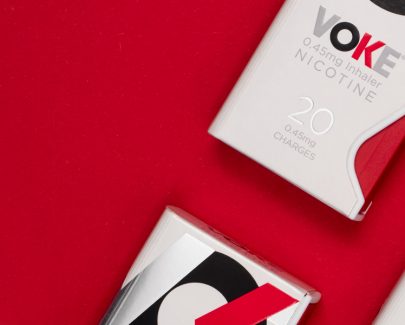
It’s been over a decade since the new generation of tobacco and nicotine Reduced Risk Products (RRPs) hit the market as part of a rethought ‘harm reduction’ approach. These include everything from sleek tobacco heating products (THPs) like IQOS and Glo, to the myriad of e-vapour devices (vapes) offered by the likes of Vuse and Juul, and the modern oral nicotine formats (pouches) from brands that include Zyn and Nordic Spirit. And yet, despite being billed as the answer to the ‘smoking problem’, global adoption is disappointingly low.
PMI proudly states they’ve converted over 30 million smokers to IQOS, and that is a very significant achievement, but in the grand scheme, that’s approximately 0.25% of the global smoking population of 1.2 billion. Even if you look at key developed markets like Italy and Japan, where IQOS is dominant, it’s still less than 15%* of smokers, on average. And it’s a similar story for vaping and nicotine pouches.
*It’s difficult to provide accurate figures because manufacturers’ estimates and those provided by independent research differ significantly. Moreover, it’s clear from both sources that the majority of IQOS users still smoke (‘dual use’). Consequently, we are using an average from both for smokers who only use IQOS (‘solus use’).
Why This Question Matters Right Now
Whilst Big Tobacco companies say they are happy with the progress they have made so far towards a future beyond combustible tobacco products, other stakeholders aren’t so convinced. Regulation is tightening in every RRP category and there are increasing moves towards new forms of prohibition. Disposable vapes are getting banned in the UK and some European countries appear likely to follow. Public health watchdogs and regulators are taking aim at youth access, ‘child-friendly’ flavours, and even the sustainability of devices around batteries and recyclability of consumables. Investors are beginning to ask harder questions about long-term profitability in a world that’s slowly but surely closing down more and more RRP options on the basis that they’re just too risky.
This isn’t just a theoretical challenge – it’s a business imperative.
The Elephant in the Smoking Room
So, what’s really stopping most smokers from making the switch?
It comes down to a simple truth: these RRP products are not what smokers really want. Smokers have been clear for a long time that they want a safe (or at least much safer) cigarette. That hasn’t changed much in the past 3 decades, (except for the more recent request that it’d also be good if the secondhand smoke didn’t bother other people).
But why don’t THPs and vapes provide the desired ‘safer cigarette’ experience? Let’s start with the ‘taste’. Not satisfying – especially when benchmarked against that first cigarette of the day with a cup of coffee. And smokers aren’t just looking for a nicotine fix. They’re after a much more holistic experience, but one that is also convenient and flexible enough to fit the needs and the environments in which each smoking ‘moment’ takes place. This is where device-centric THPs and vapes fall flat for anyone except a minority of smokers.
Devices need to be turned-on, programmed and activated with screens and buttons. And they also need to be charged, maintained and cleaned. It’s tech, not tobacco. And devices don’t easily lend themselves to the creation of satisfying rituals. Think about all the behaviours around unwrapping a fresh pack of cigarettes, peeling back the foil, lighting-up, the satisfaction that comes from the familiar taste, the throat hit, the sensation as the nicotine is absorbed into the body, the slow, measured burning-down of the stick, the final, decisive stubbing-out. These interactions and cues are what define each moment. And the moments matter – they define the rhythm of the smoker’s day.
One of the other important (though largely underappreciated) differences between THP or vape products and cigarettes is the commitment. Smokers might be loyal to brands, but they could always say that they were no more invested in the category than their last purchase of a pack of 20. This is arguably one of the defining characteristics of a FMCG product. THP and vape products, on the other hand, typically require consumers to invest in a system that locks them into a limited range of product options and reinforces the idea that the RRP user is now committed. It’s one of the key reasons disposable vapes and nicotine pouches are so appealing.
Socially, smoking may be stigmatised, but RRPs haven’t managed to win over the court of public opinion either. If anything, vapes have generated their own controversies concerning youth uptake or the misinformation around the health risks of e-liquids (and nicotine pouches are increasingly being singled out for similar reasons). Regulators are lumping everything together under one dark cloud. Even well-intentioned alternatives that aren’t appealing to underage consumers or irresponsibly marketed are being treated as the same.
Basically, each type of RRP offers a different trade-off in terms of satisfaction, usability, and social acceptability. But most smokers don’t want a new experience. They want the old one, just safer (and ideally more considerate).
The China Question
So how did an industry with huge resources, world-class capabilities and decades of insight into what consumers wanted get caught out?
Perhaps Big Tobacco got distracted. Combustible innovation had long been incremental. Product development cycles grew longer and more risk averse. Meanwhile, disruptive innovation came without much warning from outside the industry and tobacco firms, more accustomed to the slow grind of regulatory sparring, found themselves scrambling to catch up with more agile Chinese competitors who didn’t play by the rules.
And when they did react, Big Tobacco focused on reinventing the product but also quickly moved away from trying to better replicate the smoking experience in favour of matching what the upstart vape manufacturers were doing. More recently, it has focused on volume over value – switching to buying off-the-shelf solutions versus the unpredictability of trying to create new products from scratch. Instead of reimagining how to replicate or improve on the smoker’s experience, it opted for me-too and copy-paste.
Focus on the Experience.
So what can be done?
Start by remembering what smokers want: a simple, convenient, low-commitment product (remember the FMCG point) that feels familiar but doesn’t harm them or others. That means designing for ritual. For anticipation. For satisfaction (oh, and it probably shouldn’t involve an electronic device…). The first use should be intuitive, not intimidating. And whilst many RRP users like the new world of non-tobacco flavours, the remaining majority of smokers still crave something that better replicates the overall sensorial experience of the thing they want to stop using. Look to the alcohol and coffee industries. People don’t just drink – they seek-out meaningful, real experiences. These categories build consumption around peak moments. Big Tobacco can do the same, if it stops chasing gadgets and starts seeking human connection built around much simpler products.
“Start by remembering what smokers want: a simple, convenient, low-commitment product… that feels familiar but doesn’t harm them or others.”
Simon Rucker | Deputy Head of THR at Cambridge Design Partnership
Break Free from the Tech Trap
The race to create device-centric THP and vape systems has had the unintended consequence of handing the advantage to Chinese contract manufacturers. When your key suppliers control what you offer your consumers, innovation is going to suffer. The focus on hardware has also created an IP arms race. One reason PMI dominates THP (apart from the billions it invested in building its IQOS brand), was its successful ring-fencing of key IP around more efficient THP heating technology. That leaves its competitors boxed out.
But that doesn’t mean they should throw in the towel. We believe new technologies and innovation can still unlock new, potentially more competitive market positions – if it’s aimed in the right direction.
Rather than chasing better hardware, focus on better, more convenient experiences. More engaging rituals. Products that resonate emotionally, not just functionally. Understand the nuance, the feel, the moment.
The Clock Is Ticking
Time is running out. Regulation is clamping down. Consumers are having doubts. And investors are asking for more than good intentions.
There’s still a window to make RRPs what they were always supposed to be: viable, scalable, appealing alternatives to smoking. But only if the industry rethinks and shifts gears.
The question isn’t whether RRPs can work. It’s whether Big Tobacco companies will come round to an approach that should be less about ‘safer tech’ and more about FMCG fundamentals.
“There’s still a window to make RRPs what they were always supposed to be: viable, scalable, appealing alternatives to smoking. But only if the industry rethinks and shifts gears.”
Ben Illidge | Head of THR at Cambridge Design Partnership
Receive further news from our THR team at CDP
Connect with CDP
For more on how to accelerate meaningful innovation in tobacco harm reduction, contact Cambridge Design Partnership.
Tobacco smoking poses a significant public health risk, causing approximately eight million deaths annually. Global Action to End Smoking is actively working to reduce tobacco harm, particularly focusing on marginalized communities and low- and middle-income countries.
Meanwhile, the World Health Organization (WHO) has published the Framework Convention on Tobacco Control (FCTC), including strategies for eliminating or reducing the consumption of tobacco products to accelerate the reduction of tobacco harm.
Cambridge Design Partnership and Inter Scientific Limited conducted a systematic review and quantitative assessment of the availability, awareness, efficacy and legal status of tobacco harm reduction (THR) interventions in six countries – Brazil, China, Egypt, Indonesia, South Africa, and Turkey – each representing a separate WHO region.
This white paper presents the findings of the review to navigate the complexity of tobacco harm reduction and evaluate which interventions are proving most efficacious. This includes the use of pharmacotherapy in combination with human-factor interventions, as well as the potential for increased adoption of novel smoking cessation aids including heated tobacco, snus, and oral NPs in the future.
We specialize in solving complex problems. Wherever you are in your journey we can seamlessly integrate into your innovation cycle, accelerate time to market and deliver competitive advantage.
Reducing the carbon footprint and plastic waste of LFTs: Evidence-based opportunities
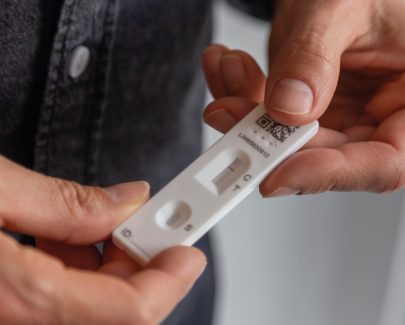
Billions of lateral flow tests have been used worldwide during the COVID-19 pandemic – over two billion have been provided in the UK alone. Debate has raged on social media about why the tests need to use so much single-use plastic and how they could be made more ‘sustainable’. The test strip caseworks is a particular source of dismay – why so much plastic to house such a tiny test strip?
With the UK government ending the free distribution of lateral flow tests for the general public – citing a transition from emergency response to longer-term management of the pandemic – now is the ideal time to look more closely at the sustainability of these lateral flow tests, and to seek the data to demystify some of the emotional assumptions being made.
Familiarity with lateral flow testing has certainly increased, as has confidence in their clinical performance. It’s expected that lateral flow devices will be more present in our daily lives post-pandemic – not just for COVID-19 and pregnancy testing but to diagnose diseases such as seasonal influenza and sexually transmitted infections – all from the comfort of the home.
We’ve carried out a high-level assessment to quantify the approximate environmental impact of lateral flow tests and identify evidence-based suggestions for improving their environmental sustainability.
Why do COVID-19 lateral flow tests contain lots of single-use plastic in the first place?
The emergence of COVID-19 was a global emergency, and vast quantities of lateral flow tests were needed urgently. Once developers could produce the right immunoassay chemistry to detect the virus (SARS-CoV-2), it required implementation in a low-cost, low-risk device, that has a mature supply chain – with proven, readily available materials that wouldn’t compromise analytical or clinical performance.
This meant using existing plastic casework designs to retain and protect the nitrocellulose test strip. Plastic is robust, low cost, lightweight, easy to transport, and easily printed for QR codes and LOT numbers. Critically, it’s a consistent material proven for the highest volume manufacturing and won’t interfere with the immunoassay chemistry.
From a performance, cost, and manufacturing perspective, redesigning the product with new materials would have been high risk. Material changes may also have needed significant R&D costs, new capital equipment as well as additional cost and effort needed to demonstrate equivalence and achieve regulatory approval – risking the ability to provide sufficient numbers of high-quality tests, at speed during the pandemic.
Our results: The sustainability of lateral flow tests
But how serious an environmental impact do these tests have? To find out, we broke down a test into its constituent components and weighed them to calculate the approximate environmental impact, using standard emissions factors to calculate the carbon footprint of a single test.
We focused on carbon footprint (the carbon dioxide and other greenhouse gases emitted during manufacture, transport, and disposal of the tests) and plastic waste (waste that would persist indefinitely if released into the environment) – the two issues that have attracted the most attention around lateral flow tests. A more comprehensive study should consider a broader range of environmental impacts, for example, the use of scarce resources and emission of other pollutants to avoid unintended consequences of any product changes.
Our results reveal:
The components needed to conduct the test account for around half of the carbon footprint and around two-thirds of the plastic waste. Packaging makes up most of the rest – as is often the case, a surprisingly high proportion of the total environmental impact.
The test strip caseworks, which attracts the most comment online, is responsible for around 30% of the carbon footprint and 40% of the plastic waste. While it’s the most significant single contributor to the environmental impacts we evaluated, the large number of other small parts is also significant. Focusing on the caseworks therefore might not be the best strategy for improving the sustainability of the tests overall.
Lateral flow tests a minor piece of UK healthcare’s environmental impact
To put these numbers into context, we can compare the environmental impact of the two billion COVID-19 lateral flow tests distributed in the UK with the UK healthcare system’s overall environmental impact. We estimate the UK’s lateral flow tests have a carbon footprint equivalent to around 0.5% of the total NHS carbon footprint. This isn’t a trivial amount, but it’s also not the largest single contributor to the impact of the UK health system.
It’s also worth considering the positive environmental impact of a user-administered test on the health system. Conducting a test at home can eliminate the need for an individual to visit a test site, GP’s surgery, or hospital (assuming the clinical performance of the lateral flow test is adequate). Based on estimates from the Sustainable Healthcare Coalition, one lateral flow test has around 5% of the carbon footprint of a single GP appointment and produces a similarly low percentage of non-degradable (plastic) waste.
And that’s before we consider travel. We estimate one lateral flow test has the same carbon footprint as driving 350 metres in an average UK car. So, if you’re driving yourself to a test site or GP surgery some distance away, at-home lateral flow tests compare even more favorably.
If a lateral flow test prevents an individual from transmitting COVID-19 to a vulnerable person, there’s a public health benefit – as well as an environmental benefit – to keeping people out of the hospital. We can all see the discarded waste from home tests, but the less visible impact from energy- and material-intensive medical interventions is often significantly higher.
These approximate figures demonstrate why building an evidence base is vital during product development targeting sustainability objectives – because the results can be unexpected and non-intuitive.
Quick ways to optimize today’s lateral flow tests
Just because waste from lateral flow tests might not be the most urgent sustainability issue for UK healthcare, that doesn’t mean we can’t and shouldn’t do something about it.
We used the ‘avoid/shift/improve’ model to find potential quick wins for lateral flow tests. These reduce the carbon footprint of each test by nearly a third and the plastic waste by almost a quarter – without impacting the fundamentals of how the test works.
They include:
Eliminate waste bags. There’s a case for quickly isolating contaminated waste (even given COVID-19 also spreads from infected individuals through the air), but the bags account for around 5% of the carbon footprint of the test. It’s not clear how widely used they are in a domestic setting – there may be a risk-based justification for not including them in the test kit.
Package all the test strips in a single foil pouch. Using a single re-sealable pouch to protect the tests from ambient humidity (rather than individually packing each test in a pouch with desiccant) is common in packs of lateral flow tests designed for use by healthcare professionals. However, once opened, the stability lifetime of the remaining tests is affected.
Reduce the size of paper instructions. These are important for the effectiveness of the tests and are a regulatory requirement, but account for 5% of the carbon footprint of a test – could they be reduced in size?
Eliminate the cardboard sleeve. This packaging isn’t essential to the safe and effective functioning of the test, and it seems likely that the functions it does provide could be achieved with less material.
Prefill the extraction tubes with buffer solution. This is already done in some test kits, although manufacturers need to be conscious of moisture loss and the effect on shelf life. However, the separate plastic vial used in the test kit we studied accounts for around 5% of the carbon footprint and plastic waste.
Increase the size of the pack from seven to ten tests. This would mean less package waste per individual test. Including ten tests in one pack instead of seven reduces the carbon footprint by around 5% (depending on how many other optimizations are done at the same time). Perhaps a pack of seven tests was originally designed to cover a week of daily testing – but is that how tests are being used in practice?
Redesign of the test strip caseworks
Looking to the longer-term gets us into product redesign – creating a new generation of the product with sustainability in mind. Doing this can take significant investment since, for medical devices, it’s likely to require new regulatory approval, which is a lengthy and costly process.
A popular idea circulating for lateral flow tests is to minimize the plastic test strip caseworks (without compromising the essential functions of providing a stable platform, and protecting the nitrocellulose test strip). It might be possible to halve the caseworks mass and reduce the overall carbon footprint and plastic waste by 15-20%. This would require significant investment in R&D, production tooling, and regulatory approval hoops to jump through – but could be worthwhile if future demand for tests stays high.
Longer-term options
If we consider that the world may require billions more lateral flow tests over the coming decade, a more comprehensive redesign becomes commercially viable. This could involve stripping the design back to the fundamental requirements for a lateral flow test – flowing a sample through the test strip in a way that is controlled and free from contamination. Current designs take advantage of established components to collect, buffer, and dose the sample – but, at this production volume, it may be worthwhile designing a system from the ground up that is optimized for cost, usability, performance, and sustainability.
Sustainability as a brand differentiator
It’s clear there’s scope to optimize lateral flow tests to reduce their environmental impact – and a systematic analysis reveals options beyond those that might jump out to someone when they use the tests. But it’s essential to put the impact of lateral flow tests in the context of the wider healthcare system, to focus resources where they can have the most environmental impact – and to recognize that, sometimes, the plastic waste people can see helps to avoid more serious, but less visible consequences.
On the other hand, while visible plastic waste from lateral flow tests may not be the most pressing environmental issue facing the healthcare industry, it highlights the growing influence consumer opinion is likely to have as diagnosis and treatment shift from hospitals to homes. And as lateral flow tests become (in the UK, at least) a product people buy with their own money, choosing from a range of options, there may be a competitive advantage for businesses that take note and optimize their products for sustainability.
Featuring analysis conducted by Katie Williams, Mechanical Engineer
References
Prime Minister sets out plan for living with COVID [Internet]. GOV.UK. 2022 [cited 1 April 2022]. Available from: https://www.gov.uk/government/news/prime-minister-sets-out-plan-for-living-with-covid
The Sustainable Healthcare Coalition. Care Pathways Calculator. [Internet]. Sustainable Healthcare Coalition. 2022 [cited 1 April 2022]. Available from: https://shcoalition.org/
By Cambridge Design Partnership
January 10th 2022
Impediments to tobacco harm reduction in LMICs
WHITE PAPER
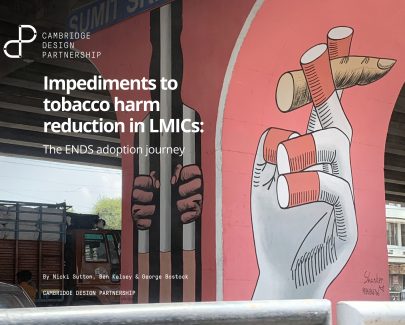
Impediments to tobacco harm reduction in LMICs:
The ENDS adoption journey
BY NICKI SUTTON, BEN KELSEY & GEORGE BOSTOCK
Tobacco consumption has, for decades, represented a global pandemic. Over 1.3 billion people, or 16% of the world’s population, use tobacco in one of its many forms, grouped into combustible or smokeless types. 80% of these users reside in low and middle-income countries (LMICs) where tobacco use contributes to increased morbidity and mortality directly and indirectly, via poverty.
The Foundation for a Smoke-Free World (FSFW) has a goal to advance progress in smoking cessation and tobacco harm reduction (THR) with a particular focus on LMICs. To better understand some of the challenges faced in these markets, FSFW commissioned us to identify the barriers or impediments to adoption of electronic nicotine delivery systems (ENDS) in LMIC countries.
Download our whitepaper to discover the seven steps a smoker must take to substitute combustible tobacco products with ENDS.
Routes to success in the therapeutic cannabinoid market
WHITE PAPER
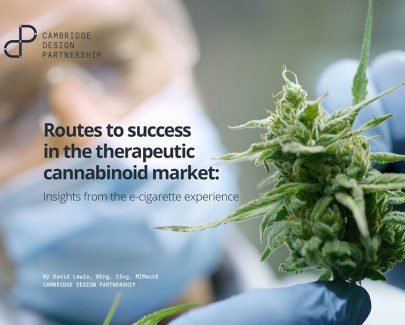
Routes to success in the therapeutic cannabinoid market:
Insights from the e-cigarette experience
BY DAVID LEWIS
David Lewis is a Chartered Engineer with international experience working with large corporations and technology start-ups. He has a deep understanding of reduced-risk nicotine and cannabinoid product development and the associated technological, commercial and regulatory issues.
In this whitepaper, David draws upon his and his team’s long experience of the smoking cessation, e-cigarette and vaping markets to explore opportunities for therapeutic cannabis.